This site is supported by our readers. We may earn a commission, at no cost to you, if you purchase through links.

Most sewing machines tap out when denim hits four layers. The Singer Heavy Duty 4452 treats that as a warm-up. With a motor 60% stronger than standard machines and a top speed of 1,100 stitches per minute, it doesn’t flinch at canvas, leather, or corduroy stacked thick enough to challenge an industrial setup. That kind of power usually lives in machines costing twice as much.
Whether you’re reinforcing workwear, building upholstery, or finally graduating from a beginner machine that skips and jams, the 4452 puts serious capability within reach—and the specs back it up.
Table Of Contents
- Key Takeaways
- Singer Heavy Duty 4452 Review
- Singer 4452 Key Specifications
- Build Quality and Motor Power
- Stitch Options and Adjustments
- Sewing Thick Fabrics
- Everyday Fabric Performance
- Included Accessories and Feet
- Ease of Use Features
- Singer 4452 Pros and Cons
- Is The Singer 4452 Worth It?
- Frequently Asked Questions (FAQs)
- Conclusion
Key Takeaways
- The Singer 4452’s motor runs 60% stronger than standard machines, hitting 1,100 stitches per minute — so denim, canvas, and stacked layers don’t slow it down.
- With 32 built-in stitches, a walking foot, non-stick foot, and one-step buttonhole, you get a ready-to-work setup right out of the box without spending extra.
- A heavy-duty metal frame and stainless steel bed plate keep every stitch locked and stable — even when you’re pushing thick seams at full speed.
- Backed by a 25-year limited warranty and priced between $150–$350, it delivers durability and power that most machines in this range simply can’t match.
Singer Heavy Duty 4452 Review
The Singer Heavy Duty 4452 isn’t for everyone — but for the right person, it’s hard to beat. Before you decide, there are a few things worth knowing about how it performs in the real world. Here’s what to keep in mind.
If you’re just getting started with this machine, a beginner-friendly project like making a simple drawstring bag is a great way to get a feel for how it handles.
Best Use Cases
Knowing which projects this machine actually manages well makes a real difference before you buy.
- Upholstery Projects — cushions, chair coverings, and home furnishings
- Leather Crafting — vinyl, leather edges, and clean tension control
- Layered Quilting — multiple fabric layers without feeding jams
It also manages heavy seam construction on denim and corduroy reliably.
Key Buying Considerations
Before you commit, a few things are worth checking off your list.
| Consideration | What to Know |
|---|---|
| Budget range | $150–$350 depending on retailer |
| Warranty terms | 25-year limited warranty on mechanical parts |
| Maintenance cost | Under $20 monthly for routine upkeep |
The heavy-duty metal frame and powerful motor justify the price if you regularly sew thick fabrics. It is also wise to evaluate brand reputation and reliability before making a purchase.
Overall Value Verdict
Once you’ve weighed the buying considerations, the verdict becomes clear. The Singer 4452 delivers solid value for anyone who sews regularly. Its 25-year limited warranty, powerful motor, and metal frame combine reliability with longevity that cheaper machines can’t match:
- Manages denim, canvas, and thick layers without straining
- Reaches 1,100 stitches per minute for fast project turnaround
- Mechanical controls stay simple and dependable over years of use
- Accessories included reduce your upfront add-on costs
Worth it for most sewers.
Singer 4452 Key Specifications
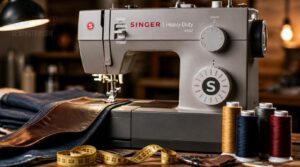
The Singer 4452 isn’t shy about what it brings to the table. Before you buy, it helps to know exactly what you’re working with — the numbers tell a clear story. Here are the key specs worth your attention.
1,100 Stitches Per Minute
The Singer 4452 hits 1,100 stitches per minute — that’s serious sewing speed for a home machine. You can power through denim, canvas, or multi-layer stacks without stalling. The 60% stronger motor keeps tension stable at full throttle.
The Singer 4452’s 60% stronger motor blazes through denim and canvas at 1,100 stitches per minute without losing tension
| Feature | Standard Machine | Singer 4452 |
|---|---|---|
| Sewing Speed | ~750 SPM | 1,100 SPM |
| Motor Strength | Standard | 60% Stronger |
| Heavy Fabric Control | Limited | Consistent |
32 Built-in Stitches
Thirty-two built-in stitches give you serious range — from everyday repairs to creative finishing work. You get 6 basic, 7 stretch, and 18 decorative patterns, all selectable through the stitch selection dial.
- Straight and zigzag for seams and edging
- Stretch stitches for knits and elastic fabrics
- Decorative patterns for garment embellishment
The adjustable stitch length helps you match any fabric with confidence.
110 Stitch Applications
Those 32 built-in stitches actually enable 110 distinct stitch applications on the Singer 4452 — meaning each pattern on the stitch selection dial can be adapted for multiple fabric types and techniques.
That’s real range. You can shift from functional seam work on denim to decorative finishes on cotton without switching machines or losing momentum.
14.6. pound Machine Weight
At 14.6 pounds, the Singer 4452 hits a sweet spot. It’s heavy enough to stay planted on your table — vibration reduction is noticeably better than lighter plastic machines — but still light enough that one person can move it between rooms without trouble.
That heavy-duty metal frame does the real work here, keeping every stitch stable even at full speed.
Mechanical Sewing Controls
The Singer 4452 runs on mechanical sewing controls — no touchscreen, no guesswork. You adjust stitch length and width, presser foot pressure, and thread tension dial by hand.
The stitch selector cam clicks into position, while the reverse stitch lever locks seams without knots. Simple, tactile, and reliable every time.
Build Quality and Motor Power
The Singer 4452 doesn’t just look tough — it’s built to back that up. From the motor to the frame, every part is designed to handle real work without flinching. Here’s what’s actually inside.
60% Stronger Motor
The motor inside the 4452 isn’t just powerful — it’s 60% stronger than a standard sewing machine motor. That extra torque means it won’t choke or stall when you push through thick denim or stacked layers.
- 1,100 stitches per minute with consistent RPM across heavy fabrics
- 0.5 HP peak output for sustained heavy-duty sewing
- Electronic control delivers smooth acceleration to cut thread breakage
- Thermal sensors reduce speed before the motor overheats
- Reinforced gears sync with motor power for precise stitch placement
That’s real motor efficiency built for long sessions.
That steady 1,100-stitch-per-minute pace holds up even through dense layering, as explained in this guide on how quilting machines handle thick fabric layers.
Heavy-duty Metal Frame
The heavy-duty metal interior frame is what separates the 4452 from plastic-chassis machines that flex and vibrate under pressure. This all-metal chassis uses alloy steel construction with welded joint rigidity to keep everything locked in place — even at full speed. That structural integrity directly bolsters needle alignment precision, so your stitches stay consistent through thick passes.
| Frame Feature | What It Does |
|---|---|
| Alloy steel construction | Carries high load bearing capacity without bending |
| Welded joint rigidity | Keeps frame members stable during fast sewing |
| Powder coat durability | Resists corrosion in humid workshop conditions |
| Needle alignment precision | Maintains accurate stitch placement on dense fabrics |
| All-metal chassis | Reduces vibration for cleaner, more controlled sewing |
This heavy duty sewing machine frame isn’t just tough — it’s built to stay true.
Stainless Steel Bed Plate
The metal frame locks everything in place — and the stainless steel bed plate keeps your fabric moving just as cleanly.
On this heavy-duty sewing machine, the Singer 4452’s plate resists rust, heat, and wear without warping. It wipes clean fast and stays flat over time, so your seams stay accurate every single pass.
Stability During Fast Sewing
Speed tells the truth about a machine. At 1,100 stitches per minute, the Singer 4452’s precision motor control and high rigidity frame absorb vibration so your seams stay clean.
The balanced needle feed prevents fabric shifting, while the lock stitching mechanism and stable presser pressure eliminate skipped stitches — even through thick layers.
Stitch Options and Adjustments
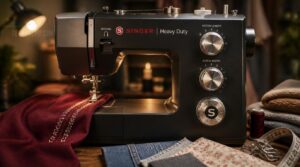
The Singer 4452 gives you more control over your stitches than most machines in this price range. You get 32 built-in options across basic, stretch, and decorative categories — plus the freedom to dial in your own length and width settings. Here’s what you’re actually working with.
Basic Stitch Selection
The Singer 4452 gives you 32 built-in stitches and 110 stitch applications to work with.
For most woven fabrics, you’ll rely on the straight stitch — set your length between 2.0 and 3.5mm depending on fabric weight. Always backstitch at the start and end of seams.
For edge finishing, the zigzag stitch keeps raw edges clean and secure.
Stretch Stitch Options
Straight stitches handle wovens well, but knit and stretch fabrics need something different.
The Singer 4452’s 7 stretch stitches give you real control here. Here’s what each one does for you:
- Zigzag stitch — the go-to for stretch; its side-to-side motion lets seams flex without splitting
- Lightning bolt stitch — overlapping passes deliver higher elasticity for thick knits
- Triple stitch — adds an extra pass for stronger, more durable seams under stress
- Straight stretch stitch — looks straight but holds slight give for light knits
- Twin needle hemming — creates two parallel lines that stay elastic, perfect for knit hems
Adjust your stitch length and width to match your fabric weight — shorter lengths on midweight knits, wider width for more stretch tolerance.
Decorative Stitch Choices
The 18 decorative stitches — part of the 4452’s 32 built-in stitches — cover floral motifs, geometric patterns, and scallop designs. Satin stitch texture creates a smooth, light-reflecting surface ideal for heirloom work.
Adjust density settings to control fabric stiffness, and match your thread color carefully. Edge finishing techniques keep motif borders clean and fray-free across all 110 stitch applications.
One-step Buttonhole
One small button can make or break a finished garment. The Singer 4452’s one-step buttonhole takes that pressure off completely.
- Automatic sizing reads your button diameter and sets the hole length for you.
- Sensor guides lock fabric edges and steer the needle path for clean, straight cuts.
- Uniform length means every buttonhole on your project matches exactly.
Attach the buttonhole foot, press once, and the Singer 4452 takes care of the rest.
Stitch Length and Width
Fine-tuning your stitch length and width is where real control begins. The Singer 4452 offers adjustable stitch length from 0–4mm and adjustable stitch width up to 6mm.
| Setting | Recommended Use |
|---|---|
| 1.0–2.0mm length | Delicate fabrics |
| 2.5mm length | General seams |
| 3.0–4.0mm length | Topstitching |
| 2.0–4.0mm width | Zigzag finishing |
| 5.0–6.0mm width | Decorative stitch patterns |
Always test stitch parameter testing on scrap fabric first.
Sewing Thick Fabrics
This is where the Singer 4452 earns its "heavy duty" name. From stiff denim to layered canvas, it’s built to push through materials that would stall a standard machine cold. Here’s how it processes the tough stuff.
Denim and Canvas Performance
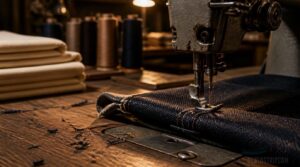
Denim doesn’t forgive a weak machine — and the Singer 4452 doesn’t flinch. Its even feed walking foot keeps heavyweight fabrics moving without slipping or bunching.
- Denim’s twill weave distributes stress diagonally, so seams hold under real pressure
- Canvas abrasion resistance stays strong through repeated friction and thick-layer stitching
- Sanforized fabrics feed predictably, giving you layered seam strength that lasts
Corduroy Seam Handling
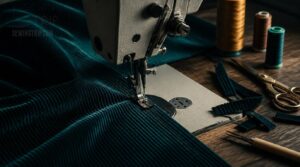
Corduroy fights back — its raised wale traps the presser foot and shifts layers if your machine can’t hold steady. The 4452’s even feed walking foot keeps everything aligned while you stitch parallel to the wale, which prevents puckering and keeps seam construction clean.
| Technique | Why It Matters | 4452 Feature |
|---|---|---|
| Wale Parallel Stitching | Reduces seam bulk | Adjustable stitch length |
| Seam Edge Finishing | Controls nap fraying | Stretch zigzag stitches |
| Thread Tension Balance | Prevents pile puckering | Adjustable presser pressure |
Bulk reduction techniques like trimming seam allowances and using the clearance plate help thick fabrics feed smoothly. Lower the presser foot pressure slightly for corduroy nap care — it stops the foot from crushing the pile during seam edge finishing.
Leather and Vinyl Use
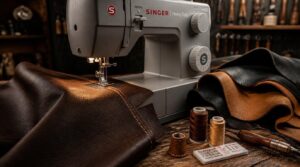
Leather and vinyl will expose every weakness in an underpowered machine — but the non-stick presser foot changes that. It glides over leather and vinyl without snagging, while the 60% stronger motor pushes through without stalling.
- Use the non-stick foot for leather conditioning tips in mind — it prevents surface gouging
- Apply vinyl UV protection sprays after sewing to preserve color
- Keep stitching leather seams slow and steady at consistent stitch length
- The walking foot prevents layer shifting on thick vinyl panels
- Choose heavyweight fabric handling needles (100/16) to avoid skipped stitches
Multiple Fabric Layers
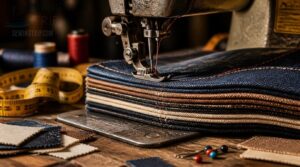
Stack two or more fabric layers together, and you’re testing whether a machine truly owns its "heavy-duty" title. The Singer 4452 processes multilayer fabric applications confidently.
Its walking foot prevents layer shifting by feeding every sheet evenly, protecting your layer stacking order from slipping mid-seam. That even feed also strengthens delamination resistance, keeping your layers locked together stitch after stitch.
Clearance Plate Benefits
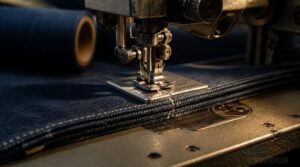
Even layers need a level playing field. The clearance plate balances your presser foot height on thick seams, so the foot doesn’t tilt and lose grip mid-stitch.
That stability means consistent stitch depth across every layer, less fabric distortion, and fewer jams. For a heavy-duty sewing machine tackling bulky material, it’s a small accessory with a real impact.
Everyday Fabric Performance
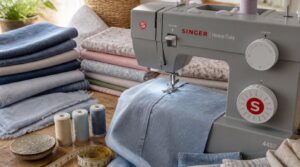
Heavy fabrics get all the glory, but everyday sewing is where a machine really earns its place at your table. The Singer 4452 manages the lighter, more common materials just as confidently. Here’s how it performs across the fabrics you’ll actually reach for most.
Cotton Sewing Results
Cotton is one of the Singer 4452’s sweet spots. Always preshrink your cotton before cutting — it shrinks after the first wash.
Set your stitch length to 2.5–3.0mm and the seams lie flat without puckering. Use a size 90/14 to 100/16 needle for clean, consistent penetration. The even feed walking foot keeps layers from shifting at high speed.
Finish raw edges with a zigzag to stop fraying.
Satin and Muslin Handling
Satin and muslin sit on opposite ends of the fabric spectrum, but the Singer 4452 manages both without drama. For satin, swap to a size 70–90 microtex needle, ease thread tension slightly, and attach the non-stick foot to keep the glossy surface gliding smoothly. Set stitch length to 2.0–2.5mm to avoid visible ridges.
Muslin is more forgiving. A size 80/12–90/14 needle at 2.5–3.0mm works cleanly, and the adjustable presser foot pressure keeps lightweight layers from bunching at high speed.
Stretch Fabric Control
Stretch fabrics can test any machine — but the Singer 4452 holds its own.
Switch to a stretch or ballpoint needle and select one of the seven built-in stretch stitches. A narrow zigzag at 2.5–3.0mm prevents seam puckering while allowing the fabric to move.
Ease thread tension slightly and attach the even feed walking foot to stop layers from shifting mid-seam.
Quilting Layer Support
Quilting puts your machine to the test. A proper quilt sandwich — top fabric, batting, and backing — creates a thick, unruly stack that cheaper machines choke on. The Singer 4452 processes it cleanly.
- Layer basting with pins or spray adhesive keeps everything locked before the first stitch
- The even feed walking foot pulls all layers through at the same rate
- Batting thickness stays consistent, avoiding needle snag mid-seam
- Quilt sandwich stability prevents drift on long edge-to-edge runs
Free-motion Sewing Option
Free-motion sewing unlocks a different level of creativity on the 4452. Drop the feed dogs using the dedicated drop feed lever, attach the free motion foot, and you control every stitch direction by hand.
| Technique | Tool |
|---|---|
| Fabric stabilization | Darning plate |
| Slippery materials | Non-stick foot |
| Layered quilting | Even feed foot |
| Thread visibility | High-contrast thread |
Included Accessories and Feet
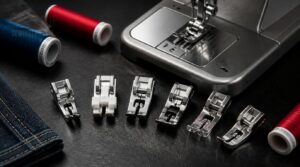
The Singer 4452 doesn’t just come with a machine — it comes ready to work. Six snap-on feet are included right out of the box, each built for a different job. Here’s what you get.
All-purpose Foot
The all-purpose foot comes attached to the Singer 4452 right out of the box. Its centered needle opening accommodates stitches up to 7mm wide, covering every built-in stitch the machine offers.
Fabric feeding guidance stays consistent on cotton, linen, and medium-weight materials. Adjust your presser foot pressure on delicate fabrics to prevent puckering and keep feeding smooth.
Zipper Foot
The Singer 4452 includes a snap-on zipper foot that lets you stitch close to zipper teeth without guessing at placement. Its narrow profile aligns with the zipper edge for consistent seam allowances on woven fabrics like denim, cotton, and canvas.
For vinyl or leather, swap to the non-stick foot instead — the standard zipper foot can drag on sticky surfaces.
Buttonhole Foot
The Buttonhole Foot on the SINGER 4452 makes clean, consistent buttonholes almost simple. Its automatic one-step function takes care of sizing and stitching in a single pass — no manual repositioning needed. The clear plastic sections let you see exactly where you’re stitching.
Always test on scrap fabric first to confirm alignment before committing to your final piece.
Walking Foot
The Even Feed Walking Foot included with the Singer 4452 is where control really takes over. It feeds the top and bottom layers of fabric at the same rate, so thick stacks don’t shift mid-seam.
- Stop fighting bunched quilt layers
- Keep denim seams straight every time
- Sew vinyl without the drag or slip
Non-stick Foot
The non-stick foot is your go-to for leather, vinyl, and PVC. Its Teflon coating lets slippery or sticky materials glide without dragging or scuffing.
| Material | Challenge | Non-Stick Benefit |
|---|---|---|
| Leather | Sticks and tears | Smooth, clean feed |
| Vinyl/PVC | Drags underfoot | Reduces friction |
| Laminated fabric | Uneven stitches | Consistent glide |
Ease of Use Features
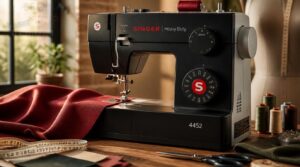
Power and stitches matter, but what really makes the Singer 4452 worth using every day is how little it fights you. Singer packed in several features that cut down setup time and keep your focus on the project itself. Here’s what makes this machine easier to handle than most in its class.
Automatic Needle Threader
Threading a needle by hand is one of those small frustrations that quietly kills your sewing momentum. The built-in needle threader on the Singer 4452 removes that entirely.
- Automatic Threader Mechanism guides a hook wire through the eye in one motion
- Dual Threading Paths support both thin and thick thread types
- Needle Eye Compatibility covers sizes 60 to 90
- Built-in safety guards protect fingers from moving parts
Top Drop-in Bobbin
The top drop-in bobbin on the Singer 4452 keeps things simple. You drop a Class 15 transparent bobbin straight in from the top — no fussing with a separate case.
The clear cover benefits you immediately: a quick glance tells you how much thread remains. The jam-proof mechanism guides the thread path automatically, so tangles stay rare.
Adjustable Presser Foot Pressure
Adjustable presser foot pressure gives you real control over how the Singer 4452 manages different fabrics. Turn the pressure dial adjustment up for denim or canvas — the machine grips and feeds without slipping. Drop it down for satin or muslin, and you avoid compression puckers.
That fabric grip balance is what separates a heavy-duty sewing machine from a basic one.
Extra-high Presser Lift
The extra-high presser lift on the Singer 4452 raises the presser foot higher than standard models — clearing over 6mm — so thick fabrics slide under without a fight. That extra clearance matters most when you’re stacking denim layers or feeding canvas through.
- Reduces compression on upper fabric layers
- Accommodates thick stabilizers without jamming
- Pairs with adjustable presser foot pressure
- Stays reliable at high speeds
Built-in Free Arm
The built-in free arm on the SINGER 4452 slides out in seconds, transforming this heavy duty sewing machine into a precision tool for tight spots. Sleeve seam precision and cuff bulk reduction become simple — your presser foot stays controlled while tubular fabric wraps cleanly around the arm.
| Task | Free Arm Benefit |
|---|---|
| Sleeve seams | Guides fabric without bulk |
| Cuff hemming | Reduces layer shifting |
| Tubular fabric guidance | Keeps edges aligned |
| Needle area access | Less hand repositioning |
| Free arm maintenance | No disassembly needed |
Singer 4452 Pros and Cons
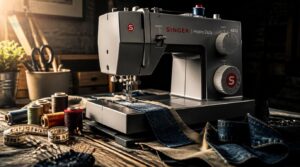
Every machine has its wins and its weak spots—the Singer 4452 is no different. Knowing both sides helps you decide if it’s the right fit before you commit. Here’s what stands out, good and bad.
Heavy-duty Strengths
The Singer 4452 doesn’t just sew — it powers through. Its powerful motor delivers 60% more torque than standard machines, hitting 1,100 stitches per minute without breaking a sweat.
- Heavy-duty metal frame resists flex under pressure
- Stainless steel bed plate keeps fabric gliding smoothly
- Covers denim, canvas, and thick layers effortlessly
- High-speed stability prevents skipped stitches
- Built to last through years of demanding use
Beginner-friendly Benefits
You don’t need experience to get results with this machine.
The automatic needle threader and top drop-in bobbin get you sewing in minutes. The 32 built-in stitches and LED workspace light mean less guessing, more doing. 1-step buttonholes handle the tricky parts automatically.
| Feature | Benefit | Best For |
|---|---|---|
| Auto Needle Threader | Fast setup | Beginners |
| Drop-in Bobbin | Reduces misfeeds | All skill levels |
| LED Light | Clear visibility | Detailed work |
Common Drawbacks
No machine is perfect — and the 4452 has real weak spots worth knowing.
- Thread tension instability creeps in when you switch between fabric types mid-project
- Skipped stitches and bent needles appear when pushing heavy layers too fast
- Motor overheating forces cooling pauses during long high-speed sessions
Vibration transmission at top speed affects stitch accuracy. Service center access stays limited in many areas.
Maintenance Considerations
Keeping the 4452 running strong takes consistent care. Stick to a monthly inspection routine — check needles, the presser foot, and tension discs for wear.
Clean lint from the bobbin area every two to four hours of heavy use. Apply oil only to moving metal parts.
Every six months, do a full preventive service: inspect the feed dogs, bobbin case, and drive belt.
Noise and Speed Control
Once maintenance becomes routine, you start noticing something else — how the machine actually sounds and responds under pressure.
The 4452 uses vibration isolation feet and motor damping strategies alongside acoustic shielding design to keep noise manageable at its 1,100 stitches-per-minute top speed. Your foot controller gives smooth, proportional speed regulation, so you’re never fighting sudden torque spikes.
Is The Singer 4452 Worth It?
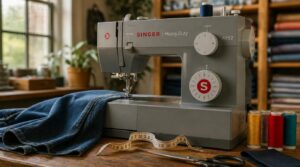
So here’s the real question: does the Singer 4452 actually earn its price tag in 2026? A few key factors make that answer clearer than you’d expect. Here’s what you need to know before deciding.
Price-to-performance Value
What does value for money really look like on a sewing machine?
- 60% stronger motor at a mid-range price
- Metal frame durability cuts long-term replacement costs
- 1,100 stitches per minute without a premium price tag
- Simple mechanical controls mean fewer costly repairs
The budget performance tradeoff here leans heavily in your favor.
Singer 4432 Comparison
The Singer 4432 is the 4452’s closest sibling, but there are real differences worth knowing.
The 4432 tops out at the same 1,100 stitches per minute and shares the metal frame, but the 4452 gives you more accessory feet right out of the box — including a walking foot — making it the stronger pick for heavy-duty sewing machine work from day one.
Warranty Coverage
The Singer 4452 backs its sewing machine durability with a 25-year limited warranty on the machine head, plus two years on the motor and electrical parts. Adjustments and attachments get 90 days.
Claims require proof of purchase and a serial number. Misuse and normal wear aren’t covered, so proper use matters.
Ideal Buyer Profile
This machine is built for intermediate to experienced hobbyists who sew heavy fabrics regularly — think denim, canvas, and upholstery. If you’re into garment construction or textile work and want a heavy-duty sewing machine that won’t quit, this fits. Upholsterers and sewing machine for professionals scenarios both make sense here.
You’ll also want suburban space and local service access nearby.
Final Purchase Recommendation
If the Singer 4452 ticks your boxes — heavy fabrics, speed, durability — buy it with confidence. The 25-year limited warranty backs the build long-term.
Factor in total cost of ownership before committing, and do a trial sewing experience on your actual materials first. Resale holds reasonably well, so your investment won’t disappear if you upgrade later.
Frequently Asked Questions (FAQs)
Can the Singer 4452 sew leather?
Yes, it can — with the right setup. Use a leather needle (90/14–110/18), shorten your stitch length, attach the walking foot, and choose bonded nylon thread. Stick to thin or medium leather for best results.
What is the difference between 4452 and 4423?
Both machines share a metal frame and automatic needle threader, but the Singer 4452 offers a stronger motor, better speed control, quieter operation, and more accessory feet than the Singer 4423.
Which is better, singer 4432 vs 4452?
Like choosing between a reliable workhorse and a more refined one, both the Singer 4432 and Singer 4452 share 32 built-in stitches and 1,100 stitches per minute, but the 4452 wins with more presser feet and a 60% stronger motor.
Can the Singer 4452 sew denim?
The Singer 4452 manages denim well. Its 60% stronger motor and heavy-duty metal frame push through thick layers without stalling. Use a size 16–18 jeans needle, set tension around 4, and run a test seam first.
How to maintain the Singer 4452?
Unplug before cleaning. Monthly, remove the needle plate and brush out lint. Add 1–2 drops of oil to the bobbin area, then turn the handwheel to spread it evenly.
Can it handle quilting projects easily?
Yes, it accommodates quilting well. The Even Feed Walking Foot keeps your quilt sandwich from shifting, and the extra-high presser lift fits thick layers easily. Free-motion sewing is smooth.
What needles work best with it?
The right needle is the difference between clean seams and shredded fabric. Use ballpoint needles for knits, jeans needles (90/14–100/16) for denim, and leather point needles for vinyl. Replace every 2–3 sewing hours.
Is it suitable for beginner sewists?
The Singer 4452 is genuinely beginner-friendly. The automatic needle threader cuts setup frustration, and the built-in stitches cover everyday projects. It’s durable enough to learn on without babying it.
What fabrics are difficult for it?
Even a powerhouse has its limits. Velvet, sheers, and slippery synthetics like satin challenge it most. Rayon blends and stretch knits also need extra care to avoid puckering and skipped stitches.
How do I troubleshoot thread tension problems?
Start with a balanced stitch test on scrap fabric. If loops appear underneath, increase top tension slightly. Loops on top mean reduce it. Clean lint from bobbin area regularly to keep tension consistent.
Conclusion
Some machines quietly step aside when the fabric gets too demanding. The Singer Heavy Duty 4452 leans in where others simply won’t.
It won’t stall on thick denim, won’t buckle under stacked canvas, and won’t leave you fighting seams that should already be finished. What you’re really gaining here isn’t just raw speed or a stronger motor—it’s the confidence to finally stop avoiding the projects you’ve been quietly pushing to the back of your shelf.
- https://rockymountainsewing.com/products/singer-heavy-duty-4452
- https://www.sewingmachinedirectory.com/sewing-machine/singer-4452
- https://www.techgearlab.com/reviews/electronics/sewing-machine/singer-4452-heavy-duty
- https://www.sewingpartsonline.com/products/singer-heavy-duty-4452-mechanical-sewing-machine
- https://www.singer.com/products/singer-heavy-duty-4452-sewing-machine