This site is supported by our readers. We may earn a commission, at no cost to you, if you purchase through links.
Computerized sewing machines with automatic functions have quietly reshaped what’s possible at the home sewing table, from self-trimming threads to one-touch buttonholes that used to demand real skill. These innovations transform tasks like threading a needle—once a ten-minute struggle—into seconds-long processes, eliminating friction between inspiration and execution.
Whether piecing together a quilt, tailoring a jacket, or simply avoiding bobbin battles, the right machine streamlines creativity. By handling tedious steps effortlessly, it bridges the gap between your idea and the finished piece, empowering sewists of all levels.
The ten models ahead cover the full spectrum of needs, ensuring you find one that aligns perfectly with how you actually sew—no compromises required.
Table Of Contents
- Key Takeaways
- 10 Best Automatic Sewing Machines
- 1. Brother XM2701 Lightweight Sewing Machine
- 2. Singer Quantum Stylist 9960 Sewing Machine
- 3. Brother SE600 Sewing Embroidery Machine
- 4. Brother Project Runway Sewing Machine
- 5. Singer C7250 Computerized Sewing Machine
- 6. Janome S5 Sewing Machine
- 7. Brother CP100X Sewing Quilting Machine
- 8. Singer Quantum Stylist 9985 Sewing Machine
- 9. Feiyue FY710 Computerized Sewing Machine
- 10. Brother CS5055 Computerized Sewing Machine
- Automatic Features That Save Time
- Stitch Options and Sewing Performance
- Controls, Displays, and Ease of Use
- Choosing by Project and Skill
- Buying Factors and Common Mistakes
- Frequently Asked Questions (FAQs)
- Conclusion
Key Takeaways
- Automatic features like needle threading, one-step buttonholes, and drop-in bobbins cut setup time dramatically, so you spend more time sewing and less time fighting your machine.
- Matching a machine to your actual projects — quilting, garment-making, or heavy fabrics — matters far more than chasing the highest stitch count.
- Build quality and frame stability directly affect long-term stitch consistency, making a metal frame a smarter investment than a plastic one at any price point.
- With proper maintenance — regular cleaning, occasional oiling, and annual servicing — a computerized sewing machine can reliably last 7 to 15 years.
10 Best Automatic Sewing Machines
Finding the right computerized sewing machine comes down to knowing what each one actually does well.
Matching a machine to your specific projects—whether that’s quilting, garment construction, or everyday repairs—is exactly what guides like this breakdown of computerized sewing machine efficiency help you figure out.
The ten models below cover a range of skill levels, project types, and budgets — so there’s something here whether you’re just starting out or ready to tackle more complex work. Here’s what made the cut.
1. Brother XM2701 Lightweight Sewing Machine
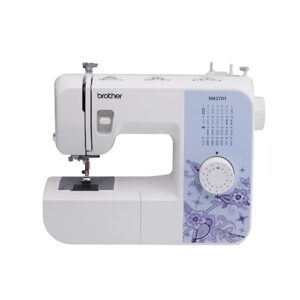
The Brother XM2701 is a smart starting point if you want reliable automation without overcomplicating your setup. At just 12.6 pounds, you can move it anywhere without a second thought.
It comes with 27 built-in stitches, an automatic needle threader, and a jam-resistant drop-in bobbin — features that cut setup time and frustration fast. The six quick-change presser feet handle everyday projects from zippers to blind hems.
And that 25-year limited warranty? That’s real long-term confidence at a $149 price point.
| Best For | Beginners and hobbyists who want an easy, reliable machine for everyday sewing projects without spending a fortune. |
|---|---|
| Built-in Stitches | 27 |
| Automatic Threader | Yes |
| Bobbin System | Drop-in top bobbin |
| Frame Material | Plastic |
| Buttonhole Styles | 1 auto-size |
| Weight | 12.6 lb |
| Additional Features |
|
- Automatic needle threader and drop-in bobbin make setup quick and frustration-free
- 27 built-in stitches plus six quick-change feet cover most everyday projects with ease
- Backed by a 25-year limited warranty at a very approachable $149 price point
- Struggles with heavy fabrics like denim or upholstery — it’s not built for that kind of workload
- No advanced computerized features, so it may feel limiting as your skills grow
- Only works with US voltage, which is something to keep in mind if you ever sew abroad
2. Singer Quantum Stylist 9960 Sewing Machine
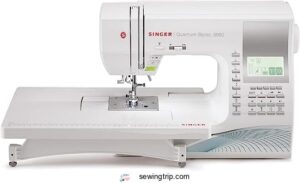
Step up from entry-level, and the Singer Quantum Stylist 9960 transforms what’s possible.
You get 600 built-in stitches, 13 automatic one-step buttonholes, and five lettering fonts—all on one machine priced at $540.99.
The automatic needle threader, built-in thread cutter, and drop-in bobbin maintain your workflow between projects.
A heavy-duty metal frame handles thick layers effortlessly.
Speed control and the start/stop button grant full command, whether quilting a king-size blanket or finishing a fine seam.
| Best For | Intermediate to advanced sewers who want a versatile, feature-packed machine for quilting, garment making, and creative projects without jumping to an industrial model. |
|---|---|
| Built-in Stitches | 600 |
| Automatic Threader | Yes |
| Bobbin System | Top drop-in bobbin |
| Frame Material | Metal and plastic |
| Buttonhole Styles | 13 automatic |
| Weight | 14.6 lb |
| Additional Features |
|
- Massive stitch library (600 types, 1,172 applications) means you’re rarely reaching for a second machine
- Automatic needle threader, built-in thread cutter, and drop-in bobbin keep interruptions to a minimum
- Speed control dial and start/stop button give you real hands-on control, no foot pedal required
- The learning curve is steep—beginners may feel overwhelmed by the sheer number of options
- At nearly 15 lbs, moving it around your workspace (or to a class) gets old fast
- Warranty coverage is patchy—only 90 days on some issues, and the full stitch-quality guarantee may require registration
3. Brother SE600 Sewing Embroidery Machine
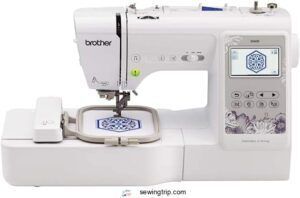
Want stitching and embroidery in one package? The Brother SE600 delivers both without forcing you to choose. It offers 103 built-in sewing stitches, 80 embroidery designs, and 6 lettering fonts—enough variety to handle garment work and custom projects seamlessly.
The 3.2-inch color touchscreen simplifies design selection, while USB import ensures your custom.pes files are readily accessible.
At $589.99, it’s a capable dual-purpose machine that grows with your ambitions.
| Best For | Beginners and hobbyists who want a reliable all-in-one machine for everyday sewing, monogramming, and small embroidery projects without buying two separate machines. |
|---|---|
| Built-in Stitches | 103 |
| Automatic Threader | Yes |
| Bobbin System | Drop-in top bobbin |
| Frame Material | Metal |
| Buttonhole Styles | 10 auto-size |
| Weight | 26.24 lb |
| Additional Features |
|
- Automatic needle threader and drop-in bobbin make setup quick and frustration-free
- USB import lets you bring in custom designs, which is a big deal for creative hobbyists and small shop owners
- 103 stitches plus 80 embroidery designs gives you a lot to work with right out of the box
- The 4×4 inch embroidery area is pretty limiting if you ever want to tackle larger designs
- It’s a chunky machine—over 26 lbs and wide—so storage can be a real headache in small spaces
- Switching between sewing and embroidery mode isn’t automatic; you’ll need to manually swap parts each time
4. Brother Project Runway Sewing Machine
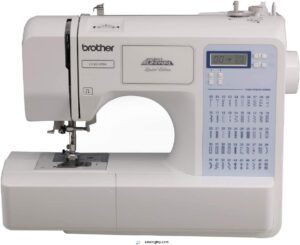
If the SE600 pushed your ambitions, the Brother Project Runway PC-420PRW gives you sharper control over every stitch. It offers 129 built-in stitches, 10 one-step buttonhole styles, and 3 lettering fonts—all selectable via a 10-key pad that eliminates menu-scrolling. The Start/Stop button ensures no foot pedal is required.
Thirteen presser feet are included, alongside a knee lifter for hands-free positioning. These features collectively enhance precision and ease of use.
Fundamentally, the machine is designed for sewists who demand precision without struggling to achieve it.
| Best For | Beginners and hobbyists who want an easy-to-use machine with enough variety to handle everyday sewing, simple garments, and light quilting. |
|---|---|
| Built-in Stitches | 50 |
| Automatic Threader | Semi-automatic |
| Bobbin System | Drop-in top bobbin |
| Frame Material | Metal housing |
| Buttonhole Styles | 5 auto-size |
| Weight | 14.8 lb |
| Additional Features |
|
- 50 built-in stitches plus 5 buttonhole styles give you plenty of options for both practical and decorative sewing.
- The LCD screen, drop-in bobbin, and semi-automatic threader make setup quick and approachable, even if you’re new to sewing.
- Solid metal housing and a 25-year warranty mean this machine is built to last well beyond its $234.99 price tag.
- No memory function, so you’ll have to re-select your stitch settings every time you sit down.
- The presser foot doesn’t auto-lift, which makes more advanced quilting techniques a bit of a hassle.
- Only works with clear acrylic bobbins—metal ones won’t function, so you’ll need to stock the right type.
5. Singer C7250 Computerized Sewing Machine
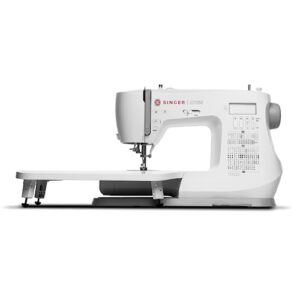
The Singer C7250 is designed for sewists seeking creative range without the learning curve. It offers 200 built-in stitches across 417 applications—utility, decorative, stretch, and lettering—all accessible via a clear LCD screen.
For efficiency, the machine features eight one-step buttonhole styles to streamline garment work. Its variable speed control allows users to adjust pacing, slowing for intricate tasks or speeding up for long seams.
The package includes presser feet, an extension table, and a free arm, ensuring immediate readiness for diverse projects, from detailed work to larger creations.
| Best For | Sewists of all skill levels who want a versatile, ready-to-go machine that handles everything from casual projects to detailed garment construction. |
|---|---|
| Built-in Stitches | 200 |
| Automatic Threader | Yes |
| Bobbin System | Top drop-in bobbin |
| Frame Material | Metal and plastic |
| Buttonhole Styles | 8 one-step |
| Weight | 14 lb |
| Additional Features |
|
- 200 built-in stitches with 417 applications means you’ve got options for just about any project—decorative, utility, stretch, or lettering.
- The LCD screen and pre-threaded setup make it genuinely beginner-friendly without dumbing things down for experienced sewists.
- Comes loaded with presser feet and accessories worth around $300, so you’re not hunting for add-ons right out of the box.
- Thread jams and tension issues pop up for some users, especially when working with thicker fabrics or multiple layers.
- The buttonhole lever can bind on heavy materials, which is frustrating right when you need it most.
- The LCD font is pretty small, making stitch editing a bit of a squint-fest.
6. Janome S5 Sewing Machine
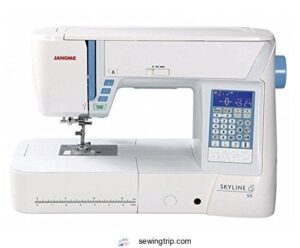
The Janome Skyline S5 is built for sewists who want control without compromise. Its 170 built-in stitches and 10 one-step buttonhole styles cover everything from tote bags to custom-made garments.
The included extension table makes it easy to tackle quilts and bulky projects, and you can explore how the Skyline S5 stacks up in our breakdown of top sewing machine brands and their standout features.
The 7-piece feed dog system ensures smooth fabric movement, even through quilts and thick layers. Additional features include automatic needle threading, a thread cutter, and a speed slider for precise pacing.
The rigid aluminum frame maintains stability at higher speeds, eliminating wobble and frustration.
| Best For | Sewists of all skill levels who want a powerful, quiet machine that can handle everything from everyday projects to complex, multi-layer work like quilts and wedding dresses. |
|---|---|
| Built-in Stitches | Unspecified library |
| Automatic Threader | Yes |
| Bobbin System | Unspecified drop-in |
| Frame Material | Alloy steel |
| Buttonhole Styles | Unspecified |
| Weight | 31 lb |
| Additional Features |
|
- Built-in stitch library with single-click selection makes it easy to use, even for those with limited technical ability
- High-torque, quiet motor pushes through thick fabrics and multiple layers without breaking a sweat
- Sturdy alloy-steel frame keeps things stable and wobble-free, even at higher speeds
- Bobbin-side tension can be tricky to dial in and may need a professional to sort out
- No built-in quilting table, so larger projects will need extra workspace
- On the pricier and heavier side, which makes it a tough sell if you’re budget-conscious or need something portable
7. Brother CP100X Sewing Quilting Machine
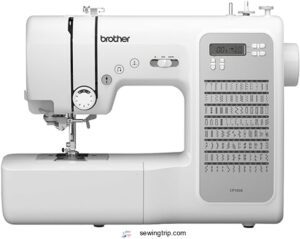
The Brother CP100X punches above its weight for a $229.99 machine. You get 100 built-in stitches, 8 one-step buttonholes, and a metal frame that deals with denim and quilts without flinching.
The speed control slider and start/stop button let you work at your own pace — no foot pedal required. Setup is straightforward, and the wide table provides ample workspace for larger projects.
Add a 25-year chassis warranty, and it’s a solid pick for quilters seeking reliability without overspending.
| Best For | Quilters, beginners, and seniors who want a reliable, easy-to-use machine that handles heavy fabrics without breaking the bank. |
|---|---|
| Built-in Stitches | 100 |
| Automatic Threader | Yes |
| Bobbin System | Quick-Set bobbin |
| Frame Material | Metal frame |
| Buttonhole Styles | 8 auto-size |
| Weight | 10.5 lb |
| Additional Features |
|
- 100 built-in stitches and a metal frame make it surprisingly capable for a $229.99 machine
- Speed slider and start/stop button mean you can sew comfortably without a foot pedal
- Wide table and 10 included feet give you a lot of value right out of the box
- Bobbin winding can be uneven and may need manual babysitting
- First-time setup has a learning curve, and some buyers have reported missing accessories
- Locked to US 120V outlets — not an option if you travel or sew internationally
8. Singer Quantum Stylist 9985 Sewing Machine
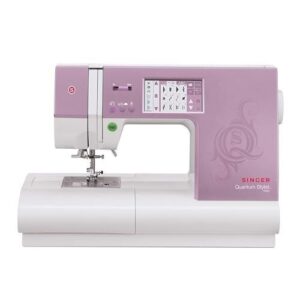
If the 9985 is your measuring stick for stitch variety, it leads its class with 960 built-in stitches, including 919 decorative options, stretch stitches, and 6 monogramming fonts. This eliminates the need to hunt for specific stitches.
The machine’s color touch LCD displays each stitch at actual size, removing guesswork during selection.
At $629.99, the 9985 also includes 13 one-step buttonholes, automatic thread cutting, and 13 presser feet, ensuring versatility for diverse projects.
It’s engineered for sewists demanding serious creative range without machine switching.
| Best For | Sewists who want serious creative range — from fashion and quilting to home décor — without swapping machines. |
|---|---|
| Built-in Stitches | 1000+ applications |
| Automatic Threader | Yes |
| Bobbin System | Class 15 drop-in |
| Frame Material | Full metal and plastic |
| Buttonhole Styles | 13 one-step |
| Weight | 14 lb |
| Additional Features |
|
- Over 1,000 stitches plus 60 memory slots means you’re rarely hunting for the right option.
- The color touch LCD shows stitches at actual size, so what you see is what you get.
- 13 one-step buttonhole styles make garment finishing fast and frustration-free.
- No knee-lifter port, which heavy-duty quilters will notice pretty quickly.
- You’re locked into Singer Class 15 bobbins — generic ones can cause real headaches.
- At $629.99, it’s a hard sell for anyone who only sews a few times a year.
9. Feiyue FY710 Computerized Sewing Machine
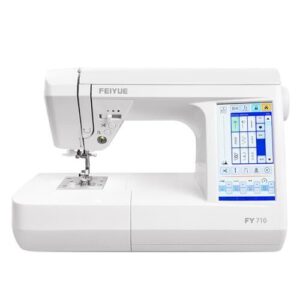
The FY710 punches above its weight class. You get 180 built-in stitches—utility, decorative, and monogram styles—plus a 7-inch LCD touchscreen that streamlines selection.
Automatic features like the needle threader, thread cutter, and one-step buttonhole maintain seamless workflow efficiency.
Its metal frame ensures stability when handling thick layers, while adjustable presser foot pressure provides precise control over delicate or heavy fabrics.
The pedal-free start/stop adds genuine convenience. For capability and practicality, this machine delivers both.
| Best For | Home sewers and hobbyists who want a feature-rich computerized machine for everything from everyday mending to decorative projects and light quilting. |
|---|---|
| Built-in Stitches | 180 |
| Automatic Threader | Lever-action |
| Bobbin System | Drop-in guided path |
| Frame Material | Metal and plastic |
| Buttonhole Styles | Unspecified |
| Weight | 19.84 lb |
| Additional Features |
|
- 180 built-in stitch patterns with mirror and twin-needle support give you a lot of creative range without needing extra equipment.
- Automatic thread trimming and a lever-action needle threader cut down on setup hassle and keep your workflow moving.
- Pedal-free start/stop and adjustable presser foot pressure make it flexible for different working styles and fabric types.
- Motor power and max material thickness aren’t listed, so it’s hard to know how it holds up on seriously heavy or dense fabrics.
- At nearly 20 lbs, it’s not the easiest machine to move around or tuck away between projects.
- The overheat protection kicks in after extended use, pausing the machine for around 10 minutes—which can break your rhythm on bigger projects.
10. Brother CS5055 Computerized Sewing Machine
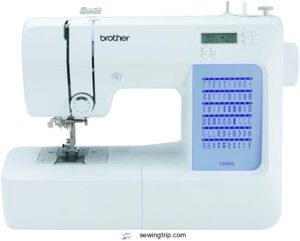
At $134, the Brother CS5055 is a smart starting point — not a compromise. Its metal frame manages denim and tweed without flinching, ensuring durability for diverse projects.
You get 60 built-in stitches and 7 auto-sized buttonholes, alongside an automatic needle threader that simplifies setup. The quick-set drop-in bobbin minimizes interruptions, streamlining the sewing process.
The LCD screen eliminates guesswork by guiding stitch selection intuitively. Compact and quiet, the machine fits seamlessly into real-life spaces, balancing practicality with performance.
If you’re building your sewing foundation, this machine holds its ground as a reliable, user-friendly choice.
| Best For | Beginners and home sewers who want a reliable, easy-to-use machine that can handle everyday projects without breaking the bank. |
|---|---|
| Built-in Stitches | 60 |
| Automatic Threader | Yes |
| Bobbin System | Quick-set drop-in |
| Frame Material | Metal frame |
| Buttonhole Styles | 7 auto-size |
| Weight | 10.5 lb |
| Additional Features |
|
- Metal frame keeps things sturdy — it handles denim and tweed without any drama
- 60 stitches, auto buttonholes, and an automatic needle threader make it genuinely easy to get started
- Quiet motor and compact size mean you can use it in an apartment or small space without bothering anyone
- Some parts like the presser-foot lever and spool spindle are plastic, so long-term durability isn’t guaranteed
- The LCD error messages can be confusing at first, and the foot-lever placement takes some getting used to
- Thread can slip out of the needle eye during longer sessions, and the speed won’t cut it for anything high-volume
Automatic Features That Save Time
The right automatic features can cut your sewing time in half — sometimes more. Knowing which ones actually matter helps you pick a machine that works with you, not against you.
Here are the key automatic functions worth paying attention to.
Automatic Needle Threading
Threading a needle by hand gets old fast — and that’s exactly why automatic needle threading matters. On the best computerized sewing machines, the hook mechanism does the hard work for you in seconds. For reliable operation, select a recommended needle size of 80 or larger.
- Threader Setup: Raise the presser foot and set the correct needle height first
- Thread Compatibility: Use fine to medium-weight thread for reliable results
- Common Failures: A bent needle or wrong position blocks the hook every time
One-step Buttonholes
Once your thread is in place, one-step buttonholes take over from there. Top computerized sewing machines of 2026 handle the full stitch sequence automatically — bartacks, rails, and stopping — once you’ve dropped your button into the foot design.
Sizing setup is instant, and good fabric preparation ensures each hole remains clean.
Opening finishing requires only a seam ripper and a quick press.
Automatic Thread Cutting
After nailing that buttonhole, your machine can take one more task off your plate. Top computerized sewing machines of 2026 — including the Singer 9960 and 9985 — feature an automatic thread cutter that trims both threads simultaneously.
With smart Trim Settings and Jump-Stitch Optimization, plus built-in Seam Reinforcement before each cut, Cutter Maintenance stays simple and your workflow stays clean.
Jam-resistant Drop-in Bobbins
Once the thread is cut, your next job is loading a fresh bobbin — and that’s where a jam-resistant drop-in top bobbin system earns its keep. Models like the Brother XR9550 and Singer C7250 make this fast and nearly foolproof.
- A Clear Bobbin Cover lets you monitor thread levels at a glance
- A Bobbin Orientation Mark shows exactly how to seat it correctly
- Drop-in Lint Management keeps the Thread Path Design clear
Follow the Bobbin Tension Guide, wind evenly, and you’re back to sewing in seconds.
Speed Control Sliders
Speed is power — but only when you control it. A sewing speed control slider lets you cap how fast your machine runs before your foot even touches the pedal. Slider placement on most computerized models positions this control front and center for quick adjustments mid-project.
| Speed Setting | Best Use | Benefit |
|---|---|---|
| Low | Curves, appliqué | Maximum precision |
| Medium | Garment seams | Consistent pacing |
| High | Long straight runs | Faster output |
| Variable | Quilting turns | Fine Speed Tuning |
| Memory-stored | Repeat projects | Speed Memory Retention |
Safety slider design prevents sudden surges, ensuring steadier fabric control. Match your adjustable speed settings to your material — that’s Fabric-Specific Speed thinking in action.
Start/stop and Needle Position Controls
Hands-free stitching transforms how you work through long seams. Hit the start/stop button, and your machine eases in with a ramp-up start — no pedal needed.
Needle stop customization lets you choose fabric hold pause or needle-up exit, ensuring pivoting at corners stays clean.
Toggle needle mode for precise placement, while digital controls maintain predictability from the first stitch to the last.
Stitch Options and Sewing Performance
Stitch count and speed can make or break your sewing experience. The right machine gives you the range to handle everyday basics and the power to push into more demanding projects.
Here’s what to look for across six key performance areas.
Built-in Stitch Variety
Your built-in stitch library is your creative toolkit — and size matters. The best computerized machines pack far more than the basics into their menus.
- Utility Stitch Set: straight, zigzag, blind hem, and stretch stitches for everyday sewing
- Buttonhole Variations: from simple one-step to multiple auto-size styles
- Heirloom Patterns: lace-like and pintuck designs for fine fabric work
- Lettering Motifs: alphanumeric options for labels and personalization
Models offering 150 unique built-in stitches handle most projects with ease, while machines boasting 241 stitches offer serious stitch variety and customization options — including Sophisticated Stitch Pattern Libraries with adjustable stitch width control for precision finishing.
Specialty Stitches and Decorative Options
Decorative stitches are where your machine’s personality really shows. Scallop edges give hems a soft, shell-like finish. Satin outlines fill shapes cleanly with a polished sheen. Mirror borders flip patterns for balanced, symmetrical trim without extra setup.
Adding repeat sequencing to control motif length, and heirloom effects to bring a handworked feel to lightweight fabrics.
Your stitch pattern library makes all of it surprisingly simple.
Embroidery-ready Features
Embroidery-ready machines do more than stitch — they think ahead. With solid built-in embroidery tools, you get stitch memory to save custom patterns and a USB port to load new designs instantly.
Touchscreen display controls simplify Hooping Control and Design Digitizing adjustments mid-project. These features ensure seamless modifications during embroidery workflows.
Smart Stabilizer Choice Guidance, precise Thread & Needle compatibility, and an automatic needle threader maintain smooth, error-free embroidery from start to finish.
Maximum Sewing Speed
Speed is where machines separate themselves. Most home computerized machines hit top speed benchmarks between 700 and 850 stitches per minute — the Brother SE600 and Singer 9960 both reach that top speed of 850 stitches per minute ceiling.
- 850 spm manages long seams fast without skipping stitches
- Stitch consistency depends heavily on motor type and drive quality
- Speed vs. Fabric matters — dense materials need slower speeds
- Industrial speed comparison puts home machines far below 5,500 spm industrial lockstitch rates
- High-speed motor designs prioritize multi-function use over raw output
Choose your sewing speed based on your fabric, not just the spec sheet.
Precision at Slower Speeds
Raw speed gets the job done, but slow speed is where the real control lives. With Feed Dog Synchronization keeping fabric steady and Thread Tension Fine-tuning holding stitch balance, low-speed precision sewing becomes almost simple.
Needle Stop Precision lets you land exactly where you need to. Low-Speed Speed Limiting, Stitch Formation Accuracy, and variable speed control together make corners, appliqué, and topstitching look intentional — not accidental.
Thick-fabric Sewing Capability
Thick fabrics are where a machine either earns its place or falls apart. Motor Torque keeps the needle moving through denim and canvas without stalling.
Reinforced Feed Dogs grip heavy fabrics evenly, while High Presser Lift and adjustable presser foot pressure handle bulk without flattening it.
Heavy-Duty Needles, automatic tension adjustment, and a durable metal frame with Metal Frame Stability hold everything together under real pressure.
Controls, Displays, and Ease of Use
A great stitch library means nothing if the controls feel like a cockpit you were never trained to fly. The display, layout, and feedback system on your machine shape how fast you learn and how much you enjoy the process.
Here’s what to look for when comparing how these machines handle the user experience.
LCD and Touchscreen Displays
Your machine’s display is the command center — and it matters more than you’d think. Models like the Singer 9960 use a backlit LCD screen with backlight uniformity that keeps every corner bright and easy to read.
Touchscreen displays with multi-touch gestures, in-cell touch technology, and optical bonding deliver resolution sharpness with zero lag.
A large LCD screen puts full control right at your fingertips.
Easy Stitch Selection
Once your display guides you in, picking the right stitch should feel just as smooth. Direct stitch buttons let you jump straight to your go-to without scrolling, while numeric stitch entry keeps large built-in stitch libraries organized without crowding the panel.
Preset stitch groups sort options by type, so you spend less time hunting. Some machines even offer foot recommendation cues after selection — a small detail that prevents big setup mistakes.
Stitch Preview and Settings Visibility
Before you sew a single stitch, a Live Stitch Preview on your backlit LCD screen shows exactly what you’re working with. This preview includes a Real-time Width Indicator, Foot Symbol Guidance, and a Color-coded Thread Display, ensuring no surprises during your work.
Touchscreen interface models enhance this experience further by offering Adjustable Preview Size for a clearer, more detailed view.
Your clear LCD display maintains stitch selection honesty and visibility, keeping your choices accurate and straightforward.
Memory Functions for Custom Patterns
Saving a stitch you’ve perfected is where Pattern Recall earns its place. Machines like the Brother SE600 let you build a User Stitch Library through Memory Editing Tools — adjusting placement, arc lettering, and thread color before locking it in. Custom Stitch Storage keeps those patterns ready for repeat projects.
Without a My Custom Stitch feature, though, built-in stitch patterns stay fixed — no saving, no revisiting.
Beginner-friendly Controls
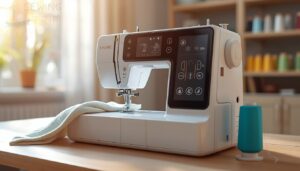
When you’re just starting out, a beginner‑friendly sewing machine shouldn’t feel like a cockpit.
The best ones keep controls tight and readable — a compact control panel, clear foot‑icon display, and an automatic needle threader do the heavy lifting.
- Safety lockout prevents accidental stitching mid-setup
- One‑touch sewing lets you start seams without foot‑pedal coordination
- LCD screen with step‑by‑step guide confirms settings before you commit
LED Lighting and Workspace Visibility
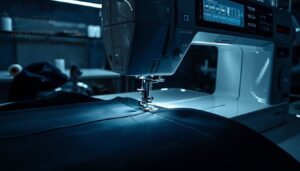
Good lighting isn’t optional — it’s where accuracy begins. A well-placed task light cuts shadows, so your stitch lines stay sharp. Look for machines with LED lighting that targets the work area directly.
Cool-white LEDs improve color accuracy, helping you tell navy from black before you sew. A backlit LCD screen and glare reduction keep your settings readable throughout every session.
Choosing by Project and Skill
The right machine depends less on specs and more on what you actually make. A quilter, a garment sewer, and someone stitching through denim all need different things from the same price range.
The right machine matters less than the projects you actually make
Here’s how the top models stack up when matched to real projects and skill levels.
Best Machines for Beginners
Your first machine sets the tone for everything that follows. The best machines for beginners combine setup simplicity with just enough automation to keep frustration low. Look for these must-haves:
- Automatic needle threader — skips the squinting
- LCD screen with stitch preview for instant clarity
- Digital display showing length and width settings
- Jam-resistant drop-in bobbin for stress-free loading
Affordability range, portability options, user community support, and learning resources all matter too — Brother CS5055 checks every box.
Best Models for Quilting
Throat space is everything — the Janome Continental M8’s 13.5 inches lets you wrestle with a king-size quilt without fighting the machine.
A reliable walking foot keeps your layers moving together, while a stitch regulator like Bernina’s BSR ensures free-motion work remains even and controlled.
For the best computerized sewing machine in quilt making, prioritize workspace and feed precision first.
Best Choices for Embroidery
The Brother SE600 brings 80 built-in embroidery designs, an automatic needle threader, and an automatic thread cutter — cutting setup time in half.
- Match Hoop Sizing to your design’s dimensions to prevent misalignment
- Use Stabilizer Guidance: cut-away for knits, tear-away for wovens
- Prioritize Thread Compatibility and Needle Selection for clean, sharp results
Strong Fabric Foundations and embroidery functions make the best computerized sewing machines worth every penny.
Best Options for Garment Sewing
Garment sewing rewards machines that offer real Fit Precision and Seam Durability — not just a long stitch menu. The Singer 9960 and Janome Skyline S5 deliver strong Garment Feed Control, blind-hem stitches for clean Hem Finishing, and automatic buttonholes that keep plackets consistent. These features ensure sophisticated functionality for serious garment sewers.
Both machines include Free Arm Functionality, simplifying tasks like sewing sleeves and cuffs. An automatic needle threader maintains workflow efficiency, eliminating interruptions.
| Feature | Singer 9960 | Janome Skyline S5 |
|---|---|---|
| Fabric Compatibility | Wovens to knits | Knits, silks, denim |
| Free Arm | Yes | Yes |
| Automatic Buttonholes | 13 one-step styles | 10 one-step styles |
These best computerized sewing machines integrate sophisticated features that serious garment sewers prioritize, combining precision, durability, and user-centric design.
Best Picks for Heavy Fabrics
Heavy fabrics demand more than finesse — they need raw capability. The Singer Heavy Duty 6700C‘s High Torque Motor pushes through denim, canvas, and leather without stalling. Its metal frame absorbs vibration, while Extended Throat Depth accommodates bulky jackets.
Denim Needle Compatibility, an automatic needle threader, and Free Arm Adaptability keep your workflow moving. When Layer Capacity Rating matters, this machine earns its place.
When to Upgrade to Advanced Features
At some point, your machine stops keeping up with you. That’s the clearest sign it’s time to move up. Watch for these signals:
- Hitting your stitch count ceiling on decorative or heirloom work
- Fabric complexity outpacing your tension control
- Automation fatigue from manual threading and cutting slowing your project volume
- Reaching a skill plateau where smart sewing technology, machine connectivity, and automatic thread tension control would genuinely change what you make
Buying Factors and Common Mistakes
Picking the right machine comes down to more than just features on a spec sheet.
A few key factors separate a smart buy from a purchase you’ll regret six months later. Here’s what to look at before you spend a single dollar.
Stitch Count Versus Practical Use
A 960-stitch library sounds impressive — but how many do you actually use? For most home sewing projects, your practical stitch set comes down to five or six workhorses.
Utility stitch focus wins every time: straight, zigzag, stretch, and a reliable one-step buttonhole cover everyday stitching needs for nearly any job.
Stitch count relevance matters less than having core stitch essentials that actually match what you sew.
Build Quality and Frame Stability
A durable metal frame isn’t just about weight — it’s your machine’s backbone. Metal Frame Durability and Chassis Material Strength directly affect how steady your stitches look after years of use.
Models with heavy-duty metal frame construction and strong Joint Connection Strength resist flexing under load. This structural integrity ensures consistent performance over time.
Bed Plate Rigidity and Vibration Dampening also play critical roles, minimizing disruptions like skipped stitches when sewing through thick layers.
Workspace Size and Extension Tables
Workspace Dimensions shape every project you take on. A wide table gives your fabric room to breathe, while poor Clearance Planning leads to bunched seams and frustration.
Extension Table Types range from fold-down leaves to sliding panels, with Support Rails that keep surfaces level. These designs enhance stability and adaptability for diverse tasks.
Models like the Janome S5 offer large extension table utility with Project Fit flexibility, including Free Arm Functionality for garment sewing. This combines expansive workspace with precision-focused features.
Included Presser Feet and Accessories
What’s actually in the box matters more than most people think. A solid basic feet set — zipper, buttonhole, blind hem — gets you started without extra spending.
Quilting feed foot and button hem feet expand what you can do fast. Machines like the Singer 9960 include 13 presser feet, plus a small tools kit with bobbins, needles, and a seam ripper.
That’s real value upfront.
Warranty and Technical Support
A machine warranty isn’t just fine print — it’s your safety net. Brother backs many models with a 25-year warranty on the chassis and lifetime technical support. Singer and Janome offer tiered coverage periods separating electronics from mechanical parts.
Before buying, check these five things:
- Claim documentation requirements
- Authorized service center locations
- Replacement policies for defective units
- Available support channels
- Electronics-specific coverage length
Mistakes to Avoid Before Buying
Most buying mistakes come down to rushing. Skipping budget checks means surprise costs after closing — the same goes for sewing machines. Ignoring upgrade path leaves you outgrowing your machine fast.
Neglecting compatibility with your project types, overlooking power needs for heavy fabrics, and underestimating maintenance all add up. These oversights compound, leading to frustration and wasted resources.
A solid computerized sewing machine buying guide helps you weigh durability and warranty considerations before committing. This ensures a purchase aligned with long-term needs and avoids costly errors.
Frequently Asked Questions (FAQs)
Which singer is best for heavy fabrics?
The Singer 4452 is virtually unbeatable for heavyweight fabrics.
Its high-torque motor, heavy-duty metal frame, adjustable presser foot pressure, and a sturdy fabric feeding system handle denim and leather with zero hesitation.
How do computerized sewing machines compare to mechanical ones?
Mechanical machines excel in Control Simplicity and Tactile Feedback — you turn a knob, you feel the change.
Computerized models handle more automatically, but have a steeper learning curve and higher maintenance needs.
Can beginners use computerized sewing machines effectively?
Yes, beginners can use them effectively. Start with straight stitch basics, verify your thread path, and use speed adaptation to stay in control. An automatic needle threader and easy-to-use interface removes most of the guesswork.
What maintenance is required for computerized sewing machines?
Skip one oiling session, and lint quietly wins.
Brush feed dogs every 8 hours, oil sparingly, clean the bobbin case regularly, and schedule an annual service — your machine will last for decades.
Are computerized sewing machines compatible with all fabric types?
Computerized sewing machines aren’t a one-size-fits-all solution. Fabric compatibility depends on needle selection, thread compatibility, and tension adjustment.
So always cut test swatches and dial in speed management before committing to your final fabric.
How long do computerized sewing machines typically last?
With proper care, your machine can last 7 to 15 years. Electronic wear, usage intensity, and environmental conditions all play a role.
A consistent maintenance schedule protects machine durability far longer than most people expect.
Can computerized machines sew through multiple fabric layers?
Think of a machine that cuts through layers like a hot knife through butter. Yes, they can. Strong motor torque, deep needle penetration, and a solid feed mechanism make multi-layer quilting smooth.
How often should a computerized sewing machine be serviced?
For most home sewists, once a year covers it. Heavy daily use calls for maintenance every six months. Watch for warning signs like grinding sounds, skipped stitches, or tension issues — don’t wait.
Do computerized machines work with industrial sewing threads?
Yes, but with limits. Match your thread weight to the right needle size, and check that the tension system can adapt.
Heavy industrial thread may overwhelm a standard bobbin or motor built for lighter work.
Can automatic stitches be customized beyond preset options?
You can tweak stitch length, width, and tension, but firmware limitations mean you can’t build brand-new stitch types.
Real stitch customization happens through software digitizing and design file editing outside the machine.
Conclusion
Imagine a home sewist tackling her first well-made blazer—no tangled threads, no fumbled buttonholes, just clean stitches and momentum. That’s what the right computerized sewing machines with automatic functions actually deliver: fewer interruptions, more finished projects.
Each model in this list removes a specific barrier, whether that’s fabric thickness, stitch complexity, or setup time. These machines streamline the process, ensuring every session moves forward instead of sideways.
Match the machine to how you sew, not how you hope to sew, and every session moves forward instead of sideways.
- https://www.maggieframes.com/blogs/embroidery-blogs/brother-se600-mastery-guide-setup-features-creative-embroidery-techniques
- https://www.kehuasmart.com/brother-project-runway-sewing-machine-review.html
- https://www.singer.com/products/singer-c7250-sewing-machine
- https://threadridinghood.com/the-most-amazing-thing-reviewed-janome-skyline-s5/
- https://www.sewingpartsonline.com/products/brother-cp100x-computerized-sewing-machine