This site is supported by our readers. We may earn a commission, at no cost to you, if you purchase through links.
Threading a needle used to be the tax you paid before any real sewing began—squinting, stabbing, muttering under your breath.
Modern machines now thread themselves in under two seconds, cut threads automatically, and warn you before the bobbin runs dry.
That shift isn’t just convenient; it changes how you work. You stay focused on the fabric instead of fighting the machine.
Today’s contemporary sewing machine features handle the tedious mechanics so your hands and mind stay on the creative work—whether you’re hemming stretch knits, quilting dense layers, or stitching twin-needle rows without tunneling.
The right features don’t just save time; they expand what’s possible.
Table Of Contents
- Key Takeaways
- Essential Advanced Machine Features
- Automation That Speeds Sewing
- Stitch Control and Customization
- Fabric Handling and Workspace Support
- Top 9 Advanced Sewing Machines
- 1. Brother Computerized Sewing Quilting Machine
- 2. Singer M3500 Sewing Machine Beginner Kit
- 3. Brother CS7000X Sewing and Quilting Machine
- 4. Singer Start 1304 Sewing Machine
- 5. Singer Heavy Duty Sewing Machine
- 6. Singer 7285Q Quilting Sewing Machine
- 7. Singer 9960 Sewing Quilting Machine
- 8. Juki TL 2000Qi Sewing Quilting Machine
- 9. Brother SE600 Embroidery Sewing Machine
- Frequently Asked Questions (FAQs)
- Conclusion
Key Takeaways
- Modern sewing machines handle threading, thread cutting, and bobbin monitoring automatically, so you spend less time on setup and more time actually sewing.
- The right stitch controls — adjustable length, width, tension, and hundreds of built-in patterns — let you match any fabric, from stretchy knits to stiff denim, without guessing.
- Smart fabric-handling features like dual feed, automatic presser foot pressure, and laser guides take the wrestling match out of tricky materials and big projects.
- Choosing the best machine comes down to your work — speed-focused quilters will love the Juki TL-2000Qi, while creative embroidery lovers get more from the Brother SE600.
Essential Advanced Machine Features
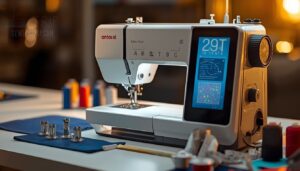
If you’re ready to level up your sewing, the machine you choose makes all the difference. Modern models pack in features that save time, reduce frustration, and give you more control over every project.
Check out this versatile sewing machine brands comparison to find the model that best matches your skill level and project goals.
Here’s what to look for first.
Automatic Needle Threading for Faster Setup
Threading a needle used to be the tax you paid before the real work began. Modern automatic needle threading mechanisms change that entirely.
The Threading Mechanism Design uses a fine hook and guided channel for Thread Path Alignment, getting thread through the eye in under two seconds.
Lighting-Assisted Threading and Adaptive Thread Tension keep everything aligned, so your automatic needle threader works right every single time.
This feature provides quick predictable threading, saving minutes per project.
Automatic Thread Cutting and End-of-stitch Functions
Once your needle is threaded, finishing cleanly matters just as much. Automatic thread cutting technology takes care of that final step for you.
Here’s what automatic end-of-stitch features actually do:
- Seam Lock Automation secures your seam with a backstitch before cutting
- Multi-Thread Trimming severs top and bobbin threads simultaneously
- Adjustable Cut Length minimizes tail length to prevent puckering
- Trim Safety Feature uses protective covers with soft-start cutting
- Vibration Damping keeps cuts smooth at high speeds
Automatic stitch termination and thread management mean cleaner seams, every time.
Built-in Thread Sensors and Bobbin Warnings
Clean cuts are great, but what happens mid-seam when thread runs out? That’s where bobbin thread sensor technology earns its place.
Low bobbin detection warns you before disaster strikes, while upper thread monitoring catches breaks instantly.
Some machines even offer alert customization options and sensor calibration alerts for different fabrics.
Good sewing machine sensor technology — combined with smart thread tension control — keeps your work running smoothly.
Interchangeable Needle Plate Systems
Sensors catch thread problems, but the right needle plate stops them before they start.
Interchangeable needle plates let you match your setup to the job:
- Wide hole needle plate accommodates zigzag and decorative stitches
- Small hole needle plate guides delicate fabrics with precision
- Alignment pin accuracy keeps needle placement repeatable every swap
- Hardened aluminum plates resist wear through heavy sessions
- Quick‑swap mechanism with plate sensor integration blocks wrong stitch selections automatically
Twin-needle Compatibility for Stronger Seams
Want seams that actually hold up? Twin needle capability gives you two parallel rows of stitching at once — perfect for knit hems and stretch garments.
Nail your Needle Gap Optimization and Stitch Length Calibration, and tunneling disappears.
Thread Weight Matching with Balanced Tension Control keeps both lines even.
Smart Fabric Type Selection determines everything, from variable needle placements to seam accuracy.
Built-in Accessory Storage for Everyday Tools
Built-in accessory storage solutions keep your tools exactly where you need them. Magnetic Tool Rails hold screwdrivers and scissors along a 24-inch vertical line — no hunting around.
Hidden Compartments behind flush cabinet doors protect delicate nibs and bobbins. Integrated Drawer Organizers use color-coded trays for fast identification.
Hook Loop Pockets grip needles and thread snips within arm’s reach. Slide Out Cests with adjustable dividers handle full accessory packages and included presser feet, making accessory compatibility simple.
Automation That Speeds Sewing
Modern sewing machines don’t just stitch — they think ahead for you. The automation features can cut your setup time in half and keep your focus where it belongs: on the project.
Here’s what to look for regarding speed-boosting technology.
Computerized Stitch Selection Menus
Scrolling through hundreds of stitches used to feel like hunting for one song on a scratched CD. Computerized stitch selection menus fix that.
Digital stitch selection organizes everything — utility, decorative, stretch — into clean categories.
Iconic stitch previews show exactly what each stitch looks like before you sew a single inch. Adaptive stitch filtering narrows options by fabric type, while contextual stitch recommendations guide smarter choices.
User profile presets save your favorites, and real-time stitch feedback confirms settings instantly.
Touchscreen Controls and Guided Navigation
Think of a color LCD touchscreen as your co-pilot — always one tap away from the right setting.
Modern touchscreen interfaces on sewing machines do more than look pretty:
- On-screen tutorials walk you through complex setups step by step
- Contextual tips appear the moment you enter a new function
- Visual progress indicators show exactly where you’re in a project
- Haptic feedback confirms every tap with a subtle click
Accessibility settings let you adjust font size and contrast too.
Memory Functions for Custom Stitch Settings
Your machine’s memory is like a well-organized sewing drawer — everything exactly where you left it.
With Stitch Profile Sync, you can store up to 50 custom stitch profiles, each saving tension, length, width, and foot pedal behavior.
Fabric Memory Presets lock in denim or silk settings instantly.
Sequence Looping Controls replay multi-step patterns automatically.
User Profile Settings and Cloud Stitch Backup keep your customizable user settings memory safe across sessions.
Programmable Needle Up/down Positioning
Controlling exactly where your needle stops is a breakthrough for precision work.
Programmable needle up/down positioning uses Sensor-driven Needle Timing and Microstepping Needle Control to land your needle exactly where you need it — every time.
- Adjustable Needle Height adapts automatically to thick denim or delicate silk.
- Adaptive Needle Travel minimizes fabric drag between stitches.
- Preset Needle Profiles recall your programmable needle up/down settings instantly.
Customizable user settings and adjustable speed control make pivoting on curves smooth.
Independent Bobbin Winding Systems
Once your needle stops exactly where you want it, the next bobbin prep is bobbin prep. Independent winding systems fix that fast. With High-Speed Spindle technology, you can fill a bobbin in under 20 seconds.
Programmable Tension keeps every layer uniform — no slippage, no surprises. Parallel Winding Stations mean you’re never waiting. Modular Winder Design and Automatic Cut-Off handle the rest so you just keep sewing.
Laser Guide Tools for Accurate Stitching
Straight lines are harder than they look — until a laser guide takes over. A sharp beam projects right onto your fabric, marking the exact stitching path.
Beam Color Options let you pick red for light fabrics or green for dark ones.
Adjustable Beam Width, Auto-Focus Calibration, and Multi-Mode Projection keep your seam accuracy locked in, even on thick quilts.
Safety Interlock System protects your eyes automatically.
Stitch Control and Customization
This is where a sewing machine really starts to feel like yours. The right stitch controls let you match every project — from stretchy jersey to stiff denim — without guessing or settling.
Here’s what to look for.
Hundreds of Built-in Stitch Patterns
Your stitch library size can genuinely transform what’s possible on the machine. Many sophisticated models offer hundreds of options — and Pattern Family Organization makes browsing fast.
- Utility stitches for everyday seams and hems
- Stretch stitches built for knits and activewear
- Decorative stitches for borders and embellishments
- Buttonhole styles with automatic sizing
- Satin stitches for smooth appliqué fills
Stitch Preview Thumbnails let you see each pattern before sewing. That’s real stitch versatility — no guessing required.
Saved Custom Stitch Sequences
Beyond a deep stitch library, the real power kicks in when you save your own sequences. Name each one, sort it into folders, and recall custom stitch programming with a single tap on your intuitive touchscreen interface.
Metadata preservation keeps stitch count and timing intact.
Cross-device transfer via USB even moves your memory stitch patterns between compatible machines.
Adjustable Stitch Length, Width, and Tension
stitch length, width, and tension as your three dials of control. Fine Stitch Length ranges from 0 to 6 mm — shorter for dense, strong seams; longer for delicate silks. Variable Stitch Width reaches up to 7 mm for stretch knits. Adaptive Tension Settings and Fabric-Specific Tension keep threads balanced.
Always test Stitch Density Optimization on scrap fabric first.
Decorative, Stretch, and Buttonhole Stitch Options
Your machine’s stitch library is where creativity really opens up. Satin Stitch lays down a glossy, dense fill — perfect for monograms.
Stem Stitch mimics hand embroidery, while Chain Stitch adds flexible, looping texture to seams.
For knits, Zigzag Stretch moves with the fabric.
Buttonhole Styles range from classic to keyhole, each needing the right buttonhole presser foot.
That stitch variety and application potential is genuinely exciting.
Variable Needle Positions for Precision Work
Variable needle placements give you a level of control that changes everything. With 13 distinct needle locations, you can nail Zipper Alignment, lock a perfect Topstitch Edge, or stick a clean Quilting Pivot every time. Rework Adjustments become less painful, and Fabric Registration stays consistent across sessions.
With 13 needle positions, every zipper, topstitch, and quilting pivot lands exactly where you need it
- Zipper work – place stitches exactly at the teeth
- Topstitching – hold uniform distance from any edge
- Quilting pivots – turn corners without skipping a beat
Custom Embroidery Import and Editing Features
Your computerized embroidery machine becomes a design studio the moment you plug in a USB. Format Compatibility covers DST, PES, and EXP files, so most designs load without drama.
Then you’re into real editing — Node Editing, Density Adjustment, Color Mapping, and Live Preview before a single stitch drops.
| Tool | What It Does | Why It Matters |
|---|---|---|
| Node Editing | Adjusts curves and anchor points | Refines imported shapes precisely |
| Density Adjustment | Recalculates stitch counts after scaling | Prevents gaps or thread buildup |
| Live Preview | Simulates stitching on screen | Catches mistakes before fabric does |
Digital embroidery placement and alignment tools inside your embroidery design software make embroidery capabilities professional — your embroidery design library grows with every saved edit.
Fabric Handling and Workspace Support
Getting fabric to behave is half the battle in any sewing project. Modern machines now pack in some seriously smart features to help you stay in control — no wrestling with slippery silk or thick denim required.
Here’s what to look for regarding fabric handling and workspace support.
Automatic Presser Foot Pressure Adjustment
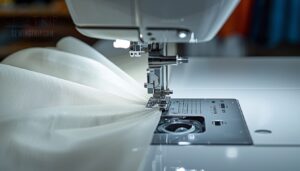
Your presser foot pressure sensor does something most sewists overlook — it reads fabric thickness in real-time and adjusts automatically. That’s Real-time Thickness Sensing paired with Servo-driven Pressure Control working together.
Feedback Loop Calibration keeps contact consistent stitch by stitch. Whether chiffon or denim, Fabric Zone Adaptation and Stitch-specific Pressure management deliver clean results.
Your digital display panel shows every adjustment instantly.
Dual-feed Systems for Even Fabric Movement
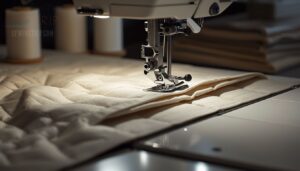
Think of dual feed as two hands guiding fabric together — perfectly in sync. Synchronized Feed Dogs on top and bottom use Dual-Feed Sensors for real-time Top-Bottom Alignment, keeping layers honest.
Whether you’re quilting a sandwich or sewing slippery satin, walking foot system manages Fabric Tension Balancing automatically. Integrated Feeding Systems for MultiLayer Fabrics and AcuFeed Flex feeding system deliver Layered Seam Consistency without wrestling your fabric through.
Drop Feed for Free-motion Quilting
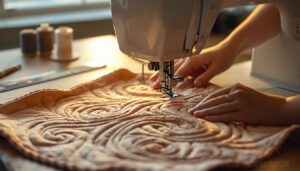
Drop feed flips the script — lower those feed dogs, and your hands take over. You guide the fabric freely, using a Free-Motion Foot for visibility and control.
Set Stitch Length Zero to keep movement intentional.
Good Batting Stability prevents creep, and a Quilting Ruler keeps lines honest.
It’s Hand Guidance that unlocks expressive Free Motion Quilting Techniques and Settings.
Knee Lifter for Hands-free Fabric Control
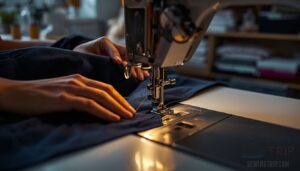
Once your hands are free from drop-feed work, a knee lifter keeps that freedom going. This padded lever manages your presser foot pressure management without breaking your grip on the fabric.
- Knee Pressure Adjustment lets you customize resistance to match your pace
- Foot Lift Ergonomics reduce shoulder strain during long sessions
- Fatigue Reduction is real — users report noticeably less tension
- Installation Compatibility works with most low-shank feet
- Maintenance Lubrication at pivot points keeps it smooth
Extension Tables and Large Throat Space
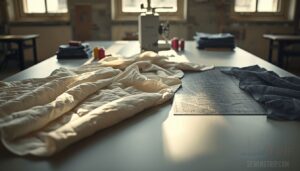
workspace size directly shapes what you can sew. Extension tables for large projects give you room to spread out quilts, gowns, or heavy canvas without wrestling fabric off the edges.
Foldable Table Leaves store neatly underneath, and a Quick‑Attach Mechanism locks them in under a minute.
| Feature | Why It Matters |
|---|---|
| Throat Depth Measurement | Up to 11 in. clearance for bulky batting |
| Non‑Slip Table Surface | Keeps fabric stable across wide panels |
| Weight Capacity Guidelines | Bears heavy denim or layered quilts |
| Free Arm Capability | Manages sleeves and hems on narrow tubes |
| Wide Hole Needle Plate | Accommodates twin‑needle and decorative stitches |
large workspace footprint simply means fewer frustrating repositioning stops mid-seam.
LED Lighting for Improved Visibility
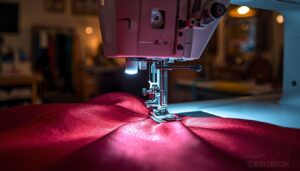
Good lighting isn’t a luxury — it’s what separates clean stitches from costly mistakes. LED lighting on modern machines delivers High CRI illumination, so your fabric colors read true every time.
- Color temperature ranges from warm 2700K to daylight 6500K
- Dimmable brightness suits every task and time of day
- Anti-glare lenses eliminate reflections off silky or metallic fabrics
- Ambient dimming adjusts automatically to your studio light
- Energy-efficient LED lighting lasts tens of thousands of hours
LED illumination for sewing precision means you’ll catch every misaligned thread instantly.
Top 9 Advanced Sewing Machines
Knowing the features is one thing — finding the right machine to bring them all together is another. nine models each offer something distinct, whether you’re quilting king-size layers or adding embroidery to a jacket.
Here’s a closer look at what each one brings to the table.
1. Brother Computerized Sewing Quilting Machine
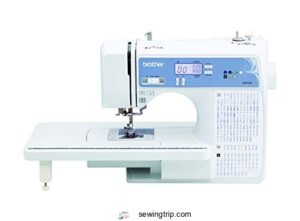
The Brother XR9550 punches well above its 10-pound frame. You get 165 built-in stitches — including eight automatic buttonhole styles — without the bulky footprint of heavier machines.
The automatic needle threader alone cuts your setup time dramatically, and the jam-resistant drop-in bobbin means fewer frustrating mid-project stops.
Its LCD screen makes stitch selection genuinely natural, even for complex decorative work.
Add the wide quilting table and eight included presser feet, and you’ve got a surprisingly capable machine for quilters and garment sewers alike.
| Best For | Beginners and hobbyists who want a lightweight, versatile machine that handles everything from quilting to garment sewing without a steep learning curve. |
|---|---|
| Built-in Stitches | 165 |
| Frame Material | Plastic |
| Machine Weight | 10 lbs |
| Needle Threader | Automatic |
| Voltage | 120V only |
| Price Range | Budget |
| Additional Features |
|
- 165 built-in stitches plus an automatic needle threader make setup and project variety genuinely effortless
- The jam-resistant drop-in bobbin keeps things moving — fewer interruptions, more sewing
- Lightweight at 10 pounds, so it’s easy to carry to a class or pack away when you’re done
- Plastic parts raise durability questions over time, and repairs aren’t really an option — you’d replace it
- Only works on 120V, so international use is a no-go if you want the warranty to hold
- A few users have noted the hard cover doesn’t fit perfectly and occasional stitch tension quirks
2. Singer M3500 Sewing Machine Beginner Kit
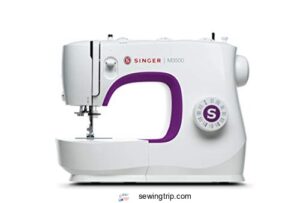
If you’re just starting out, the Singer M3500 is a solid first machine that won’t overwhelm you.
You get 110 built-in stitches covering basic, decorative, and stretch options — plenty of range for clothing repairs, small quilts, and everyday crafts.
The one-step buttonhole works automatically, saving real time on garment projects. Its automatic needle threader reduces eye strain, and the free arm manages cuffs and sleeves with ease.
At roughly 13 pounds, it’s light enough to move between rooms without a second thought.
| Best For | Beginners, older users, or anyone who wants a reliable, easy-to-use machine for everyday sewing projects like clothing repairs, quilts, and small crafts. |
|---|---|
| Built-in Stitches | 110 |
| Frame Material | Metal |
| Machine Weight | 13 lbs |
| Needle Threader | Automatic |
| Voltage | 110V only |
| Price Range | Budget |
| Additional Features |
|
- 110 stitches plus a one-step buttonhole makes it versatile right out of the box
- Automatic needle threader and LED light take the frustration out of setup
- Light enough to move around easily, but the metal frame keeps it sturdy
- Occasional bobbin jamming issues reported by some owners
- Manual often isn’t included, so expect to lean on YouTube for troubleshooting
- Only works with 110V outlets — not compatible with UK/EU power without a transformer
3. Brother CS7000X Sewing and Quilting Machine
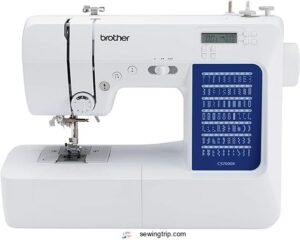
If quilting is your main game, the Brother CS7000X deserves a serious look. It packs 70 built-in stitches — utility, decorative, heirloom, and quilting — plus 7 one-step auto-size buttonholes.
The detachable wide extension table gives you real room to wrestle a king-size quilt into shape. A metal frame keeps stitching steady at up to 750 stitches per minute.
At $279.99, you’re getting a durable, capable machine that manages denim and delicate fabrics without breaking a sweat.
| Best For | Quilters and home sewers who want a sturdy, feature-packed machine that can handle everything from delicate fabrics to heavy denim without spending a fortune. |
|---|---|
| Built-in Stitches | 70 |
| Frame Material | Metal |
| Machine Weight | 14 lbs |
| Needle Threader | Automatic |
| Voltage | US only |
| Price Range | $279.99 |
| Additional Features |
|
- 70 built-in stitches plus a detachable wide table make it a genuine quilting workhorse
- Metal frame keeps stitching consistent and stable, even at higher speeds
- Beginner-friendly features like automatic needle threading and a clear LCD take the frustration out of setup
- US-only voltage means international users need a converter
- No automatic bobbin threading — you’re still doing that part by hand
- At 14 lb, it’s not the easiest machine to haul around compared to lighter portables
4. Singer Start 1304 Sewing Machine
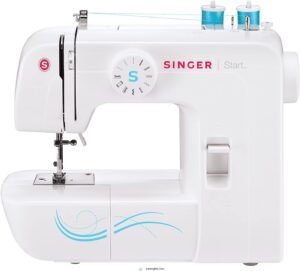
Not every sewer needs 600 stitches and a touchscreen. Sometimes you just want something that works.
The Singer Start 1304 keeps it simple — six essential stitches, a sturdy metal frame, and a free arm for cuffs and sleeves.
It winds bobbins quickly, includes a zipper foot and buttonhole foot, and weighs under 12 pounds. At 350–400 stitches per minute, it’s a calm, beginner-friendly machine that takes care of everyday repairs and small projects without overwhelming you.
| Best For | Beginners, occasional sewers, and anyone who needs a simple, portable machine for everyday repairs and basic projects. |
|---|---|
| Built-in Stitches | 6 |
| Frame Material | Metal |
| Machine Weight | Under 12 lbs |
| Needle Threader | Not included |
| Voltage | Not specified |
| Price Range | Budget |
| Additional Features |
|
- Easy to set up and use — great if you’re just starting out or only sew now and then
- Lightweight and compact, so it fits in small spaces and travels well
- Comes with a solid accessory kit (zipper foot, buttonhole foot, needles, and more) right out of the box
- Fixed 5mm stitch width means you can’t adjust it for thicker fabrics or decorative work
- Only six basic stitches, which will feel limiting if you want to tackle more advanced projects
- Can jam if the bobbin or thread isn’t seated just right — proper setup matters with this one
5. Singer Heavy Duty Sewing Machine
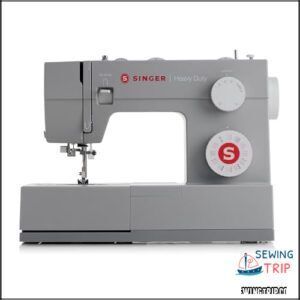
When a project calls for real muscle, the Singer Heavy Duty 4452 delivers. Its high-torque motor pushes through denim, canvas, and leather at up to 1,100 stitches per minute — without bogging down.
You get 110 stitch applications, a built-in needle threader, and adjustable presser foot pressure for everything from thin silk to stacked upholstery layers.
The metal frame keeps vibration low.
At $219.99, it’s a serious workhorse that won’t flinch when your fabric does.
| Best For | Sewers who regularly work with heavy fabrics like denim, canvas, or leather and need a machine that can keep up without breaking a sweat. |
|---|---|
| Built-in Stitches | 110 |
| Frame Material | Metal |
| Machine Weight | Not specified |
| Needle Threader | Built-in |
| Voltage | US plug only |
| Price Range | $219.99 |
| Additional Features |
|
- Punches through thick, multi-layer fabrics with ease thanks to a high-torque motor
- Comes loaded with accessories (walking foot, quilting guide, extra bobbins) so you’re not hunting for add-ons right away
- Transparent bobbin cover makes it easy to keep an eye on thread without stopping your work
- Knobs and dials aren’t well-labeled, so you’ll be reaching for the manual more than you’d like
- Noisy and a bit jerky at high speeds, and zig-zag stitches on stretchy fabric can disappoint
- Ships with a US plug only, so international users will need a converter on top of the purchase price
6. Singer 7285Q Quilting Sewing Machine
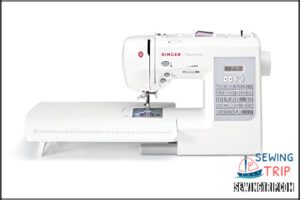
If quilting is your main game, the Singer 7285Q was built with you in mind. It packs 100 built-in stitches — including 15 quilting-specific patterns — plus a programmable needle up/down function that makes precise turns and appliqué corners feel easy.
The extension table gives your quilt room to breathe, and the included walking foot keeps all those layers moving together smoothly.
The metal frame holds steady even during free-motion runs.
At around 15 pounds, it’s solid without being a gym session.
| Best For | Quilters and home sewers who want a reliable, feature-rich machine that handles everything from basic garments to complex quilting projects without a steep learning curve. |
|---|---|
| Built-in Stitches | 100 |
| Frame Material | Metal |
| Machine Weight | 15 lbs |
| Needle Threader | Not specified |
| Voltage | Not specified |
| Price Range | Mid-range |
| Additional Features |
|
- 100 built-in stitches with 15 quilting-specific patterns give you plenty of creative options right out of the box.
- The programmable needle up/down function makes pivot points and appliqué corners way less stressful.
- Electronic speed control and the start/stop button mean you stay in control without relying on foot pedal pressure.
- The plastic bobbin basket is a weak spot — users have reported breakage and thread tangling over time.
- No real feed-dog control, which can be frustrating if you want to do free-motion work the traditional way.
- Error codes like C4 can lock the machine up, and finding local service support isn’t always easy.
7. Singer 9960 Sewing Quilting Machine
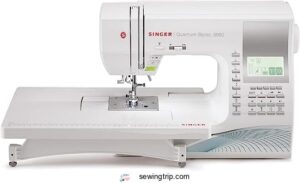
Want more than quilting-only features? The Singer 9960 steps things up considerably.
You get 600 built-in stitches — covering stretch, decorative, and utility options — plus 13 automatic one-step buttonholes. The automatic needle threader and integrated thread cutter keep your workflow moving fast. Five built-in lettering fonts let you add monograms without a separate embroidery machine.
At $540.99, it accommodates heavy fabrics, large quilts, and garment work equally well. It’s genuinely hard to outgrow.
| Best For | Sewers who want one machine that handles quilting, garments, and decorative work without ever feeling like they’ve hit a ceiling. |
|---|---|
| Built-in Stitches | 600 |
| Frame Material | Metal |
| Machine Weight | 15 lbs |
| Needle Threader | Automatic |
| Voltage | Not specified |
| Price Range | $540.99 |
| Additional Features |
|
- 600 stitches plus five lettering fonts means you can quilt, sew clothes, and add monograms all on one machine
- Automatic needle threader, built-in thread cutter, and top-drop bobbin make setup and finishing genuinely fast
- Handles heavy fabrics and multi-layer projects without skipping stitches — great for rag quilts and upholstery
- The throat plate is on the smaller side, which can feel cramped when maneuvering a big quilt
- At nearly 15 lbs, moving it around the house gets old fast without a dedicated cart
- Beginners might feel overwhelmed by 600 stitch options right out of the box
8. Juki TL 2000Qi Sewing Quilting Machine
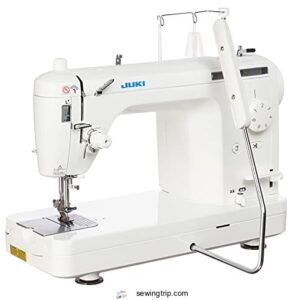
The Juki TL-2000Qi is a different animal entirely. Where the Singer 9960 gives you versatility, the Juki gives you raw, focused power.
It’s a straight-stitch-only machine — no decorative stitches — but it hits 1,500 stitches per minute with a die-cast aluminum frame that barely vibrates. That matters when you’re pushing through canvas, denim, or thick batting.
The automatic needle threader and thread cutter keep things moving fast. If speed and heavy-fabric control are your priorities, this machine delivers.
| Best For | Quilters and heavy-duty sewers who need raw speed and stability for large projects like king-size quilts, bags, canvas, or thick garments. |
|---|---|
| Built-in Stitches | 1 (straight) |
| Frame Material | Die-cast aluminum |
| Machine Weight | Not specified |
| Needle Threader | Automatic |
| Voltage | 220V converter needed |
| Price Range | Premium |
| Additional Features |
|
- Blazing fast at 1,500 SPM with an aluminum frame that stays rock-solid, even through thick or layered fabric
- Automatic thread cutter and needle threader keep your workflow moving without constant interruptions
- Wide throat and walking foot make it a dream for pushing big quilts through without wrestling the machine
- Straight stitch only — no buttonholes, no decorative stitches, nothing fancy
- No built-in speed control, so you’re going full throttle unless you manually ease up on the pedal
- Needs a voltage converter for 220V regions, and the needle threader can be finicky enough that many users just grab a separate tool
9. Brother SE600 Embroidery Sewing Machine
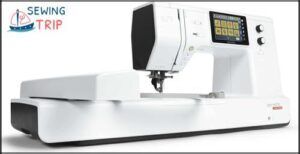
Now, if power isn’t your thing and you’d rather create than conquer, the Brother SE600 is worth a close look.
It’s a 2-in-1 sewing and embroidery machine with a 3.2-inch color touchscreen, 80 built-in embroidery designs, and USB import for custom patterns.
The 4×4-inch embroidery field accommodates monograms and motifs beautifully.
At 710 stitches per minute, it won’t win any speed races, but for decorative work and custom projects, it’s a capable, creative workhorse priced at $2,299.
| Best For | Hobbyists and creative sewers who love embroidery, decorative stitching, and custom projects like home décor or cosplay costumes. |
|---|---|
| Built-in Stitches | Not specified |
| Frame Material | Cast aluminum |
| Machine Weight | 47 lbs |
| Needle Threader | Semi-automatic |
| Voltage | Not specified |
| Price Range | $2,299.00 |
| Additional Features |
|
- Hands-free operation with the programmable foot control and back-kick function makes longer sessions way less tiring.
- Supports multiple embroidery file formats and includes built-in design editing tools, so custom work is genuinely flexible.
- The cast-aluminum frame and dual-feed mechanism keep things sturdy and fabric feeding smooth.
- Takes over 40 seconds to boot up every time, which gets old fast if you’re jumping in and out of projects.
- The menu-heavy interface has a steep learning curve, and the manual isn’t even in the box — you have to download a 170-page PDF.
- Not built for heavy fabrics or thick layers, and lower-bobbin threading is finicky enough to cause bird-nesting if you’re not careful.
Frequently Asked Questions (FAQs)
What were the major advancements in sewing machine technology?
From hand-cranked bobbins to servo motors and touchscreens — sewing machines have come a long way.
Today’s biggest leaps include automatic threading, computerized stitch selection, precision fabric sensors, and built-in embroidery editing tools.
What features are important in a sewing machine?
The right features depend on what you sew.
Look for automatic threading, reliable thread sensors, strong motor power, and good stitch variety. Those basics make every project — simple or complex — go much smoother.
What are advanced sewing skills?
Expert sewing skills include free-motion quilting, precise seam control, twin-needle work, custom embroidery, and handling tricky fabrics like denim or silk.
They’re about mastering control, speed, and creative confidence at the machine.
What are the essential features of a sewing machine?
The essentials come down to reliable stitch control, smooth fabric feeding, and easy threading.
You want a machine that processes your materials well, finishes seams cleanly, and doesn’t fight you every step.
How many models of sewing machines & sergers are there?
Think of the sewing machine market like a library — massive and growing.
There are thousands of models globally, plus dozens of serger options ranging from simple 3-thread home units to heavy-duty industrial machines.
What is the best sewing machine?
The best sewing machine depends on your projects.
For quilting, the Juki TL-2000Qi is hard to beat. For embroidery, the Brother SE600 wins.
Match the machine to what you actually make.
What is the new technology for sewing?
New sewing technology now includes AI-assisted fabric recognition, laser seam guides, and automatic thread management. Some machines even adjust tension in real time — cutting setup time by up to 80%.
What is the advantage of a Computerised sewing machine?
A computerised sewing machine gives you precise control at your fingertips.
You can select stitches, adjust tension, and save custom settings instantly — cutting setup time and letting you focus on the actual sewing.
What can a Computerised sewing machine do?
A computerised sewing machine manages stitch selection, tension, and thread cutting automatically. It stores custom settings, guides you through setups, and even warns you when the bobbin runs low.
How do sewing classes benefit advanced users?
Sewing classes give you direct feedback, faster problem-solving, and real hands-on practice. You’ll sharpen fit, fabric knowledge, and technique — skills that solo home practice rarely builds as quickly.
Conclusion
Like Edison’s lightbulb turning darkness into possibility, modern sewing machine features transform frustration into creative freedom. Every automatic thread cut, every sensor alert, every programmable stitch sequence quietly remove the friction between your vision and your fabric.
You’re no longer wrestling with setup—you’re building something real.
The right machine doesn’t just keep pace with your ambition; it amplifies it. Choose features that work as hard as you do, and watch what your hands can finally make.