This site is supported by our readers. We may earn a commission, at no cost to you, if you purchase through links.
You’ll find that most modern dressmaking machines pack 200+ built-in stitches, yet professional seamstresses typically rely on just 12 to 15 core functions for 90% of their garment construction. The gap between advertised features and practical utility creates confusion when you’re investing $150 to $3,000 in equipment that needs to handle everything from bias-cut silk charmeuse to structured wool suiting.
What actually separates a machine that struggles with basic seam allowances from one that executes impeccable French seams, invisible zippers, and bound buttonholes comes down to five mechanical specifications that manufacturers rarely emphasize in their marketing materials.
Understanding these performance indicators—along with which stitch categories genuinely expand your construction techniques versus adding digital clutter—transforms your selection process from overwhelming to strategic.
Table Of Contents
- Key Takeaways
- Key Features for Dressmaking Machines
- Stitch Variety and Customization
- Types of Sewing Machines for Dressmaking
- Factors to Consider Before Buying
- Essential Accessories for Dressmaking
- Comparing Top Sewing Machine Brands
- Maintenance Tips for Dressmaking Machines
- Top 9 Sewing Machines for Dressmaking
- 1. Brother Lightweight Sewing Machine
- 2. Singer Heavy Duty Sewing Machine
- 3. Singer Quantum Stylist Sewing Machine
- 4. SINGER Start 1304 Beginner Portable Sewing Machine
- 5. Brother Sewing Embroidery Machine Combo
- 6. Brother Sewing And Quilting Machine
- 7. Brother Project Runway Sewing Machine
- 8. Brother Heavy Duty Sewing Machine
- 9. Singer Curvy Sewing Machine
- Choosing The Best Machine for Your Needs
- Frequently Asked Questions (FAQs)
- Conclusion
Key Takeaways
- Professional seamstresses rely on just 12-15 core stitch functions for 90% of garment construction, despite machines advertising 200+ built-in stitches—focus on five mechanical specifications (automatic needle threader, jam-resistant drop-in bobbins, adjustable presser foot height, essential stitch options, and automatic buttonhole functions) that manufacturers rarely emphasize but directly impact seam quality and construction capability.
- Your machine selection should match actual project demands rather than price alone: mechanical models offer straightforward durability for basic construction, computerized versions provide programmable precision for complex work, and specialized overlockers handle professional seam finishing—with throat space, presser foot pressure adjustability, and metal frame construction determining whether you’ll execute French seams and invisible zippers or struggle with basic seam allowances.
- Maintenance practices separate machines that last 5 years from those delivering 20+ years of professional performance: clean lint from feed dogs and bobbin cases every 8-10 hours of sewing, apply one drop of approved oil to metal pivot points (never belts) every six months, and maintain 40-50% humidity to prevent rust on components—80% of stitch failures trace back to improper threading and bobbin winding rather than mechanical defects.
- Budget strategically across the $100-$600 range by evaluating long-term durability over advertised features: entry-level machines like the Brother XM2701 ($100-200) deliver essential functions for basic garments, mid-range models ($250-600) offer enhanced build quality and expanded capabilities for complex construction, while holiday discounts can slash costs 20-40%—with metal gear trains outperforming plastic assemblies and resale values holding 20-40% after five years.
Key Features for Dressmaking Machines
When you’re shopping for a dressmaking machine, certain features separate workhorses from frustration generators. You’ll want capabilities that handle everything from delicate silks to heavyweight denim without constant adjustments or thread jams.
One machine that consistently delivers on that promise is the Juki DX-7 reviewed here, which handles both extremes with minimal fuss.
Shop for dressmaking machines that handle silks to denim without constant adjustments—separating workhorses from frustration generators
Here are the five non-negotiables that’ll keep your garment construction moving forward instead of grinding to a halt.
Automatic Needle Threader
You’ll find automatic needle threaders on machines like the Brother XM2701 use a hooked wire threader mechanism that completes threading in 1 to 2 seconds. The needle alignment must be precise for the auto retraction feature to work.
Thread compatibility extends to medium-weight spools, though threading speed varies by model. This mechanism transforms dressmaking workflow when you’re switching between fabric types frequently.
For those seeking added convenience, an automatic sewing needle threader can further simplify the process, especially in low-light or challenging conditions.
Jam-Resistant Drop-in Bobbins
Drop-in bobbins snap directly into top-loading cases without needle plate removal, cutting your setup time to seconds. They use jam-resistant designs with tighter tolerances and magnetized rims to prevent thread catch on feed dogs during high-speed stitching.
You’ll maintain consistent bobbin tension control across polyester and cotton threads, eliminating those frustrating thread nests mid-seam. The plastic construction with low-friction surfaces reduces heat buildup when you’re running long dressmaking sessions.
Adjustable Presser Foot Height
You’ll gain precise fabric clearance control when your machine offers height adjustment—critical for maneuvering heavyweight denim seams or sandwiching multiple tulle layers without stitch skipping. Proper foot calibration maintains consistent tension from collar to hem, eliminating those wavy topstitches that scream amateur construction.
- Thick seam navigation: Raise the presser foot 1–2 millimeters above standard to glide over bulky intersections without compression
- Stitch quality control: Correct clearance prevents fabric lift and thread looping that ruin professional finishes
- HeavyDuty sewing capability: Higher settings accommodate leather and canvas without drag or needle deflection
- Portable sewing machine advantage: Quick-adjust levers let you switch from chiffon to twill mid-project without tooling
For more detail, consult these to fine-tune your setup for various fabrics and thicknesses.
Built-in Stitch Options
Your machine’s stitch library determines whether you’ll nail crisp topstitching or fumble through makeshift workarounds. Look for free motion zigzag and satin stitches up to 5 mm width for fabric compatibility across jersey to canvas.
Programmable sequences—storing up to four custom patterns—release embellishment techniques without constant manual adjustments.
Secure lock stitches at seam starts prevent unraveling, while adjustable density settings give you sewing precision on delicate silks without puckering.
Automatic Buttonhole Functions
One-step buttonhole precision transforms garment closures from guesswork to calibrated accuracy. Your sewing machine measures button diameter—then calculates hole length, stitch reinforcement, and bar-tack placement automatically.
Thread tension adjusts to fabric compatibility, from lightweight chiffon to twill, while the dedicated foot guides edges for uniform satin stitches.
Automatic settings deliver consistent results across repeated cycles, so you’ll achieve professional finishes without manual recalibration between dressmaking projects.
Stitch Variety and Customization
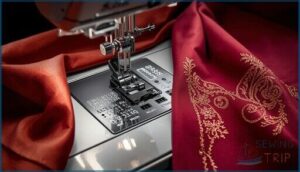
You’ll need more than just a straight stitch to construct professional garments from scratch. The range of built-in stitches—from utility basics to decorative finishes—determines what you can create without switching machines or doing hand-sewing workarounds.
Here’s what stitch variety actually gives you when you’re pattern-making and constructing garments.
Utility and Decorative Stitches
You’ll need both utility and decorative stitches to gain complete creative control over your dressmaking projects. Straight stitch and zigzag form your foundation for seam construction and fabric selection, while satin stitches and heirloom patterns enhance embellishment techniques.
Thread tension adjustments paired with proper stitch variety guarantee sewing precision across garment assembly and embroidery work. Your sewing machine becomes a powerhouse tool when you master these essential sewing techniques for dressmaking and quilting applications.
Adjustable Stitch Length and Width
Precision stitch control transforms your dressmaking from basic assembly into refined couture construction. You’ll adjust stitch length from 0.0 to 5.0 mm and width from zero to 7 mm on most computerized models, tailoring every seam to fabric weight and garment requirements.
- Set 2.0–2.5 mm length for lightweight fabrics to prevent puckering during seam construction
- Use 3.0–4.0 mm length on heavier materials to reduce bulk and thread tension issues
- Adjust zigzag width to 1–2 mm for clean seam finishes on woven edges
- Test fabric settings on scraps before sewing to verify stitch precision
- Modify length for knits to accommodate stretch without skipped stitches
Buttonhole Styles for Garments
Buttonhole shapes determine garment durability and visual polish across diverse fabric types. You’ll select rectangular styles for clean woven edges on shirts, keyhole buttonholes for denim reinforcement with thicker buttons, or rounded ends for lightweight fabric compatibility.
Thread selection and sewing techniques affect stitch density—critical in garment construction where heavy fabrics demand deeper bite areas.
Your sewing machine’s automatic buttonhole function streamlines dressmaking, though embroidery settings add decorative contrast for elevated finishes.
Types of Sewing Machines for Dressmaking
You’ll encounter three main machine categories when shopping for dressmaking equipment, and each fulfills distinct construction purposes. Mechanical models offer straightforward dial controls, while computerized versions provide programmable stitch parameters and LCD interfaces.
Beyond standard machines, you’ll find specialized overlockers and combination units that integrate embroidery capabilities directly into your workspace.
Mechanical Vs Computerized Models
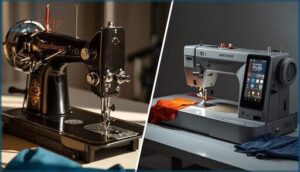
You’ll find that mechanical and computerised machines represent fundamentally different approaches to dressmaking. Mechanical models deliver straightforward operation through manual gears and dials, while computerised units use microprocessor controls for stitch precision and automated adjustments. Your sewing machine selection depends on three critical factors:
- User interface complexity – mechanical dials versus LCD screens with graphical previews
- Machine durability – fewer electronic controls mean reduced failure points in mechanical units
- Maintenance costs – computerised models require software updates; mechanical machines need regular oiling
Overlock and Serger Machines
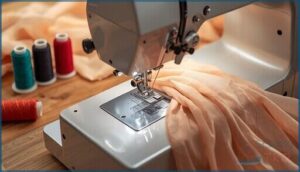
Serger threads and differential feed transform your garment construction workflow—you’ll trim, stitch, and finish edges in one pass with industrial-grade performance.
Overlock stitches, from two to five thread configurations, handle everything from delicate rolled hems to heavy-duty seam finishing.
Your overlocker’s thread tension adjustments control stitch formation across woven and knit fabrics, while sewing speed and serging precision deliver professional results that standard sewing machines can’t match.
Combination Sewing and Embroidery Machines
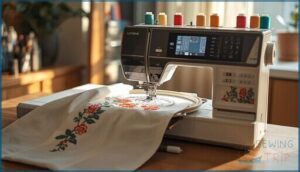
You’ll merge dressmaking and embroidery workflows when dual functionality machines deliver built-in design libraries with hundreds of patterns for monograms and decorative motifs. Machine integration through USB or wireless design customization lets you import files in DST and PES formats, while automatic needle threader and thread management systems advance color changes during embroidery.
Embroidery software provides real-time design preview, and tactile touchscreen controls adjust stitch density across sewing techniques—from utility construction to precision embellishment work.
Factors to Consider Before Buying

Before you invest in a sewing machine for dressmaking, you’ll need to match the equipment to your specific situation and long-term goals. The right machine depends on where you’re in your sewing journey, what you’re willing to spend, and how the equipment fits into your workspace.
Here’s what you need to evaluate before making your purchase.
Sewing Skill Level
Your sewing skill level determines the features you’ll need most. Beginner sewers master straight stitches and basic seam techniques on woven fabrics, requiring automatic needle threaders and simplified controls.
Intermediate crafters handle zigzag stitching and fabric handling across diverse materials, benefiting from adjustable presser foot pressure.
Expert dressmakers execute pattern modification and garment fitting with precision, demanding computerized stitch customization and professional-grade tension management for complex sewing techniques.
Budget and Price Range
Your budget determines your dressmaking control. Entry-level machines like the Brother XM2701 start around 100 to 200 USD, delivering essential features and reliability for basic garment construction.
Mid-range models (250 to 600 USD) offer enhanced build quality and expanded stitch options. Price comparison reveals holiday discount options can slash costs by 20 to 40 percent.
Savings strategies include evaluating cost analysis against long-term durability rather than chasing features you won’t use.
Machine Size and Portability
Once you’ve locked down your budget, you’ll need workspace reality to match your ambitions. Compact Designs like the Brother XM2701 measure 12 to 16 inches wide, while Portable Machines generally weigh 6 to 12 pounds for one-handed transport.
Consider these Space Savings strategies:
- Desktop models under 15 pounds lift easily onto folding tables
- Aluminum frame construction reduces Weight Factors without sacrificing stability
- Grips and protective cases transform any Sewing Machine into Portable Sewing Solutions
Warranty and Support
Beyond the bells and whistles, you’ll want one to three years of Warranty Claims protection covering defects—most manufacturers stand behind their Sewing Machine with free parts and labor through authorized Repair Options.
Customer Service matters when threads tangle: look for brands offering multiple Support Channels including phone, email, and chat, with response times under 72 hours.
Extended Coverage adds years of peace and protects your investment.
Essential Accessories for Dressmaking
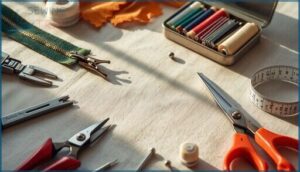
You’ll need more than just a great machine to master dressmaking—the right accessories transform your workflow from frustrating to efficient. Professional results demand specialty feet for zippers and hems, precise needle selections for different fabrics, and workspace upgrades that prevent fatigue during long sessions.
Here’s what belongs in your essential toolkit before you tackle your first garment.
Specialty Presser Feet
You’ll discover new garment construction possibilities with specialty presser feet designed for sophisticated sewing techniques. Beading techniques become manageable with beading feet that guide sequins along seam lines, while roller feet handle leather without creasing.
Invisible zipper inserts demand dedicated zipper feet for professional closures, and edge guides maintain perfect topstitch alignment.
Walking and quilting feet control multiple fabric layers, essential tools when your dressmaking projects push beyond basic sewing patterns.
Needle Types and Sizes
Master fabric selection by matching needle types to your material—sharps cut through wovens while ballpoint tips glide across knits without snagging. Sewing machine needles range from size 60 for silk to 110 for canvas, with your automatic needle threader accommodating various shaft diameters.
- Universal needles in sizes 70-90 handle cotton and linen for everyday dressmaking
- Twin needle sets create professional parallel topstitching on hems and decorative seams
- Denim needles with reinforced shanks penetrate multiple layers without deflection during complex sewing techniques
Bobbins and Thread Sets
You’ll find drop-in bobbins in two essential materials—clear plastic for monitoring thread supply and stainless steel for high-speed garment construction.
Stock your sewing machine with matched thread sets covering 1000 to 5000 meters in polyester blends for stretch fabrics or cotton for natural fibers.
Master even winding techniques to prevent jam-resistant drop-in bobbin failures during critical dressmaking seams.
Extension Tables and Lighting
You’ll need extension tables that add two to four leaf sections for expanded workspace optimization during garment construction and pattern cutting.
Install task illumination delivering 450 to 800 lumens with LED lamps featuring CRI ratings above 80 to reveal true fabric colors.
Clip-on and clamp-on table lighting options attach directly to your sewing machine or extension types without consuming valuable desk space, improving sewing ergonomics for dressmaking projects.
Comparing Top Sewing Machine Brands
Two brands dominate the dressmaking machine market with distinct approaches to construction quality and feature integration. Singer delivers sturdy mechanical systems with straightforward controls, while Brother emphasizes computerized precision and stitch versatility.
Understanding each manufacturer’s core strengths and support infrastructure will directly impact your long-term satisfaction with whichever model you select.
Singer Brand Overview
Singer’s legacy stretches back to 1851, when Isaac Merritt Singer revolutionized home sewing in the United States. You’ll recognize the Singer trademark worldwide—it’s become synonymous with accessible dressmaking innovation.
The brand delivers consistent product quality across models like the Singer 4423 and Singer Heavy Duty SM024, backed by global presence through authorized dealers and customer support networks that keep your sewing machine running smoothly for years.
- Brand History: Founded 1851, establishing groundbreaking innovation trends
- Product Quality: Professional-grade construction in heavy duty models
- Customer Support: Authorized service networks across multiple countries
- Global Presence: Recognized trademark with extensive dealer access
Brother Brand Overview
Brother launched in Japan over a century ago, and you’ll find that At your side motto reflected in every Brother CS7000X, Brother GX37, and Brother CS5055 sewing machine for dressmaking.
The brand’s corporate values center on product innovation through proprietary technologies—you’ll notice sophisticated stitching features and intuitive interfaces across models.
Global presence means fast access to customer support networks and spare parts, keeping your dressmaking workflow uninterrupted when deadlines approach.
Brand Reliability and Support
Warranty terms spanning 2 to 3 years on mechanical failures and 1 to 2 years on electrical components protect your investment in any sewing machine for dressmaking.
You’ll access multi-channel customer service through phone, email, and live chat with response times under 24 hours.
Authorized repair options and technical support networks across major regions guarantee your industrial sewing machines stay production-ready, building the brand loyalty that keeps professional seamstresses returning for sewing machine reviews and maintenance guidance.
Maintenance Tips for Dressmaking Machines
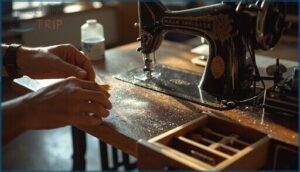
You’ll extend your machine’s lifespan by decades with consistent maintenance—most mechanical failures trace back to lint buildup and improper lubrication.
The difference between a $500 machine that lasts five years and one that delivers 20+ years of professional-grade performance comes down to three fundamental practices. Master these maintenance essentials and you’ll maintain consistent stitch quality while avoiding costly repairs.
Regular Cleaning and Oiling
You’ll extend your machine’s lifespan dramatically by establishing a cleaning schedule every 8 to 10 hours of sewing. Lint removal from feed dogs and the bobbin case prevents skipped stitches that derail your workflow. Machine lubrication requires just one drop of approved oil on metal pivot points—never on belts. This sewing machine maintenance routine transforms reliability:
- Brush dust from the needle plate after each project
- Apply oil application to moving parts per your manual
- Vacuum monthly to minimize dirt ingress
- Store covered to reduce airborne lint accumulation
Proper Threading and Bobbin Winding
Misrouted thread causes 80% of stitch failures you’ll encounter during garment construction. Follow your machine’s numbered guides from spool pin to needle eye—raising the presser foot first so tension discs open properly.
For bobbin winding, route thread through the tension disc to guarantee even distribution; overfilling creates puckering on silks. Drop-in bobbins must unwind left, while front-loading cases require counterclockwise threading for the shuttle to catch correctly.
Storage and Longevity Practices
Climate Control keeps your sewing machine running for decades—you’ll maintain 40 to 50 percent humidity with a dehumidifier to prevent rust on metal components. Cover your equipment with breathable fabric for Dust Prevention between garment construction sessions, storing it away from heating vents that warp lint screens.
Schedule professional Machine Maintenance annually, oil moving parts every six months, and keep fabrics in airtight containers for proper Fabric Storage that protects your dressmaking investment.
Top 9 Sewing Machines for Dressmaking
You’ve narrowed down your requirements, weighed features against your budget, and now you’re ready to see which machines actually deliver for dressmaking.
The following nine models span beginner-friendly portables to heavy-duty workhorses, each offering distinct advantages depending on your project complexity and skill level.
You’ll find precise specifications and standout features that matter when you’re constructing garments from pattern to finished seam.
1. Brother Lightweight Sewing Machine
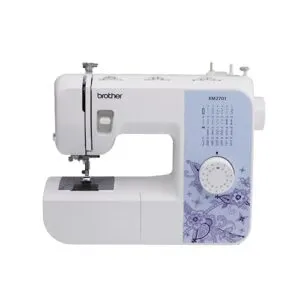
You’ll find the Brother XM2701S delivers 27 stitches, an automatic needle threader, and a jam-resistant drop-in bobbin—making it a straightforward workhorse for dressmaking projects. Weighing just 12.6 pounds, you can move this machine between cutting tables and sewing stations without breaking a sweat.
The free arm lets you tackle cuffs and sleeves with precision, while six included presser feet handle everything from zippers to buttonholes.
At 120 volts, it’s designed for US use and ships with LED lighting for accurate stitch placement on dark fabrics.
| Best For | Beginners and intermediate sewers looking for a lightweight, versatile machine that handles everyday projects like garments, home decor, and basic alterations without taking up much space. |
|---|---|
| Built-in Stitches | 27 |
| Needle Threader | Automatic |
| Bobbin Type | Drop-in top |
| Weight | 12.6 lbs |
| Buttonhole Styles | One-step automatic |
| Frame Material | Metal |
| Additional Features |
|
- 27 built-in stitches and automatic needle threader make setup quick and give you plenty of creative options for different fabrics
- Free arm design and included presser feet let you sew sleeves, cuffs, and buttonholes with professional-looking results
- Lightweight at 12.6 pounds, so you can easily move it around or store it when you’re done
- Only works with 120-volt US outlets, and using it elsewhere voids the warranty
- The spool pin can feel flimsy and may break with regular use
- Not built for heavy-duty projects like thick upholstery or multiple layers of denim
2. Singer Heavy Duty Sewing Machine
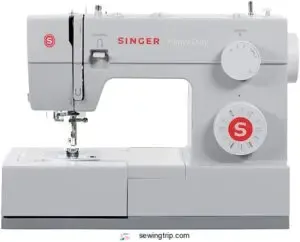
You’ll get 97 stitch applications and a metal interior frame that stays rock-solid when you’re pushing through heavyweight denim or canvas. This machine punches through multiple layers at 1,100 stitches per minute, backed by a high-torque motor that won’t bog down mid-seam.
The stainless steel bed plate feeds fabric smoothly, while the automatic needle threader and adjustable presser foot pressure let you switch from chiffon to upholstery without fighting your equipment.
At 14.6 pounds with a free arm design, you’ll handle cuffs and hems with professional control.
| Best For | Home sewers who need a reliable workhorse for heavy fabrics like denim, canvas, and upholstery without spending thousands on an industrial machine. |
|---|---|
| Built-in Stitches | 97 |
| Needle Threader | Automatic |
| Bobbin Type | Top drop-in |
| Weight | 14.6 lbs |
| Buttonhole Styles | Multiple styles |
| Frame Material | Heavy-duty metal |
| Additional Features |
|
- Handles thick materials and multiple layers at high speed (1,100 stitches/minute) thanks to the heavy-duty metal frame and high-torque motor
- Automatic needle threader and 97 stitch options make it versatile enough for everything from garment repair to home decor projects
- Free arm design and adjustable presser foot pressure give you control on detailed work like hems and cuffs
- The instruction manual lacks detail, which can frustrate beginners trying to learn advanced techniques
- Some included accessories (like the seam ripper) are low quality and may need replacing
- Can be noisy during operation and may require tension adjustments when switching between different fabric weights
3. Singer Quantum Stylist Sewing Machine
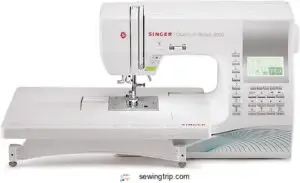
You’ll command 600 built-in stitches and 1,172 stitch applications with this computerized powerhouse, priced at $549.99. The color touch screen navigates stitch selection faster than manual dials, while 13 automatic one-step buttonhole styles deliver couture-level closures every time. Mirror imaging and stitch elongation let you customize patterns on the fly.
At 14.6 pounds with an extended workspace and free arm access, you’ll construct everything from custom-fitted blazers to evening gowns with professional precision and zero compromise.
| Best For | Sewers who want premium features at a mid-range price—whether you’re quilting intricate patterns, designing custom garments, or tackling home décor projects with professional-looking results. |
|---|---|
| Built-in Stitches | 600 |
| Needle Threader | Automatic |
| Bobbin Type | Top drop-in |
| Weight | 14.6 lbs |
| Buttonhole Styles | 13 automatic styles |
| Frame Material | Metal |
| Additional Features |
|
- 600 stitches and 1,172 applications give you endless creative options for any project type
- Automatic needle threader and top drop-in bobbin save time and eliminate frustrating setup tasks
- 13 one-step buttonholes and built-in lettering let you add polished, custom details without extra work
- The needle threader can be tricky to use despite being automatic
- Limited throat space might frustrate quilters working on larger projects
- The learning curve requires reading the manual to unlock all 600 stitches and features
4. SINGER Start 1304 Beginner Portable Sewing Machine
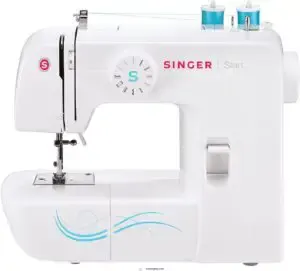
You’ll break free from complicated features with this simplified workhorse priced under $100. Six built-in stitches—straight, zigzag, satin, blind hem, scallop, and a four-step buttonhole function—cover everything you need for garment construction without digital overload.
Weighing just 11.5 pounds with free arm access, you’ll tackle sleeves and cuffs on any workspace. The preset stitch width and length eliminate guesswork, while 350-400 stitches per minute keep production moving.
A 25-year limited warranty backs this portable machine, designed for confident beginners ready to own their craft.
| Best For | Beginners and hobbyists who want a straightforward, reliable machine for basic sewing projects without spending a fortune. |
|---|---|
| Built-in Stitches | 57 |
| Needle Threader | Manual |
| Bobbin Type | Class 15 |
| Weight | 11.5 lbs |
| Buttonhole Styles | 4-step |
| Frame Material | Standard |
| Additional Features |
|
- Six essential stitches handle most common projects, from hemming to buttonholes, without overwhelming new users
- Lightweight at 11.5 pounds with a free arm design makes it easy to move around and work on sleeves or pant legs
- 25-year warranty and sub-$100 price point offer serious value for anyone starting their sewing journey
- Limited to six stitches means advanced sewers will outgrow it quickly
- No automatic threading or modern features that make setup faster
- Not built for heavy fabrics or commercial-level workloads
5. Brother Sewing Embroidery Machine Combo
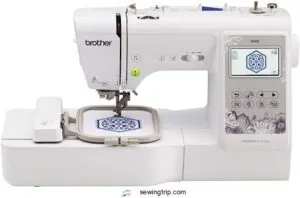
You’ll gain dual-function mastery with this powerhouse that stitches and embroiders in one 26.2-pound frame. The 103 built-in stitches include 10 auto-size buttonhole styles, while 80 embroidery designs and 6 lettering fonts transform garments into signature pieces through the 4″ x 4″ embroidery field.
A 3.2″ LCD touchscreen controls wireless design transfer and automatic thread cutting. Seven included presser feet handle denim to polyester at up to 850 stitches per minute.
The metal frame construction delivers rigid stability for precision work—essential for embellishing custom dressmaking projects with monograms and decorative elements.
| Best For | Crafters who want to combine everyday sewing with personalized embroidery work, especially those creating custom garments, monograms, and decorative projects without needing a huge embroidery area. |
|---|---|
| Built-in Stitches | 110 |
| Needle Threader | Built-in |
| Bobbin Type | Top drop-in |
| Weight | 17.6 lbs |
| Buttonhole Styles | Multiple styles |
| Frame Material | Full metal |
| Additional Features |
|
- Handles both basic sewing and embroidery in one machine, so you don’t need separate equipment for different projects
- Touchscreen makes it easy to navigate features, and the automatic needle threader saves time and frustration
- Works well with different fabrics from lightweight cotton to heavier denim, giving you flexibility for various projects
- The 4″ x 4″ embroidery area limits you to smaller designs, which won’t work if you want to embroider larger items
- At over 26 pounds, it’s bulky and takes up considerable space for storage
- Requires regular cleaning and maintenance to keep it running smoothly, which adds extra upkeep time
6. Brother Sewing And Quilting Machine
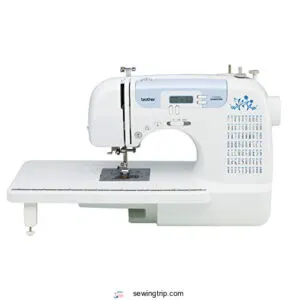
You’ll conquer large-scale projects with this machine’s MuVit dual feed system that prevents fabric shift during garment construction. The 70 built-in stitches range from utility seams to decorative appliqués, with stitch lengths adjustable from 0 to 6 mm for precision control.
An LCD screen displays settings while automatic needle threading and drop feed for free motion work simplify your workflow.
The included wide extension table accommodates oversized pattern pieces, and 10 presser feet handle everything from invisible zippers to edge finishing on professional garments.
| Best For | Beginners and experienced sewists who need a versatile machine for garments, quilts, and decorative projects without breaking the bank. |
|---|---|
| Built-in Stitches | 103 |
| Needle Threader | Automatic |
| Bobbin Type | Drop-in top |
| Weight | 26.2 lbs |
| Buttonhole Styles | 10 auto-size styles |
| Frame Material | Metal |
| Additional Features |
|
- 70 built-in stitches with adjustable lengths plus an automatic needle threader make it easy to tackle everything from basic seams to complex decorative work
- Wide extension table and 10 included presser feet give you the workspace and tools for large quilting projects right out of the box
- Free arm capability and drop feed mechanism let you handle tricky details like cuffs and sleeves or switch to free-motion quilting
- Heavy plastic construction raises questions about how well it’ll hold up over years of regular use
- Included hard case feels flimsy and doesn’t offer much protection for a machine at this price point
- Can be noisy during operation, and you’ll need to buy thread and needles separately to get started
7. Brother Project Runway Sewing Machine
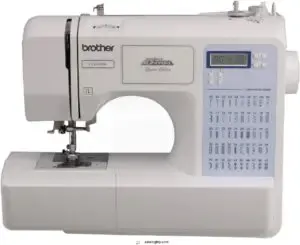
This machine delivers 50 built-in stitches with an LCD screen that puts stitch selection and preview at your fingertips. Seven included presser feet handle zippers, decorative stitching, and edge finishing across your dressmaking projects.
You’ll breeze through setup with the automatic needle threader, while the drop-in top bobbin maintains consistent tension throughout garment construction. The one-step buttonhole function automatically sizes closures for professional results.
At 14.75 pounds with dimensions of 10.75″D x 19.48″W x 15.96″H, you’ll manage transport without strain.
| Best For | Beginners and intermediate sewers who want a reliable machine for everything from basic garments to quilting and decorative projects. |
|---|---|
| Built-in Stitches | 70 |
| Needle Threader | Automatic |
| Bobbin Type | Drop-in top |
| Weight | 17.66 lbs |
| Buttonhole Styles | Multiple styles |
| Frame Material | Metal and plastic |
| Additional Features |
|
- 50 built-in stitches with LCD screen make it easy to select and preview patterns for creative projects
- Automatic needle threader and drop-in bobbin simplify setup so you spend more time sewing
- One-step buttonhole function creates professional-looking closures automatically
- Automatic threader can be tricky to align properly
- Requires careful maintenance to prevent rust and damage over time
- Metal bobbins aren’t compatible, limiting your bobbin options
8. Brother Heavy Duty Sewing Machine
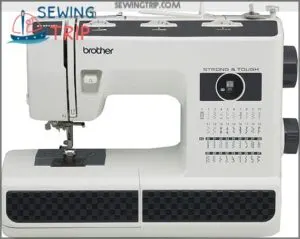
You’ll power through denim, canvas, and leather with the Brother ST371HD‘s high torque motor and direct drive system. This 18.4-pound workhorse features a metal frame that eliminates vibration during high-speed sewing, while the metal needle plate accelerates thread pickup on thick fabric layers.
The adjustable presser foot pressure handles everything from silk to multiple denim layers. You’ll manage buttonholes in one step, adjust stitch length for precise seams, and monitor thread supply through the clear bobbin cover. The free arm design streamlines cuff and sleeve construction.
| Best For | Sewers who work with heavy fabrics like denim, canvas, and leather and need a reliable machine that can handle high-volume projects without slowing down. |
|---|---|
| Built-in Stitches | 50 |
| Needle Threader | Automatic |
| Bobbin Type | Drop-in top |
| Weight | 14.75 lbs |
| Buttonhole Styles | 5 auto-size |
| Frame Material | Metal |
| Additional Features |
|
- High torque motor and metal frame deliver consistent stitching through thick fabric layers without vibration
- Adjustable presser foot pressure lets you switch between delicate silk and heavy denim easily
- Metal needle plate speeds up thread pickup, making your workflow faster on tough materials
- Needs occasional oiling to keep running smoothly and prevent squeaking
- As a refurbished product, you might get a unit with missing parts or defects (though Amazon’s Renewed Guarantee covers replacements)
- Heavier than standard machines at 18.4 pounds, which could make it harder to move around frequently
9. Singer Curvy Sewing Machine
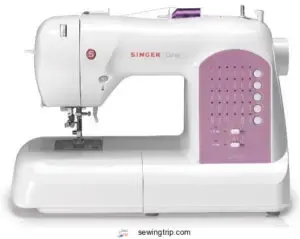
With 225 built-in stitches and a SwiftSmart threading system, the Singer Curvy delivers the versatility you need for fashion construction and decorative detailing.
The metal frame construction eliminates vibration during high-speed work, while the LCD display presents stitch recommendations and width adjustments at a glance.
You’ll customize seam allowances with adjustable stitch length controls, execute multiple buttonhole styles for garment openings, and utilize the free arm design for precise sleeve and cuff finishing on custom-fitted pieces.
| Best For | Beginners and hobbyists who want a reliable, easy-to-use machine for basic sewing projects and quilting without overwhelming features. |
|---|---|
| Built-in Stitches | 37 |
| Needle Threader | Manual |
| Bobbin Type | Standard |
| Weight | 18.4 lbs |
| Buttonhole Styles | Multiple styles |
| Frame Material | Metal chassis |
| Additional Features |
|
- SwiftSmart threading system and automatic needle threader make setup quick and frustration-free
- 30 built-in stitches with adjustable length and width give you enough variety for most common projects
- 25-year limited warranty and extra-high presser foot lifter make it a solid long-term investment for quilting
- Only 30 stitches compared to higher-end models with 200 options limits creative possibilities
- Computerized parts may fail over time and can be expensive to repair
- Struggles with very thick or heavy materials, so it’s not ideal for upholstery or dense fabrics
Choosing The Best Machine for Your Needs
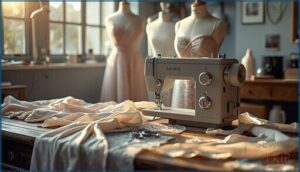
You’ve narrowed down the features and specs—now it’s time to match the right machine to your actual sewing goals. The perfect dressmaking machine isn’t determined by price alone, but by how well its capabilities align with the garments you’ll construct and the long-term reliability you’ll need.
Here’s how to evaluate your final choice with the precision your projects deserve.
Matching Features to Dressmaking Projects
Your dressmaking projects demand fabric selection features that adapt tension and feed for woven versus knit materials. Stitch customization is essential, including adjustable length for darts and width for satin-stitch hems.
Presser foot control accommodates thick seams on coats, while an automatic needle threader reduces strain with fine needles.
Buttonhole options with sensing technology guarantee consistent sizing. Match these capabilities to your garment construction methods and sewing patterns and techniques for professional results.
Evaluating User Reviews and Ratings
Consistently, verified purchase reviews reveal real-world performance for dressmaking applications you can trust. Review analysis exposes rating systems that weigh fabric handling and stitch precision higher than generic feedback. User feedback detailing buttonhole consistency or tension control on knits guides your purchase decisions toward sewing equipment reviews that match your sewing ambitions.
- Prioritize detailed reviews mentioning specific sewing techniques and tips for garments
- Watch for review bias through clusters of identical phrasing across platforms
- Cross-reference ratings to identify recurring issues with bobbins or needle threading
Considering Long-Term Value
Ultimately, cost analysis extends beyond sticker price when you assess industrial-grade performance against your garment construction goals. Durability tests prove metal gear trains resist wear better than plastic assemblies, while warranty options spanning one to five years protect your sewing ambitions.
Maintenance costs average twenty to sixty dollars annually, and durable sewing machines hold twenty to forty percent resale values after five years—proving long-term value for serious dressmaking.
Frequently Asked Questions (FAQs)
What is the number one sewing machine?
The Brother CS7000X consistently tops machine comparisons in sewing community reviews, earning its number one ranking through industrial-grade performance, automatic needle threader, and top-rated features that transform how you’ll approach garment construction from start to finish.
What sewing machines do they use on Dress the Nation?
You’ll find commercial grade models from Singer and Brother on set, including computerized machines with zigzag capabilities and overlock units for seam finishing—delivering industrial-grade performance for rapid garment construction under studio conditions.
What is the best dressmaking sewing machine?
Which sewing machine will truly transform your garment construction? The Brother CS7000X delivers remarkable performance metrics and user experience for dressmaking through excellent fabric handling, extensive features, and impressive investment value for diverse project suitability.
What is a dressmaking sewing machine?
A dressmaking sewing machine forms stitches to join fabric for garments using a needle and bobbin thread system. You’ll handle fabric through presser feet and feed dogs for precise seam construction.
What is the best budget sewing machine for clothes making?
You’ll find machines under 300 dollars with 60 plus built in stitches that handle basic garments reliably. Look for automatic needle threaders and free arms to simplify your early projects.
How to choose a sewing machine for making clothes?
Start by matching your skill level to machine complexity, then evaluate stitch variety and Fabric Compatibility.
Consider Thread Tension controls, Sewing Speed settings, and Machine Durability alongside warranty coverage before committing to your investment.
What is the best heavy duty sewing machine for clothes?
You’ll command thick denim and canvas with a Singer Heavy Duty model—its 1,100 stitches per minute motor and cast metal frame deliver industrial-grade performance for garment construction techniques without thread tension compromises.
What makes a good sewing machine?
You’ll need machine reliability paired with sewing efficiency across multiple fabrics. Look for automatic needle threader convenience, jam-resistant drop-in bobbin systems, straightforward user interface design, and reasonable maintenance costs for long-term dressmaking success.
How much workspace is needed for dressmaking?
You’ll command at least 140 square feet: a 60-by-60-inch cutting area, 36-by-24-inch sewing station, 3-by-3-foot ironing zone, plus fabric storage and clear walking corridors for efficient dressmaking workflow.
Can sewing machines handle specialty fabrics?
Yes, with proper needle selection and stitch optimization, you’ll handle denim, silk, knits, and leather using specialty feet, tension control adjustments, and appropriate thread choice.
Fabric manipulation techniques guarantee professional results across diverse fabric types.
Conclusion
Precision performance, purposeful purchasing—you’ve navigated the mechanical specifications that separate frustrating fabric wrestling from confident couture construction. Armed with throat plate measurements, presser foot pressure data, and stitch formation mechanics, you’ll bypass the 200-stitch marketing gimmicks and invest in the best sewing machine for dressmaking that actually delivers on French seams and invisible zippers.
Your garment quality now depends on informed selection, not advertised features. Choose the mechanics. Build the wardrobe.