This site is supported by our readers. We may earn a commission, at no cost to you, if you purchase through links.
wrong embroidery machine doesn’t just waste money—it kills projects before they start.
A machine with a 4×4 hoop sounds fine until you’re trying to stitch a jacket back panel and re-hooping it six times.
The gap between entry-level models like the Brother PE535 at $400 and high-end units like the NQ1700E at $2,299 isn’t just price—it’s speed, automation, and what you can realistically create.
Combo machines give you flexibility; dedicated embroidery machines give you focus.
Knowing fits your work changes everything.
nine computerized sewing machines for embroidery cover the full range.
Table Of Contents
- Key Takeaways
- Choosing The Right Embroidery Machine
- Key Features for Better Embroidery
- Top 9 Machines Reviewed
- 1. Sew Tech Brother Embroidery Hoops
- 2. Brother PE900 Wireless Embroidery Machine
- 3. Brother NQ1700E Embroidery Machine
- 4. Brother PE545 Wireless Embroidery Machine
- 5. EverSewn Sparrow X2 Sewing Embroidery Machine
- 6. Brother SE600 Sewing Embroidery Machine
- 7. Brother SE700 Wireless Sewing Embroidery Machine
- 8. Brother SE2000 Sewing Embroidery Machine
- 9. Janome Memory Craft Embroidery Machine
- Embroidery Workflow and Project Fit
- Setup, Maintenance, and Troubleshooting
- Frequently Asked Questions (FAQs)
- Conclusion
Key Takeaways
- Hoop size is the decision that most buyers underestimate — a 4×4 field locks you out of jacket backs and large designs, so know your project’s scale before you buy.
- Combo machines save space and money, but if embroidery is your main focus, a dedicated machine gives you faster speeds and a cleaner workflow with less hassle between tasks.
- Automation features like automatic thread trimming, needle threading, and color sort aren’t just conveniences — they’re the difference between a smooth session and a frustrating one.
- Your budget ceiling should match your output goals: the $400 PE535 is solid for monograms and gifts, but a home business pushing volume needs the speed and hoop size that only mid-to-high-end machines can deliver.
Choosing The Right Embroidery Machine
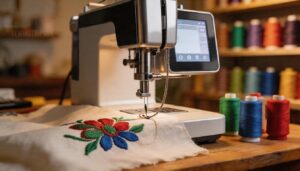
Not every embroidery machine is built for the same person, project, or budget. Before you land on a model, a few key factors will make or break how much you actually enjoy using it.
Whether you’re just starting out or shopping smarter, this beginner’s guide to choosing the right embroidery machine breaks down exactly what those factors look like in practice.
Here’s what to look at first.
Combo Vs Embroidery-only Machines
Combo machines handle both sewing and embroidery in one footprint — solid cost efficiency and smart space utilization for home creators. mode switching adds steps every time you shift tasks.
Embroidery-only machines skip that entirely, offering specialized speed up to 1,200 stitches per minute and a simpler workflow. If embroidery is your main focus, the learning curve drops fast with a dedicated machine.
Separate machines provide simultaneous operation capability for continuous workflow.
Hoop Size and Embroidery Area
Once you’ve settled your machine type, hoop size becomes your next real decision. The stitch field dimensions tell you exactly how large your design can be — and that number matters more than the hoop’s outer frame.
A 4×4 hoop gives you roughly 3.9×3.9 inches of maximum fabric area, not a full four.
Here’s what shapes your choice:
- Hoop shape variations affect project fit — square hoops suit quilt blocks; rectangular ones work better for garment panels
- Design fit guidelines say use the smallest hoop that fits your design for cleaner tension
- Large embroidery area machines like the Baby Lock Altair 2 support up to 9.5×14 inches, cutting re-hooping dramatically
- Hoop compatibility varies by brand, so always confirm your machine accepts the hoop size you need
Hoop size impact is simple: bigger area, bigger creative range.
Built-in Designs and Lettering Fonts
Your hoop size shapes what fits — now your built-in design library shapes what’s possible right away. Font variety and built-in fonts vary widely: the Singer Legacy SE300 leads combo machines with 200 designs and 6 fonts, while the Baby Lock Altair 2 packs 534 designs and 30 fonts.
Monogramming and lettering options are enhanced by specialty fonts, font editing controls, and font compatibility with TrueType files for custom work.
Stitch Speed and Automation Features
Once your design library is set, speed becomes your next lever. Most machines top out around 650 SPM — the Brother PE900 hits that ceiling — while the Janome MB‑7 pushes 800 SPM. However, raw maximum embroidery speed isn’t everything.
Features like Adaptive Speed Adjustment ensure quality by slowing down for intricate details, maintaining Speed Quality Balance. Combined with automatic thread trimming, an automatic needle threader, and Color Sort Optimization, these efficiencies streamline your workflow, making it nearly self-sufficient.
Weight, Portability, and Price Range
The Brother SE600 weighs just 11.82 lbs — a real win for lightweight options and portability benchmarks when transporting it to classes. The SE2000 weighs 22 lbs, sacrificing portability for stability.
For budget-friendly price points, the PE535 starts around $400, making it one of the most affordable entry-level models with a solid price-performance ratio.
Key Features for Better Embroidery
Once you’ve narrowed down machine type and hoop size, the next thing to look at is how the machine actually works day to day.
Some features sound nice on paper, but make a real difference once you’re mid-project. Here’s what to pay attention to before you buy.
Touchscreen Controls and On-screen Editing
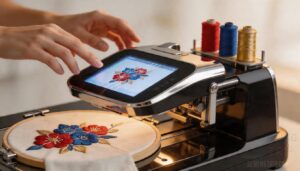
Your LCD touchscreen is basically your command center — and the best machines make it feel that way. Touchscreen LCD embroidery machines like the Brother NQ1700E and PE900 let you edit right on screen with effortless Resize Gestures, Rotation Controls, and Color Swatch Preview before a single stitch drops.
- Pattern Layering combines motifs and text on one canvas
- Touchscreen Calibration keeps your taps precise over time
- Real-time previews on the LCD interface show edits instantly
USB, Wi‑Fi, and Bluetooth Connectivity
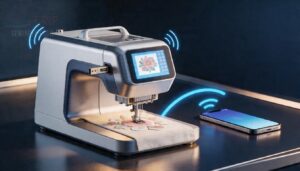
Getting designs into your machine doesn’t have to slow you down.
USB design transfer is your most reliable option — no network, no Signal Interference, just plug and go.
Wi-Fi wireless connectivity boosts Transfer Speed when your machine and computer share the same network.
Bluetooth capabilities handle Mobile App Control beautifully on high-end units.
For Network Security and convenience, having all three options means you’re never stuck.
Automatic Needle Threading and Thread Trimming
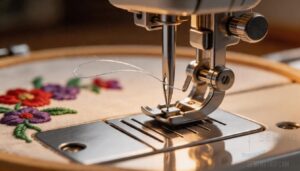
Threading by hand eats time — and frayed ends aren’t far behind. The automatic needle threader solves this with Needle Positioning at the top, Hook Alignment through the eye, and Thread Path Optimization that guides every pass cleanly.
Add automatic jump stitch trimming and an internal Trimming Mechanism handling both threads at once, and your Time Savings per project add up fast.
- Automatic needle threader: eliminates manual eye-feeding entirely
- Automatic thread cutter: replaces scissors between color changes
- Automatic bobbin winding: keeps momentum going mid-project
Custom Design Import and File Compatibility
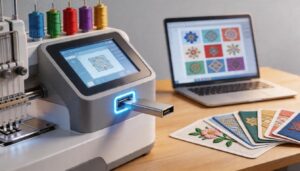
Your design is only as good as the file your machine can read. Format mismatches are where most projects stall.
| Format | Best For | Key Limitation |
|---|---|---|
| PES | Brother machines | Brand-specific |
| DST | Cross-brand transfer | Color Mapping Issues |
| JEF | Janome machines | Limited elsewhere |
Nail your USB design transfer workflow — FAT32 Drive Limits, Design Naming Conventions, and Software Compatibility matter more than people realize.
Thread Management and Color-change Efficiency
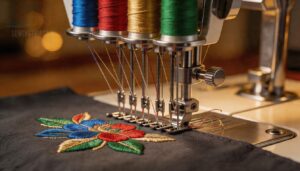
Color changes are where embroidery projects live or die. Multi-needle Cartridges let machines cycle through colors automatically, slashing downtime by up to 70%. On-demand Dyeing takes it further, blending gradients from a single spool. Meanwhile, Intelligent Tension Management and thread break detection keep stitches clean across every block.
Multi-needle machines slash color-change downtime by 70%, keeping your embroidery workflow nearly uninterrupted
- Color Queue Logic minimizes stop-and-swap interruptions
- Automated Thread Trimming cuts tails to 1–3 mm consistently
- Automatic needle threading and thread stand setup reduce operator fatigue
Top 9 Machines Reviewed
There’s no shortage of embroidery machines out there, but these nine actually earn their spot. Each one brings something different to the table — whether that’s a bigger hoop, smarter connectivity, or better automation.
what made the cut.
1. Sew Tech Brother Embroidery Hoops
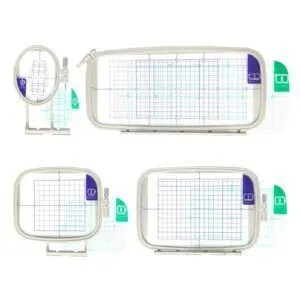
Four hoops in one box — that’s exactly what the Sew Tech Brother Embroidery Hoop Set gives you.
Priced at $29.39, it covers sizes from 4×4 up to 5×7, fitting popular Brother machines like the SE1900, SE2000, and PE900.
The magnetic frame holds fabric flat without the usual screw-ring pressure, which means less hoop burn and less hand strain.
Clear grid markings help you nail design placement every time.
It’s a smart, low-cost upgrade that keeps your setup tight and your results clean.
| Best For | Home sewers and hobbyists who own compatible Brother or Babylock machines and want an affordable way to expand their hoop options without buying separate OEM accessories. |
|---|---|
| Embroidery Designs | Compatible with machine designs |
| Touchscreen Display | No |
| Automatic Needle Threader | No |
| USB Connectivity | No |
| Embroidery Hoop Included | Yes |
| Warranty | No |
| Additional Features |
|
- Four hoops in one box for $29.39 is genuinely great value — covers most everyday embroidery sizes
- The magnetic attachment system takes pressure off your hands, which is a real win if you sew for long stretches
- Grid markings make centering designs way easier, especially on multi-color or detailed projects
- Only works with specific listed models, so double-check compatibility before buying
- Plastic construction may not hold up as well as metal hoops under heavy, frequent use
- The magnetic "click" when attaching can be easy to miss, which could trip up first-time users
2. Brother PE900 Wireless Embroidery Machine
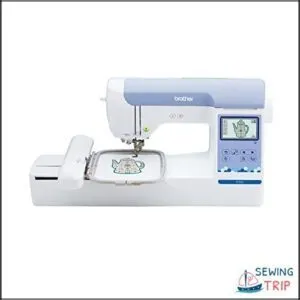
If hoops are the foundation, the Brother PE900 is where the real work begins.
This embroidery-only machine runs at 650 stitches per minute and packs 193 built-in designs across a 5×7-inch field — plenty of room for monograms, border patterns, and custom gifts. Wi‑Fi and the Artspira app mean you can push designs wirelessly from your phone or PC. The 3.7‑inch touchscreen lets you resize, rotate, and preview before a single stitch drops. At $1,179.99, it’s built for serious creators.
| Best For | Hobbyists and small-business owners who want a dedicated embroidery machine with wireless design transfer and a solid built-in library. |
|---|---|
| Embroidery Designs | 193 built-in |
| Touchscreen Display | 3.7-inch LCD |
| Automatic Needle Threader | Yes |
| USB Connectivity | Yes |
| Embroidery Hoop Included | Yes |
| Warranty | Limited (US only) |
| Additional Features |
|
- Wi-Fi and the Artspira app make sending designs from your phone or PC genuinely effortless
- Color Sort and automatic jump stitch trimming cut down on thread changes and wasted time
- The touchscreen lets you preview sizing and placement before committing a single stitch
- Embroidery only — you can’t use it for regular sewing, so it’s a single-purpose buy
- The 5×7-inch max hoop size can feel limiting if you’re working on larger designs
- Artspira’s digitizing library goes behind a paywall once you burn through the initial free designs
3. Brother NQ1700E Embroidery Machine
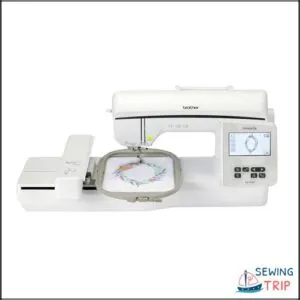
Want more room to create? The Brother NQ1700E steps it up with a 6×10-inch embroidery area — one of the largest you’ll find on a single-needle machine.
It stitches at 850 per minute, includes 258 built-in designs, and manages on-screen editing without extra software.
Wi-Fi transfer means no more fumbling with USB sticks.
Automatic thread cutting and tension control keep things moving.
At $2,299.99 and 35 pounds, it’s built for small-business owners who need serious output from a single station.
| Best For | Small-business owners and serious hobbyists who need professional embroidery output from a single-needle machine without juggling external software or USB drives. |
|---|---|
| Embroidery Designs | 258 built-in |
| Touchscreen Display | 4.85-inch LCD |
| Automatic Needle Threader | Yes |
| USB Connectivity | Yes |
| Embroidery Hoop Included | Yes |
| Warranty | Limited (US only) |
| Additional Features |
|
- Massive 6×10-inch embroidery area handles big projects like jackets, tote bags, and quilts that smaller machines can’t touch
- Built-in Wi-Fi and on-screen editing keep your workflow smooth — tweak designs and transfer files without leaving your workstation
- Automatic thread cutting and 850 spm stitch speed make high-volume orders a lot less exhausting
- At $2,299.99, it’s a serious investment that may be too steep for casual hobbyists
- Some users have reported mechanical issues like hoop sensor malfunctions, and quality can vary depending on where you buy it
- The BES Blue design app costs an extra ~$15/month, and at 35 pounds, this machine isn’t going anywhere once you set it down
4. Brother PE545 Wireless Embroidery Machine
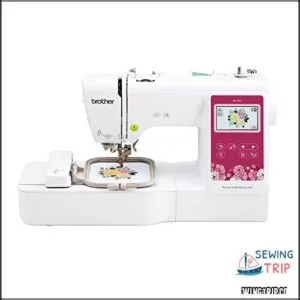
Not every project needs a powerhouse. The Brother PE545 is built for those just getting started — or those who want a clean, focused machine for smaller work.
At $499.99 and just over 14 pounds, it’s easy to move and easier on your budget.
You get 135 built-in designs, 10 fonts, a 3.7-inch touchscreen, and Wi‑Fi transfer through the Artspira app.
The 4×4 hoop keeps things compact, making it perfect for monograms, kids’ clothing, and custom gifts.
| Best For | Beginners, hobbyists, and small-business owners who want a simple, compact embroidery machine for monograms, gifts, and personalized items. |
|---|---|
| Embroidery Designs | 135 built-in |
| Touchscreen Display | 3.7-inch LCD |
| Automatic Needle Threader | Yes |
| USB Connectivity | Yes |
| Embroidery Hoop Included | Yes |
| Warranty | 25-year limited |
| Additional Features |
|
- Wi-Fi and the Artspira app make transferring designs fast and cable-free
- 135 built-in designs and a touchscreen make it easy to jump in without much setup
- Comes with a solid accessory kit, tutorial videos, and a 25-year warranty
- Embroidery only — you can’t use it for regular sewing
- The 4×4 hoop limits you to smaller projects; anything bigger needs multiple passes
- Only supports English and Japanese fonts, and some users have reported a noticeable learning curve
5. EverSewn Sparrow X2 Sewing Embroidery Machine
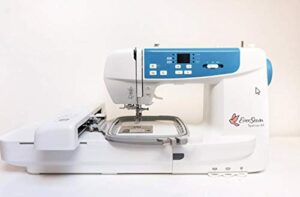
The EverSewn Sparrow X2 pulls double duty — it’s a full sewing machine and an embroidery machine in one.
At $499, you get a 4.75×7 inch embroidery area, 100+ built-in designs, and app control through your phone or tablet.
The EverSewn Pro app lets you customize designs and pick your starting stitch without touching a PC.
Auto thread trimming and jump‑stitch cutting keep your workflow moving.
Just note — Android users sometimes hit connectivity snags, so iOS usually plays nicer with this one.
| Best For | Hobbyists, quilters, and home sewers who want app-based embroidery control without investing in dedicated PC software. |
|---|---|
| Embroidery Designs | 100+ built-in |
| Touchscreen Display | No |
| Automatic Needle Threader | Yes |
| USB Connectivity | Yes |
| Embroidery Hoop Included | Yes |
| Warranty | No |
| Additional Features |
|
- App control via the EverSewn Pro app lets you design and place embroidery right from your phone — no computer needed.
- Auto thread trimming and jump-stitch cutting keep things moving so you’re not stopping every few minutes to snip threads.
- 100 built-in designs and 120 stitch patterns give you plenty to work with right out of the box.
- Android users often run into connectivity issues — iOS tends to be the safer bet for a smooth experience.
- The learning curve is steep, and getting tension settings wrong can lead to needle breakage or messy stitching.
- The needle threader is trickier than on competing machines, and you can’t adjust hoop position mid-project if something’s off.
6. Brother SE600 Sewing Embroidery Machine
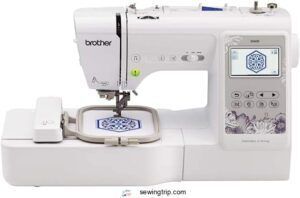
The Brother SE600 sits right in the sweet spot for hobbyists who want both sewing and embroidery without juggling two machines. At $589.99, you get 103 built-in stitches, 80 embroidery designs, and 6 lettering fonts — plenty for monograms and custom gifts.
The 3.2-inch touchscreen makes design selection quick and easy.
One honest limitation: the 4×4 inch hoop keeps you working small. But for home projects and learning the craft, it’s a solid, capable starter.
| Best For | Hobbyists and beginners who want an all-in-one sewing and embroidery machine for monograms, garment personalization, and home textile projects without breaking the bank. |
|---|---|
| Embroidery Designs | 80 built-in |
| Touchscreen Display | 3.2-inch LCD |
| Automatic Needle Threader | Yes |
| USB Connectivity | Yes |
| Embroidery Hoop Included | Yes |
| Warranty | US-only warranty |
| Additional Features |
|
- Automatic needle threader and drop-in bobbin make setup fast and frustration-free
- 103 built-in stitches plus 80 embroidery designs give you plenty to work with right out of the box
- USB port lets you import custom designs, so your creative options aren’t locked to what’s built in
- The 4×4 inch embroidery area is pretty limiting — larger designs just won’t fit
- It’s a big machine at over 26 lbs, so storage can be a real issue in smaller spaces
- Switching between sewing and embroidery mode requires manual steps, which slows down your workflow
7. Brother SE700 Wireless Sewing Embroidery Machine
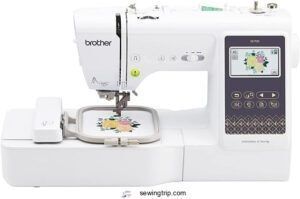
If you’re ready to level up from the SE600, the SE700 delivers a noticeable upgrade for just $579.99.
You get 135 built-in embroidery designs, 10 lettering fonts, and 103 sewing stitches — plus wireless LAN connectivity that lets you push designs straight from your PC or phone without touching a USB drive.
The Artspira app makes custom pattern creation genuinely fun.
Automatic threading and thread cutting keep your workflow moving, though the 4×4 inch hoop still keeps projects on the smaller side.
| Best For | Hobbyists and beginners who want to step into embroidery without a steep learning curve, plus crafters who love making personalized gifts, custom kids’ clothing, or small home-decor projects. |
|---|---|
| Embroidery Designs | 135 built-in |
| Touchscreen Display | 3.7-inch LCD |
| Automatic Needle Threader | Yes |
| USB Connectivity | Yes |
| Embroidery Hoop Included | Yes |
| Warranty | US-only warranty |
| Additional Features |
|
- Wireless design transfer via the Artspira app makes sending custom patterns fast and cable-free.
- Auto needle threading and auto thread cutting save time and frustration, especially for newer sewers.
- 135 built-in embroidery designs and 103 stitches give you plenty to work with right out of the box.
- The 4×4 inch embroidery hoop limits you to smaller designs — no large logos or full-size patterns.
- Narrow throat space makes it tough to maneuver wide fabrics or big quilt panels.
- Full wireless features depend on a stable Wi-Fi connection, and some users have run into bobbin tension issues early on.
8. Brother SE2000 Sewing Embroidery Machine
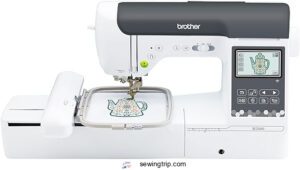
Think of the SE2000 as the SE700’s grown-up sibling — same wireless DNA, but with serious room to breathe.
You’re stepping up to a 5×7 inch embroidery field, 193 built-in designs, 13 fonts, and 241 sewing stitches, all for $1,356.09.
Color Sort and automatic Jump Stitch Trimming keep multi-color projects clean and efficient.
The 3.7-inch touchscreen lets you resize, rotate, and combine designs on the fly.
It’s a strong all-in-one for intermediate sewists who want fewer machines doing more work.
| Best For | Intermediate to advanced sewists who want sewing and embroidery in one machine without buying two separate setups. |
|---|---|
| Embroidery Designs | 193 built-in |
| Touchscreen Display | 3.7-inch LCD |
| Automatic Needle Threader | Yes |
| USB Connectivity | Yes |
| Embroidery Hoop Included | Yes |
| Warranty | 25-year limited |
| Additional Features |
|
- Big 5×7 embroidery field means fewer re-hoopings on larger projects
- Color Sort and auto Jump Stitch Trimming make multi-color embroidery way less tedious
- Wi-Fi and USB connectivity make transferring designs from your phone or PC simple
- At 38 lbs, it’s not going anywhere — transporting it is a real hassle
- The Artspira app sounds great until you hit the paywall (~$13/month for full features)
- The auto-threader lever is reportedly fragile if you don’t raise the needle all the way first
9. Janome Memory Craft Embroidery Machine
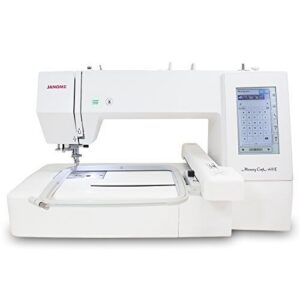
If you’re serious about going bigger, the Janome Memory Craft delivers a 7.9×7.9 inch hoop — the largest among single-needle combo machines. That means jackets, banners, and quilts without constant re‑hooping.
You get 160 built‑in designs, 6 monogram fonts, and on‑screen editing tools for resizing, rotating, and grouping motifs.
Speed adjusts from 400 to 860 stitches per minute, so delicate fabrics won’t suffer.
The catch? No Wi‑Fi, and only.jef files are natively supported. At $1,499, it rewards commitment over convenience.
| Best For | Serious hobbyists and small business owners who tackle large embroidery projects like jackets, quilts, or banners and want professional-level control without outsourcing. |
|---|---|
| Embroidery Designs | 160 built-in |
| Touchscreen Display | Full-color LCD |
| Automatic Needle Threader | Yes |
| USB Connectivity | Yes |
| Embroidery Hoop Included | Yes |
| Warranty | No |
| Additional Features |
|
- Huge 7.9×7.9 inch hoop handles big projects without constant re-hooping
- On-screen editing lets you resize, rotate, and group designs without extra software
- Variable stitch speed (400–860 spm) gives you real control over delicate or heavy fabrics
- Only supports.jef files natively — anything else needs a conversion step
- No Wi-Fi or wireless transfer, so you’re stuck with USB only
- At $1,499, it’s a serious investment, and accessories add up fast
Embroidery Workflow and Project Fit
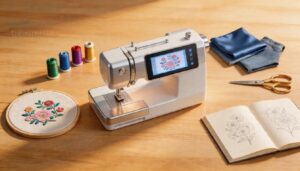
Picking the right machine is only half the work — the other half is knowing what you actually want to make with it. Your project type shapes every decision, from hoop size to how much automation you really need.
Here’s how different workflows and goals line up with the right features.
Monogramming, Lettering, and Custom Gifts
Monogramming is where machine’s built-in design libraries and monogramming fonts actually earn their keep.
Traditional Monogram Layouts place the last-name initial at the center, larger than the flanking letters — small detail, big visual difference.
Pair that with smart Color Contrast Strategies and Material Personalization (embroidery on fabric, engraving on glass), and your Custom Embroidery Techniques enhance any Gift Occasion Theme from ordinary to genuinely memorable.
Apparel, Bags, and Home Décor Projects
Beyond monograms, your machine’s large embroidery area opens up entirely different territory. Three project types where fabric hoop size and thread color coordination truly matter:
- Apparel — Uses seasonal color palettes on sweatshirts, and the automatic needle threader saves setup time
- Bags — Design scaling methods keep logos proportional on totes
- Home décor — Embellishment integration on pillows rewards wireless connectivity and smart embroidery machine features comparison
Large Designs and Re-hooping Needs
Large jackets and queen-sized table runners push past what a single hoop can handle. That’s where Multi-hoop Planning earns its place. Good software uses Automatic Hooping Algorithms and Software File Segmentation to split your design, then generates Registration Mark Strategies so each re-hooping lines up cleanly.
| Feature | Why It Matters |
|---|---|
| Stitch Sequence Optimization | Keeps layered sections aligned |
| Large embroidery area machines | Fewer re-hoopings needed |
Fabric Compatibility and Stabilizer Selection
Getting your stabilizer wrong ruins the stitch before it starts. Match your backing to the fabric:
- Use Cut-away vs Tear-away based on stretch — knits need cut-away, wovens tear-away
- Apply Topping for Textured surfaces like fleece or terry so stitches don’t sink
- Choose Adhesive Backing Specialty options for leather or velvet that won’t hoop flat
Stabilizer Weight Matching and stitch density go hand in hand.
Hobby Use Versus Home Business Needs
Your stabilizer choice sets the stitch up right — now think about who’s actually running the machine.
| Factor | Embroidery Hobby | Home Embroidery Business |
|---|---|---|
| Schedule | Occasional, flexible | Routine, order-driven |
| Profit Tracking | Not required | Essential for tax and growth |
| Time Management | Relaxed pace | Tight turnaround per order |
| Customer Service | Rarely needed | Core daily responsibility |
| Bulk Order Efficiency | Low priority | Drives machine choice |
A home embroidery business justifies faster machines, larger hoops, and stronger Marketing Strategies from day one.
Setup, Maintenance, and Troubleshooting
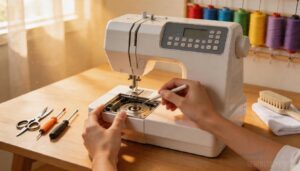
Getting your machine set up right from the start saves you a lot of frustration down the road. A little routine care goes a long way toward keeping your stitches clean and your projects on track.
Here’s what you need to know to run your embroidery machine with confidence.
Hoop Setup and Design Placement
Good placement starts before the first stitch. Find your garment’s true center using Center Marking Techniques — fold it, then mark with washable chalk or painter’s tape. From there, Hoop Centering Strategies like crosshair alignment and Template Utilization keep your design exactly where you intended.
Follow these Grid Alignment Tips for consistent results:
- Fold the garment to locate the true center before hooping
- Use Placement Marking Tools — tailor’s chalk or washable markers — to mark the design’s center point
- Match your mark to the hoop’s crosshairs before tightening
- Check the on-screen center indicator; hoop size and embroidery area dimensions must align
- Record your grid position for repeat jobs to keep placement consistent
Needle, Thread, and Bobbin Maintenance
Even one skipped stitch is a sign that needle is overdue. Needle Replacement Frequency matters more than most people think — swap it every project or after eight hours of stitching.
Thread Quality Inspection is just as important: smooth, lint-free thread keeps tension balanced.
Apply smart Bobbin Winding Techniques, clean your bobbin area regularly, and use Tension Balancing Tips to catch problems before they multiply.
Firmware Updates and Wireless Setup
Before you run any firmware updates, check your current firmware version on-screen — many Brother models like the PE900 require version 1.60 or later for App-Driven Transfer over WiFi. Stick to the 2.4 GHz Band; most machines won’t see 5 GHz networks.
Enter your Network Password. Accuracy matters here — one wrong character blocks everything. Always guard against Power Interruption Guard mid-update.
Fixing Thread Breaks and Skipped Stitches
Thread breaks and skipped stitches almost always come down to four things: Needle Wear, a wrong Thread Path, off Tension Settings, or Hook Timing.
Change your needle every 7–8 hours — a dull tip can’t catch the loop. Rethread with the presser foot raised so the thread seats in the tension discs properly. Test Fabric Stabilization on scrap first.
Hook timing is your last resort to check.
Must-have Embroidery Accessories
The right accessories can make or break your embroidery workflow. Magnetic Hoops grip fabric without over-tightening, while a proper embroidery hoop matched to your project size keeps placement accurate.
Stock up on Needle Sets, rotate them often, and use Scissor Kits with dedicated embroidery scissors to keep cuts clean.
Add Thread Organizers, a thread stand, Stabilizer Types like 88 Tearaway Embroidery Stabilizer, and an automatic needle threader to work smarter.
Frequently Asked Questions (FAQs)
Can a computerized sewing machine do embroidery?
Yes — if it has an embroidery mode or free-motion setup, a computerized sewing machine processes embroidery well. Combo machines are especially adaptable, blending sewing and stitching in one body.
Can you use a computerized sewing machine for embroidery?
Absolutely — and some machines do it brilliantly.
Combo models handle both sewing and embroidery through machine mode switching, giving you stitch quality control and embroidery software compatibility without buying two separate machines.
Is there an automatic embroidery machine?
Modern automatic embroidery machines handle Multi-needle color changes, Smart Tension Control, and automatic thread cutting on their own.
Features like On‑the‑Fly bobbin winding, automatic needle threader, and automatic jump stitch trimming make the whole process nearly hands‑free.
Are computerized sewing machines worth it?
For most people who sew regularly, yes. The automation saves real time, and the design options open doors that manual machines simply can’t.
If you use those features often, the value adds up fast.
Can any sewing machine be turned into an embroidery machine?
Short answer: no. The mechanical limitations are real — a standard machine lacks the motor requirements, hoop-motion system, and software compatibility to stitch digital files.
Sewing and embroidery combo machines are your cleanest solution.
Can I use regular thread for machine embroidery?
You can, but results vary. Regular thread lacks the sheen and weight of 40-weight embroidery thread, so fills look thin.
It’s fine for design testing, but true embroidery thread wins for coverage and shine.
How often should I clean my embroidery machine?
Clean the bobbin area after every use.
Do a Weekly Deep Clean if you embroider regularly, and schedule Professional Service once a year — or twice if you stitch more than ten hours weekly.
Whats the difference between stabilizers and interfacing?
Think of them as scaffolding versus load-bearing walls. Stabilizers offer temporary support during stitching, then tear or wash away.
Interfacing creates permanent structure, fused directly into your fabric for lasting shape.
Can I embroider on stretchy or delicate fabrics?
Yes, you can — but it takes the right setup.
Stretchy and delicate fabrics need proper fabric stabilization, smart needle selection, lower stitch density, and careful hoop tension to stitch cleanly without warping or tearing.
How do I troubleshoot thread breakage during embroidery?
When thread keeps snapping, retrace your steps — raise the presser foot, reseat every thread guide alignment point, and check spool tension. A single missed guide causes most breaks.
Conclusion
What separates a finished project from a pile of abandoned fabric? The right machine.
The best computerized sewing machines for embroidery don’t just stitch—they match your pace, your projects, and your ambitions. Whether you’re monogramming gifts or building a home business, every recommendation here gives you a real starting point.
Stop guessing at specs and start making things. Your next great piece isn’t waiting on inspiration—it’s waiting on the machine sitting at your workspace.
- https://omtech.com/blogs/knowledge/everything-you-need-to-know-about-embroidery-machines
- https://richword.com/products/poolin-eoc07re-embroidery-machine-7-9x15-hoop-area-7-touchscreen-computerized-home-embroidery-machine
- https://www.hindawi.com/journals/mpe/2022/7397637/
- https://www.maggieframes.com/de/blogs/embroidery-blogs/brother-6-needle-embroidery-machine-features-setup-pro-tips
- https://www.hooptalent.com/blogs/news/embroidery-sewing-machine-computerized-ultimate-guide-to-features-top-picks-selection-tips