This site is supported by our readers. We may earn a commission, at no cost to you, if you purchase through links.
A memory quilt carries weight that goes beyond fabric—it’s stitched from the pieces of someone’s life, and the machine you choose either honors that or fights you every step of the way. Feeding bulky layers of denim, cotton, and fleece through a machine not built for such demands leads to puckered seams and frustration, not the heirloom you envisioned.
The right quilting machine for memory quilt projects must accommodate mixed fabrics smoothly, offer enough throat space to maneuver, and keep your focus where it belongs—on the story you’re telling, not the tension dial.
Table Of Contents
- Key Takeaways
- Top 8 Quilting Machines Reviewed
- 1. Juki HZL-F600 Computerized Sewing Quilting Machine
- 2. Brother PQ1600S Sewing Quilting Machine
- 3. Singer Quantum Stylist 9960 Computerized Sewing Machine
- 4. Brother XR3774 Sewing and Quilting Machine
- 5. Brother HC1850 Sewing Quilting Machine
- 6. Juki TL2000Qi Sewing Quilting Machine
- 7. Janome MC6650 Sewing and Quilting Machine
- 8. Bernette B77 Sewing Quilting Machine
- Best Features for Memory Quilts
- Beginner Vs Professional Options
- Machine Types for Memory Quilting
- Buying Tips Before You Choose
- Frequently Asked Questions (FAQs)
- Conclusion
Key Takeaways
- Throat space and feed system matter more than stitch count—look for at least 9 inches of clearance and a dual-feed or walking foot to handle mixed fabrics without puckering.
- Your budget shapes your best pick: the Brother XR3774 (~$165) works well for beginners, the Singer 9960 (~$450) hits a versatile middle ground, and the Juki HZL-F600 ($1,499) is worth it if you quilt seriously and often.
- Computerized machines take the guesswork out of tension and stitch settings, which is a real advantage when you’re working with emotionally important, mixed-fabric projects where mistakes sting more.
- Practical extras—automatic needle threading, a thread cutter, LED lighting, and a wide extension table—aren’t just conveniences; they keep your focus on the quilt’s story instead of the machine’s quirks.
Top 8 Quilting Machines Reviewed
Picking the right machine for a memory quilt isn’t just about specs — it’s about finding something that can handle the fabrics you’re working with and keep up with your pace.
If you’re not sure where to start, these quilting machine reviews for memory quilts break down which models handle delicate and mixed fabrics best.
The eight machines below cover a wide range, from budget-friendly basics to computerized workhorses built for serious projects.
Here’s what each one brings to the table.
1. Juki HZL-F600 Computerized Sewing Quilting Machine
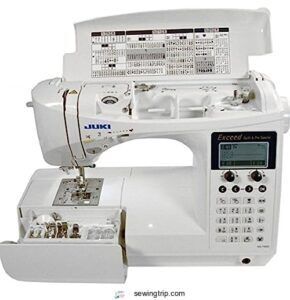
The Juki HZL-F600 earns its ‘Best Overall’ title for good reason. With 255 built-in stitches, box-feed technology, and dual LED lighting, it sews through everything from delicate silks to layered memory quilt squares without missing a beat.
Its automatic needle threader and thread trimmer maintain efficiency during extended sessions, ensuring uninterrupted workflow.
At $1,499, it represents a significant investment—but for projects of deep personal value, this machine delivers reliability when it matters most, never faltering mid-project.
| Best For | Quilters and serious home sewers who want a reliable, feature-packed machine for big, complex projects and are ready to invest in quality. |
|---|---|
| Price | $1,499.00 |
| Weight | 30 lb |
| Auto Needle Threader | Yes |
| Thread Cutter | Automatic |
| Extension Table | Included |
| Power Voltage | 110–120 V |
| Additional Features |
|
- 255 stitches and a full-color LCD make it easy to find the right setting fast, whether you’re quilting, hemming, or doing decorative work.
- Handles everything from lightweight jerseys to heavy multi-layer quilts without constantly breaking thread or skipping stitches.
- Automatic needle threader and thread cutter save time on setup, so you spend more time sewing and less time fussing.
- At 30 lb, it’s not easy to move around—if you’re short on space, that’s something to think about before buying.
- Some users have run into mechanical hiccups like a broken needle-holder screw or a failing auto-threader, which means a trip to the repair shop.
- Very thick fabrics—think four layers of denim—can cause uneven stitches and extra noise, so it’s not perfect for every heavy-duty job.
2. Brother PQ1600S Sewing Quilting Machine
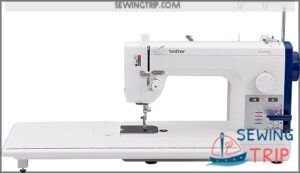
If the Juki feels like too much machine for your budget, the Brother PQ1600S sits at $999.99 and punches well above its price. It runs at 1,500 stitches per minute — same blazing speed as machines costing twice as much.
The knee lifter keeps your hands free while you guide those precious fabric squares, and the pin-feed system holds multiple layers together without shifting. It’s not for absolute beginners, but if you’re ready to commit, it rewards the effort.
| Best For | Intermediate to advanced sewists and quilters who want near-professional speed and workspace without crossing into industrial machine territory. |
|---|---|
| Price | $999.99 |
| Weight | 24 lb |
| Auto Needle Threader | Yes |
| Thread Cutter | Push-button |
| Extension Table | 11.1″ × 23.3″ |
| Power Voltage | 120 V |
| Additional Features |
|
- Blazing 1,500 spm straight-stitch speed paired with a massive extension table makes short work of big quilts and large garment projects.
- The knee lifter and pin-feed system work together beautifully — your hands stay on the fabric while layers stay locked in place.
- Seven specialty feet right out of the box means you’re ready for everything from rolled hems to free-motion quilting without extra shopping.
- The side-loading bobbin gives you zero warning before it runs out, and the auto-cutter often leaves the thread too short — expect some re-threading frustration.
- The needle threader is hit or miss, especially with finer threads, and the tension dial is awkwardly placed and hard to read mid-project.
- At 24 lb with plastic gear components, it’s not easy to move around and raises some questions about long-term durability under heavy use.
3. Singer Quantum Stylist 9960 Computerized Sewing Machine
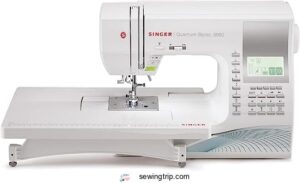
The Singer Quantum Stylist 9960 excels where versatility matters most. With 600 built-in stitches and a top speed of 850 stitches per minute, it handles everything from utility seams to decorative quilt labels, even offering built-in lettering.
Its automatic needle threader and thread cutter save real time during extended projects. For creative techniques, simply drop the feed dogs to enable free-motion work, while the speed control ensures precision.
Priced at roughly $450, this machine delivers professional-level features without the professional-level price tag.
| Best For | Sewists who want one machine that handles quilting, garment construction, and personalized projects without buying multiple specialized tools. |
|---|---|
| Price | $299.99 |
| Weight | 14.6 lb |
| Auto Needle Threader | Yes |
| Thread Cutter | Automatic |
| Extension Table | Included |
| Power Voltage | 120 V |
| Additional Features |
|
- 600 built-in stitches plus 13 automatic one-step buttonhole styles means you’re covered for everything from basic hems to decorative finishing.
- The automatic needle threader and thread cutter are real time-savers, especially during long sessions where stopping to re-thread breaks your flow.
- Comes with 13 presser feet, an extension table, and a hard case right out of the box — no extra shopping required.
- No dedicated top-thread tension dial, so getting decorative stitches just right can take some trial and error.
- The throat space is standard-sized, which can feel limiting when you’re wrestling with a large quilt.
- The needle threader can be finicky and sometimes needs a little manual help to work correctly.
4. Brother XR3774 Sewing and Quilting Machine
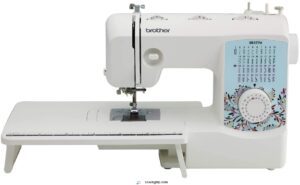
If your budget is the deciding factor, the Brother XR3774 deserves a serious look. At around $165, it punches well above its price point.
You get 37 built-in stitches — including quilting-specific options — plus an automatic needle threader, drop-in bobbin, and a wide extension table that actually gives you room to maneuver larger quilt tops.
The included walking foot helps keep fabric layers feeding evenly. It’s not the flashiest machine, but for memory quilts on a budget, it’s genuinely reliable.
| Best For | Beginner to intermediate sewists who want solid quilting features without spending a lot. |
|---|---|
| Price | $164.99 |
| Weight | 15 lb |
| Auto Needle Threader | Yes |
| Thread Cutter | Not included |
| Extension Table | Included |
| Power Voltage | 110 V |
| Additional Features |
|
- 37 built-in stitches with quilting-specific options, plus a walking foot included right out of the box
- Automatic needle threader and drop-in bobbin make setup quick and easy
- Wide extension table gives you real workspace for larger quilt tops — rare at this price
- Gets loud and vibrates noticeably at higher speeds, which can throw off your accuracy on big projects
- Struggles with thick fabrics like plush fleece or multiple minky layers stacked together
- The extension table can loosen under load, and the foot controller cord is frustratingly short
5. Brother HC1850 Sewing Quilting Machine
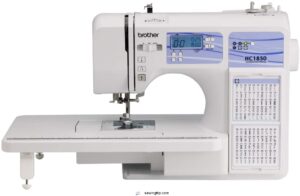
The Brother HC1850 is a sweet spot for quilters who want more than basics without spending a fortune. At $299.99, it offers 185 built-in stitches, including 55 alphanumeric characters for personalizing memory quilts with names or dates.
If you’re still weighing your options, this breakdown of top-rated sewing machines for every skill level can help you find the right fit beyond the HC1850.
Its automatic needle threader and drop-in bobbin ensure genuinely quick setup. The detachable wide table and spring-action quilting foot handle free-motion work well.
One heads-up: there’s no built-in LED, so good task lighting nearby matters.
| Best For | Quilters and home sewists who want a versatile, feature-packed machine without jumping into the $500+ range. |
|---|---|
| Price | $299.99 |
| Weight | 10.1 lb |
| Auto Needle Threader | Yes |
| Thread Cutter | Not included |
| Extension Table | Detachable wide table |
| Power Voltage | 120 V |
| Additional Features |
|
- 185 built-in stitches — including alphanumeric options — cover everything from basic seams to personalized memory quilts
- Automatic needle threader and drop-in bobbin make setup fast, which is a real win for beginners or casual sewers
- The detachable wide table and spring-action quilting foot make free-motion quilting genuinely doable right out of the box
- Only works on 120V U.S. outlets, so international use is off the table
- At 10 lbs, it’s not the lightest option if you’re hauling it to classes regularly
- Tension can be finicky — you may need a few test runs to dial in consistent stitch quality on different fabrics
6. Juki TL2000Qi Sewing Quilting Machine
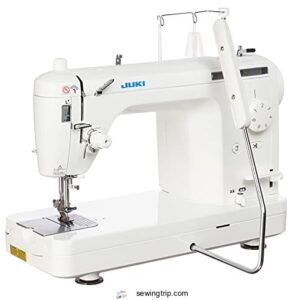
The Juki TL-2000Qi delivers uncompromising speed and stability, operating at 1,500 stitches per minute while maintaining precision through its aluminum die-cast frame, which minimizes vibration even during heavy-duty quilting.
Its 9-inch throat space provides ample room to maneuver bulky fabrics, ensuring smooth handling of layered quilt sections.
Priced at $899, the machine is straight-stitch only—a minor limitation for quilters prioritizing clean, fast seaming over decorative stitches.
| Best For | Quilters and sewists who work with large, heavy projects and need a fast, reliable straight-stitch machine that can keep up with serious production work. |
|---|---|
| Price | $899.00 |
| Weight | 25.4 lb |
| Auto Needle Threader | Yes |
| Thread Cutter | Foot-pedal reverse |
| Extension Table | Included |
| Power Voltage | 110 V |
| Additional Features |
|
- Screaming fast at 1,500 SPM with a rock-solid aluminum frame that stays smooth and quiet even through thick layers
- That extended throat space plus the included walking foot and extension table make handling big quilts way less of a fight
- Built-in LED lighting and the foot-pedal thread cutter keep your hands free and your workflow moving
- Straight stitch only — if you need zigzag or decorative stitches, this isn’t your machine
- No speed control dial means you’re managing 1,500 SPM purely by foot pressure, which takes some getting used to
- The automatic needle threader has a reputation for being finicky, and key accessories like a free-motion foot cost extra on top of the $899 price tag
7. Janome MC6650 Sewing and Quilting Machine
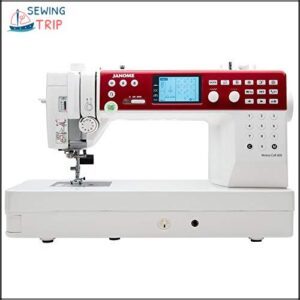
The Janome MC6650 feels like it was built with memory quilters in mind. Its 10-inch throat provides ample space for maneuvering bulky, sentimental layers, while five memory banks allow users to save stitch configurations for each block, eliminating repetitive setup.
At 1,000 stitches per minute, paired with six LEDs illuminating the workspace, precision becomes effortless.
Priced at $2,030, this machine is a significant investment, but its capabilities solidify its place in any serious quilter’s studio.
| Best For | Experienced quilters and dedicated sewists who want a heavy-duty, feature-rich machine built to handle large projects, thick fabrics, and long sessions without breaking a sweat. |
|---|---|
| Price | $2,030.00 |
| Weight | 24.25 lb |
| Auto Needle Threader | Yes |
| Thread Cutter | Automatic |
| Extension Table | Not specified |
| Power Voltage | Not specified |
| Additional Features |
|
- That 10-inch throat space is a game-changer for quilting big blocks — way less wrestling with your fabric
- 172 stitches plus memory banks mean you can save your setups and skip the repetitive fiddling between projects
- Metal construction and a 1,000 spm speed make it feel built to last through serious, high-volume work
- At 24 lbs and $2,030, it’s a heavy commitment — literally and financially
- Some users have run into mechanical hiccups like thread cutter issues and error codes that needed a service visit
- The instruction manual apparently leaves a lot to be desired, so budget some time for YouTube tutorials if you’re new to it
8. Bernette B77 Sewing Quilting Machine
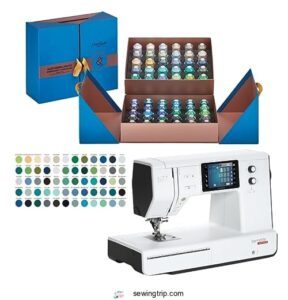
The Bernette B77 punches well above its price tag.
Its 5-inch color touchscreen makes stitch selection feel straightforward, even when juggling 500 options — including 35 dedicated quilting stitches.
The dual feed system keeps your sentimental fabrics moving smoothly without shifting or bunching. You’ll appreciate the guided sewing consultant feature when tackling tricky mixed-fabric blocks.
One honest note: manual tension adjustment means you’ll need some patience on delicate pieces.
But overall, it’s a genuinely capable machine for memory quilters who want smart features without the premium price.
| Best For | Quilters of any skill level who want a feature-rich, computerized machine that handles thick layers and frequent color changes without breaking the bank. |
|---|---|
| Price | Not disclosed |
| Weight | Not specified |
| Auto Needle Threader | Yes |
| Thread Cutter | Automatic |
| Extension Table | Included |
| Power Voltage | 110–120 V |
| Additional Features |
|
- The dual feed system keeps multiple fabric layers moving together evenly, so you get cleaner seams with less frustration.
- An automatic needle threader and thread cutter speed things up nicely, especially on projects with lots of color swaps.
- The large throat area gives you real room to maneuver big quilt blocks and bulky fabrics.
- No automatic tension adjustment means you’ll be tweaking settings by hand every time you switch fabrics.
- The lock stitch can be unreliable, so you may need to back-stitch more than you’d like to keep seams secure.
- The needle threader and thread cutter have a track record of wearing out or underperforming after a few months of regular use.
Best Features for Memory Quilts
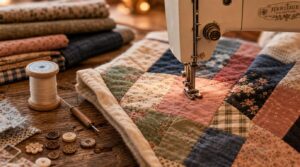
Memory quilts carry a lot of weight — emotionally and literally.
Memory quilts carry emotional weight that no machine spec can measure
Choosing the right machine comes down to a handful of features that really matter when you’re working with bulky layers and mixed fabrics.
Here’s what to look for before you commit.
Throat Space for Bulky Quilts
Think of throat space as breathing room for your quilt. That harp width—the gap between needle and machine body—determines how freely you can shift your quilt sandwich height without fighting the machine.
For bulky quilts, aim for at least 11 inches of throat space. It dramatically reduces fabric drag, improves needle clearance, and makes bulk layer maneuvering and large format sewing far less exhausting. Professional quilters often prefer larger throat space for handling oversize projects.
Feed Systems for Mixed Fabrics
Memory quilts are made from all kinds of fabrics — jersey, denim, silk, flannel — and that’s exactly where feed systems earn their keep. Differential Feed Control prevents puckering on uneven layers, while Unison Feed Synchronization keeps multi-ply seams moving smoothly.
Features like Adjustable Midline Grip, Dual-Feed Sensors, and Roller Assist Guidance eliminate slipping. These innovations ensure precise fabric handling across varied textures and thicknesses.
The AcuFeed Flex dual feed and broader dual feed technology make mixing fabric weights feel easy, streamlining complex projects with seamless efficiency.
Stitch Speed and Control
Once your feed system handles mixed fabrics smoothly, stitch speed becomes the next critical factor. Servo Motor Precision ensures clean, consistent starts without jerking the fabric, providing a stable foundation for seamless operation.
Speed control is refined through Speed Slider Calibration and Pedal Sensitivity Settings, allowing precise adjustments tailored to material demands—from 1,000 stitches per minute for delicate fabrics to 1,500 stitches per minute for heavy denim.
LED Lighting for Accuracy
Good lighting isn’t glamorous, but it changes everything. When you’re matching thread to a faded flannel shirt or tracing seams on dark velvet, the right illumination transforms guesswork into precision.
LED illumination for detailed work bridges this gap, offering clarity that elevates craftsmanship. Prioritize these essential features:
- High CRI (90+) for true fabric color
- Brightness stability that won’t shift mid-session
- CCT presets for cutting versus sewing phases
- Spectral balance to reveal subtle thread contrasts
- Thermal management keeping brightness consistent for hours
Extension Table Compatibility
Lighting sets you up, but workspace does the heavy lifting. A large extension table transforms a cramped machine bed into ample space for a king-sized quilt. Prioritize height alignment (29–31 inches), robust weight capacity, and a smooth, snag-resistant surface for delicate fabrics.
The Janome MC6650’s extension table excels with its detachable AcuFeed Flex system and 15.5-inch total work area, delivering genuinely practical functionality. Its smart mounting plate design and generous foot clearance underneath ensure seamless operation.
Beginner Vs Professional Options
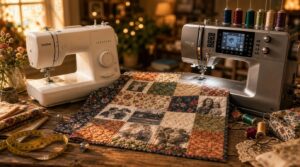
Choosing the right quilting machine really comes down to where you are in your quilting journey. A beginner has very different needs than someone who’s been stitching for years, and the price tags reflect that gap pretty clearly.
Here’s a closer look at what works best at every level.
Easiest Machines to Learn
Starting out doesn’t have to feel overwhelming. The Brother PQ1600S is Best for Beginners — its Start‑Stop Button means you don’t even need a foot pedal to get going. A One‑Touch Threader and automatic needle threading cut setup time instantly. User-friendly controls, an Easy-to-Use Touchscreen UI, and a Preset Stitch Library keep things simple, while Quiet Operation and LED illumination for detailed work help you stay focused.
| Feature | What It Does | Why Beginners Love It |
|---|---|---|
| Start‑Stop Button | Runs machine without pedal | Builds confidence at your own pace |
| One‑Touch Threader | Threads needle automatically | Saves frustration on every project |
| Touchscreen UI | Clear on‑screen stitch selection | No guesswork exploring menus |
| Preset Stitch Library | Ready‑to‑use stitch patterns | Jump straight into quilting |
| Quiet Operation | Sound‑dampened motor | Keeps your workspace calm and focused |
Best Budget-friendly Picks
Most quilters don’t need to spend a fortune to get started. The Singer 8500Q Modern Quilter hits that sweet spot — solid price performance at around $449, with reliable ease of setup right out of the box. It’s a genuinely capable, budget-friendly sewing machine for home quilting projects.
For those exploring options across different budgets, here’s a comparison of notable models:
| Model | Best for Budget | Accessory Compatibility |
|---|---|---|
| Singer 8500Q | Under $500 | Walking foot included |
| Brother XR3774 | Under $300 (used) | Standard attachments |
| Brother HC1850 | Entry-level pick | Optional extension table |
Advanced Computerized Models
If you’re ready to let technology do some of the heavy lifting, sophisticated computerized quilting machines are worth every penny. They use Data-Driven Simulation and Adaptive Stitch Prediction to enhance your memory quilt before you sew a single stitch. Features like Color touchscreen panels, USB connectivity, and Visual Analytics make complex decisions simple.
| Feature | What It Does | Best Model |
|---|---|---|
| Simulation Algorithms | Tests fabric and tension digitally | Bernina 570 QE |
| Real-Time Optimization | Adjusts settings as you sew | Janome MC6650 |
| Software Integration | Transfers designs via USB | Brother PQ1600S |
Free-motion Quilting Support
Free-motion quilting opens up a whole world of creativity, but your machine needs to keep up. Essential features like Stitch Length Variability, Needle Position Toggle, and Foot Pressure Adjustment help you maintain control. Additionally, thread tension control and fabric feeding mechanisms ensure stitches remain even.
A walking foot add-on is crucial for managing thick layers without puckering. For further precision, consider additional features such as those outlined in the table below.
| Feature | Why It Matters |
|---|---|
| Ring Light Integration | Brightens dense stitching areas clearly |
| Quilt Clamp Techniques | Holds your quilt sandwich flat and steady |
| Large Extension Table | Accommodates heavy memory quilts during free-motion quilting |
| Walking Foot Add-on | Prevents shifting across mixed fabric layers |
Learning Curve Considerations
Every beginner hits a wall somewhere — and that’s completely normal. Short practice sessions of 20–30 minutes help you build stitch control without burnout. Incremental skill scaling keeps frustration low while your confidence grows.
| Stage | Focus | Strategy |
|---|---|---|
| Week 1 | Beginner-friendly controls | 20-min sessions |
| Week 2 | Automatic tension | Varied fabrics |
| Week 3 | Speed plateau management | Timed drills |
| Week 4 | Feedback loop techniques | Review stitching |
| Week 5 | Fatigue recovery strategies | Rest + repeat |
Machine Types for Memory Quilting
Not every machine manages memory quilting the same way, and the type you choose changes everything. From a simple home sewing machine to a long-arm frame setup, each option comes with its own strengths and trade-offs.
Here’s a look at the main machine types worth knowing before you decide.
Regular Sewing Machines
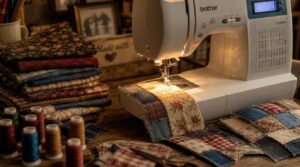
A regular sewing machine can handle memory quilts better than you might think.
Most models come with solid stitch length control, automatic tension adjustment, and a wide range of stitch patterns for mixed fabrics. Built-in needle threaders, decent bobbin capacity, and LED lighting make late‑night sessions easier.
With presser foot variety and fabric layer handling, they’re genuinely best for beginners starting their first meaningful project.
Dedicated Quilting Machines
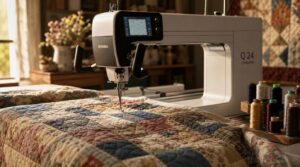
Dedicated quilting machines are built for exactly this kind of work. They offer wider throat spaces — often 10 to 18 inches — plus AcuFeed Flex dual feed to handle mixed fabrics without shifting. You’ll also get an automatic thread cutter, a wide range of stitch patterns, and solid Noise Reduction for long sessions.
Warranty Coverage and Maintenance Routine support make them a dependable long-term investment.
Computerized Versus Mechanical
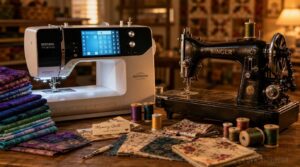
Where dedicated machines leave off, the real choice becomes personal: computerized or mechanical?
Computerized sewing machines feature Touchscreen Interface, Automatic Tension, and Stitch Pattern Library, eliminating guesswork from projects like memory quilts. Stitch memory instantly recalls favorite combinations, while a digital LCD interface ensures clarity and visual control.
Mechanical machines prioritize Repair Simplicity and Power Efficiency, though they sacrifice precision. Their design emphasizes hands-on control and reliability, with fewer components reducing potential failures.
- Store beloved stitch combinations for sentimental projects
- Auto-tension protects delicate fabrics from damage
- Visualize patterns before committing a single stitch
- Manual machines respond to your hands, not menus
- Fewer parts mean fewer things to go wrong
Long-arm Frame Setups
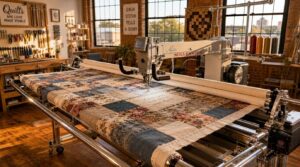
Long-arm setups take things further than any desktop machine can. A QZone Hoop Frame paired with longarm quilting machines gives you room to stretch a full king-size memory quilt flat—no bunching, no fighting the fabric.
| Feature | Why It Matters |
|---|---|
| Rail Parallelism | Keeps stitches tracking true across wide quilts |
| Leader Grip Systems | Anchors fabric layers without slippage |
| Servo Drive Integration | Delivers smooth, consistent stitch speed |
| Modular Frame Extensions | Scales to any quilt size you’re working with |
Tension Calibration across both layers prevents puckering on those precious sentimental fabrics.
Portable Workspace Needs
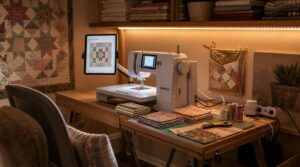
Not everyone quilts in a dedicated studio. If you’re working from a spare room or a kitchen table, a compact setup makes a real difference. An adjustable height desk, foldable monitor arm, and compact power strip with cable management solutions keep things tidy.
Add battery-powered lighting or LED lighting overhead, and you’ve got a workspace that works anywhere your memory quilt project takes you.
Buying Tips Before You Choose
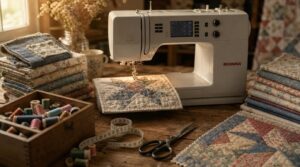
Before you spend a single dollar, there are a few practical things worth thinking through first. Memory quilts carry real emotional weight, so you want a machine that fits both your fabric and your patience.
Here’s what to check before you commit.
Fabric Weight and Stability
Memory quilts carry real weight—literally. Fabric weight and weave density significantly impact how smoothly your machine feeds layers through, with heavier fabrics tending to behave better than slippery or stretchy ones. Fiber type selection also matters: cotton is forgiving, while polyester blends can resist quilt tension control.
Always use pre-shrinking techniques and apply interfacing early to stabilize materials. Proper fabric stabilization and storage conditions—such as maintaining consistent humidity and temperature—are critical to ensure even feeding during the quilting process.
Walking Foot Requirements
A walking foot addon transforms how your machine handles thick quilt layers, preventing fabric pieces from shifting mid-stitch. Before purchasing, prioritize three critical checks:
- Shank Compatibility — Confirm whether a low or high shank fits your machine model.
- Toe Guide Alignment — Opt for open-toe designs to enhance visibility and quilt piece alignment.
- Grip Teeth Maintenance — Ensure teeth are not worn, as damage compromises the fabric feeding system.
Clearance measurement and foot pressure control directly influence long-term machine durability and build quality.
Automatic Thread Features
Automatic needle threading, automatic bobbin winding, and an automatic thread cutter eliminate tedious setup tasks, streamlining the sewing process. These features address the frustration of manual threading at the start of every seam.
Built-in alignment sensors detect misrouting before stitching begins, while automatic tension adjustment adapts to each fabric layer, ensuring precision. These technologies prevent errors and maintain consistency across materials.
Thread snipping and bobbin thread sensors further refine the finishing process, guaranteeing a clean and consistent result for projects like memory quilts.
Noise and Vibration Levels
Noise matters more than you’d think when you are quilting something precious. Most machines operate between 50 and 70 decibels — roughly conversation-level hum.
Here’s what to check:
- Vibration Isolation: Rubber feet and rigid chassis reduce motor noise and table resonance noticeably.
- Quiet Mode Design: Soft-start acceleration limits noise spikes during high-speed stitching.
- Noise Suppression: Direct-drive motors cut overall sound by several decibels versus belt-driven models.
Warranty and Support Quality
A solid warranty is your safety net when something goes wrong. Look for at least 24 months of coverage duration on parts and workmanship. The claim process is straightforward — submit within 30 days with proof of purchase, and most repairs wrap up in 7 to 14 business days.
Extended Plans add 1 to 3 years, with priority Service Turnaround and firmware updates included.
Multiple Support Channels help too.
Frequently Asked Questions (FAQs)
How many shirts do you need to make a memory quilt?
For a throw-size memory quilt, you’ll need about 20 to 25 shirts.
Quilt size and shirt size affect how many shirts you use, so always keep a spare shirt buffer just in case.
How do I care for a finished memory quilt?
Think of your memory quilt like a living heirloom.
Gentle washing in cold water, flat drying, stain treatment when needed, and acid-free storage keep it beautiful. Repair reinforcement ensures textile preservation for generations.
Can I use a quilting machine for embroidery?
Yes, but with limits. A quilting machine executes embroidery through free-motion techniques, proper needle selection, and foot attachments.
For true digital embroidery with stitch compatibility, you’ll need embroidery-specific features or separate design transfer software.
What software helps design memory quilt layouts?
Patch things up digitally before you cut a single square. PatternJam’s Fabric Preview Engine and PreQuilt’s drag-and-drop blocks let you visualize layouts instantly.
Meanwhile, QuiltCAD manages Automated Cutting Lists and Pattern Math Calculations effortlessly, streamlining your planning process.
How long does a memory quilt project take?
A memory quilt usually takes 10 to 40 hours, depending on project size scaling, fabric prep time, and quilting method speed. Block count impact and time buffering tips matter most.
Where can I find memory quilt fabric inspiration?
Scroll through online quilting forums, search social media hashtags, or visit museum textile archives — each sparks fresh ideas for your memory quilt’s fabric selection and quilt layout planning.
Join local guild swaps or browse thrift store finds to uncover unique materials and patterns, further enriching your creative vision.
Conclusion
A stitch in time saves nine—and choosing the right quilting machines for memory quilt projects saves you heartbreak later.
Every shirt, bandana, and baby blanket you feed through that machine carries someone’s story. The wrong machine turns that story into frustration; the right one lets you focus on honoring it.
Trust your needs, match them to the specs, and you won’t just finish a quilt—you’ll finish something worth keeping forever.
- https://www.mkquilts.com/longarm-quilting-machine-faq.html
- https://suzyquilts.com/quilting-sewing-machines-one-best-budget
- https://www.qualitysewing.com/collections/longarm-quilting-machines
- https://www.popsci.com/gear/best-sewing-machines-for-quilting
- https://www.bsewinn.com/blogs/inspiration/long-arm-quilting-machines-for-beginners