This site is supported by our readers. We may earn a commission, at no cost to you, if you purchase through links.
Somewhere between 27 and 960—that’s the stitch count range separating entry-level computerized sewing machines from their feature-packed counterparts. The gap isn’t just a number; it’s the difference between finishing a hem and constructing an heirloom quilt with custom monogramming.
Stitch variety determines what you can actually make, not just what the box promises.
Whether you’re reinforcing stretch seams on activewear or adding decorative borders to a table runner, the right computerized sewing machine with stitch selection gives you creative control without guesswork.
These ten machines cover every budget and skill level, so finding your match gets a lot easier from here.
Table Of Contents
- Key Takeaways
- 10 Computerized Sewing Machines With Stitch Selection
- 1. Brother CS7000X Computerized Sewing Quilting Machine
- 2. Brother CS5055 Computerized Sewing Machine
- 3. Janome Computerized Sewing Machine Thread Cutter
- 4. Singer Quantum Stylist 9985 Sewing Machine
- 5. Bernette B38 Swiss Design Sewing Machine
- 6. Brother XM2701 Lightweight Sewing Machine
- 7. Brother CP60X 60 Stitch Sewing Machine
- 8. Singer Quantum Stylist 9960 Sewing Machine
- 9. Brother HC1850 Sewing and Quilting Machine
- 10. Singer Heavy Duty 4411 Sewing Machine
- Choosing Stitch Selection Features
- Controls and Display Types
- Performance for Different Sewing Needs
- Convenience Features Worth Comparing
- Price, Accessories, and Long-Term Value
- Frequently Asked Questions (FAQs)
- Conclusion
Key Takeaways
- Stitch count is the clearest signal of what a machine can actually do — entry-level models top out around 70 stitches, while high-end picks like the Singer 9985 push past 960, unlocking monogramming, decorative borders, and serious quilting work.
- Your budget determines your control level: under $200 gets you reliable basics with drop-in bobbins and auto threading, $300–$400 adds quilting tables and broader stitch libraries, and $600+ brings touchscreens, stitch memory, and heavy-fabric muscle.
- Convenience features like automatic needle threading, built-in thread cutters, and auto tension adjustment aren’t just nice-to-haves — they’re the difference between a frustrating session and one where you actually finish what you started.
- The Brother CS7000X hits the best overall sweet spot: metal frame, 70 stitches, a wide quilting table, and a 25-year warranty at under $300, making it a smart first machine that won’t cap your growth.
10 Computerized Sewing Machines With Stitch Selection
Finding the right computerized sewing machine comes down to knowing which features actually matter for the work you want to do.
Matching your go-to projects to the right specs is easier when you explore computerized sewing machines ranked by efficiency and features.
These ten machines cover a wide range of stitch counts, controls, and price points — so there’s a real match for every skill level and project type.
Here’s a closer look at each one.
1. Brother CS7000X Computerized Sewing Quilting Machine
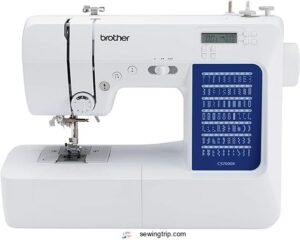
The Brother CS7000X hits a sweet spot that’s hard to ignore.
At $279.99, you get a metal-frame machine with 70 built-in stitches — utility, decorative, heirloom, and quilting — plus seven one-step buttonhole styles. The LCD screen makes stitch selection straightforward, and the automatic needle threader saves real time.
You can sew at up to 750 stitches per minute, and the detachable wide table accommodates big quilting projects without complaint. It weighs 14 lb — solid, not sluggish.
| Best For | Beginners and home quilters who want a durable, feature-rich machine without jumping to a high-end price tag. |
|---|---|
| Built-in Stitches | 70 |
| Buttonhole Function | 7 one-step |
| Frame Material | Metal |
| Work Lighting | LCD screen |
| Bobbin System | Drop-in top |
| Machine Weight | 14 lb |
| Additional Features |
|
- Metal frame keeps stitching stable and consistent — no wobbling through thick denim or heavy seams
- Automatic needle threader and clear LCD screen make it genuinely easy to pick up, even if you’ve never sewn before
- Detachable wide table and free arm give you real flexibility for both big quilting projects and small cuffs or sleeves
- US-only voltage means international users need a step-down transformer, which is an extra hassle and cost
- No automatic bobbin threading — you still have to handle that part manually
- No embroidery functionality, so if you want to add decorative designs beyond built-in stitches, you’ll need a different machine
2. Brother CS5055 Computerized Sewing Machine
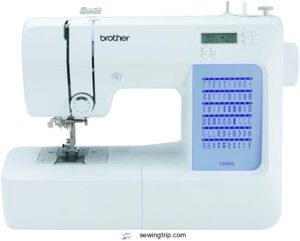
Step down in price, and the CS5055 starts to make a lot of sense.
At $134, you still get a metal frame, 60 built-in stitches — utility, decorative, and heirloom — plus seven one-step buttonholes.
The LCD screen guides stitch selection clearly, and the automatic needle threader keeps frustration low.
It weighs just 10.5 lb, so moving it around is easy.
For beginners tackling curtains, garment repairs, or light denim, this machine punches well above its price tag.
| Best For | Beginners and casual home sewers who want a reliable, feature-packed machine without spending a lot. |
|---|---|
| Built-in Stitches | 60 |
| Buttonhole Function | 7 one-step |
| Frame Material | Metal |
| Work Lighting | LED |
| Bobbin System | Quick-set drop-in |
| Machine Weight | 10.5 lb |
| Additional Features |
|
- Metal frame keeps things sturdy, and 60 built-in stitches cover way more ground than you’d expect at this price
- The automatic needle threader and drop-in bobbin make setup quick and painless — great if you’re just starting out
- Compact and light at 10.5 lb, so it fits easily in small spaces and doesn’t feel like a hassle to store
- Key parts like the presser-foot lever and spool spindle are plastic, which could be a durability concern over time
- The LCD error messages (like "Error 1") and non-standard foot-lever placement can throw off new users until they get used to it
- Thread occasionally slips out of the needle eye during longer sewing sessions, which gets annoying fast
3. Janome Computerized Sewing Machine Thread Cutter
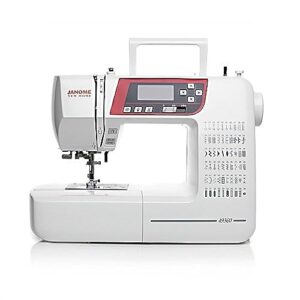
If budget is your starting point, the CS5055 delivers. But if you want more precision control, the Janome 49360 sets a higher standard.
It packs 60 built-in stitches, six one-step buttonholes, and a standout automatic thread cutter that trims both needle and bobbin threads cleanly with one press. That alone saves real time across long projects.
The excellent plus feed system processes thick layers without skipping. At 18 lb, it’s portable enough for craft nights, and the built-in LED keeps your work clearly visible.
| Best For | Hobbyists and beginners who want reliable computerized features — especially those tackling quilts, bags, or layered projects at home or craft nights. |
|---|---|
| Built-in Stitches | Multiple patterns |
| Buttonhole Function | Yes |
| Frame Material | Aluminum alloy |
| Work Lighting | LED |
| Bobbin System | Standard |
| Machine Weight | 18 lb |
| Additional Features |
|
- Automatic thread cutter trims both threads in one press, saving time on longer projects
- Handles thick, multi-layer fabrics smoothly without skipping stitches
- Built-in LED lighting and needle up/down control make detailed work like buttonholes much easier
- Runs louder than some other Janome models, so you may need to slow it down in quiet settings
- Not built for heavy commercial use — it’s strictly a home or light-duty machine
- At 18 lb, it’s manageable but not the easiest thing to haul around regularly
4. Singer Quantum Stylist 9985 Sewing Machine
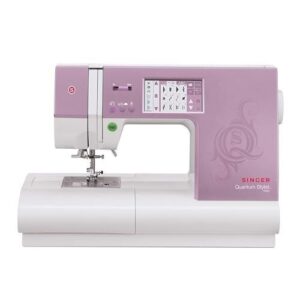
The Janome gives you precision at a fair price, but the Singer Quantum Stylist 9985 takes control to a different level entirely.
You get 960 built-in stitches, a large color touchscreen with actual-size stitch previews, and 13 one-step buttonhole styles.
The metal frame manages denim and upholstery without flinching.
Automatic thread cutting, 60 memory slots for custom stitch sequences, and 15 presser feet round out the package.
At $629.99, it’s built for sewers who want a machine that grows with their ambitions.
| Best For | Sewers who want serious creative control—whether that’s garment-making, quilting, or home décor—and are ready to grow into a machine with a lot to offer. |
|---|---|
| Built-in Stitches | 1000+ |
| Buttonhole Function | 13 one-step |
| Frame Material | Metal/plastic |
| Work Lighting | LCD color touch |
| Bobbin System | Class 15 drop-in |
| Machine Weight | 14 lb |
| Additional Features |
|
- Over 1,000 built-in stitches with a touchscreen that shows you exactly what you’re getting before you sew a single stitch.
- The metal frame handles heavy fabrics like denim and upholstery without any drama.
- 60 memory slots let you save custom stitch sequences, which is a real time-saver if you do repetitive work.
- You’re locked into Singer-brand Class 15 bobbins—standard 15J ones won’t work, so stock up.
- No knee-lifter included, which quilters especially might miss right out of the box.
- The advanced stitch editing features (mirroring, elongation) take some getting used to and will have you reaching for the manual more than once.
5. Bernette B38 Swiss Design Sewing Machine
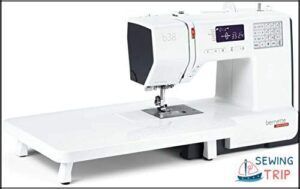
Bernette B38 Swiss Design punches well above its weight. You get 394 stitches, including 67 decorative patterns, three alphabets for monogramming, and eight one-step buttonholes — all wrapped in a sturdy metal body with a clean LCD interface. Adjustable presser foot pressure means you’re not fighting the machine on delicate knits or heavy canvas.
The extension table, automatic thread cutter, and memory function for saving stitch combos make this a genuine workhorse. At $400–$700, it’s a smart pick for sewers who want serious capability without the premium price tag.
| Best For | Sewists at any skill level who want a versatile, heavy-duty machine that can handle everything from delicate fabrics to large home décor projects without breaking the bank. |
|---|---|
| Built-in Stitches | Multiple patterns |
| Buttonhole Function | One-step |
| Frame Material | Metal |
| Work Lighting | LED |
| Bobbin System | Drop-in |
| Machine Weight | 22 lb |
| Additional Features |
|
- The LCD display and on-screen guidance make it easy to dial in stitches — great whether you’re just starting out or been sewing for years.
- Adjustable presser foot pressure means you can switch from silky knits to thick canvas without skipping a beat.
- The extension table, automatic thread cutter, and built-in serger stitch make tackling big projects like quilts or curtains way less of a hassle.
- The foot-lifting lever takes real effort — your wrist will feel it during long sessions.
- The foot area is a bit cramped, so you might find yourself hunching more than you’d like.
- Plastic bobbins only — accidentally using a metal one can damage the machine, which is an easy mistake to make.
6. Brother XM2701 Lightweight Sewing Machine
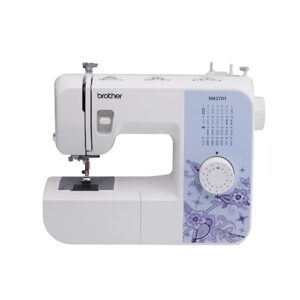
If portability is your priority, the Brother XM2701 delivers a lot for $149. At just 12.6 lb, it’s easy to carry between rooms or toss in the car for a class.
Before you buy, it’s worth checking which serger machines work best in classroom settings, since warranty terms can vary by retailer.
You get 27 built-in stitches — zigzag, blind hem, stretch, and a one-step buttonhole — plus an automatic needle threader and drop-in bobbin that make setup painless.
It won’t power through thick denim, but for everyday garments, quilts, and simple alterations, it’s a solid, no-fuss starter machine.
| Best For | Beginners and hobbyists who want an easy, affordable machine for everyday sewing projects like garments, quilts, and simple alterations. |
|---|---|
| Built-in Stitches | 27 |
| Buttonhole Function | Auto one-step |
| Frame Material | Plastic |
| Work Lighting | Standard |
| Bobbin System | Quick-Set drop-in |
| Machine Weight | 12.6 lb |
| Additional Features |
|
- 27 built-in stitches plus an automatic needle threader and drop-in bobbin make setup quick and stress-free
- Lightweight at 12.6 lb, so it’s easy to move around or take to a class
- Backed by a 25-year limited warranty and lifetime technical support
- Struggles with heavy fabrics like denim or upholstery
- No advanced features like stitch memory or LCD editing for more experienced sewers
- Only works with US voltage (120V/60Hz) — using it abroad voids the warranty
7. Brother CP60X 60 Stitch Sewing Machine
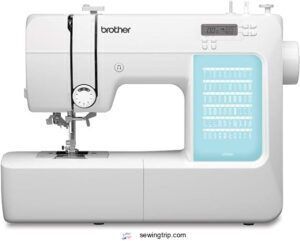
Step up from the XM2701 and the Brother CP60X gives you noticeably more to work with. You get 60 built-in stitches — utility, decorative, and heirloom — plus 7 one-step auto-size buttonholes, all selectable through a backlit LCD screen.
The metal frame keeps stitching steady on denim and medium-weight quilts.
A 2-step automatic needle threader and Quick-Set bobbin cut your setup time down fast.
At 14 lb, it’s not ultralight, but it’s still easy to move around your sewing space.
| Best For | Sewers ready to move beyond the basics who want more stitch options and a sturdier build without jumping to a fully computerized machine. |
|---|---|
| Built-in Stitches | 60 |
| Buttonhole Function | 7 one-step |
| Frame Material | Metal/plastic |
| Work Lighting | LED |
| Bobbin System | Quick-Set drop-in |
| Machine Weight | 14 lb |
| Additional Features |
|
- 60 built-in stitches plus 7 buttonhole styles give you real variety for garments, quilts, and decorative projects
- Metal frame keeps things stable on heavier fabrics like denim and tweed
- Automatic needle threader and Quick-Set bobbin make setup quick and less frustrating
- Plastic housing can feel a bit flimsy if you’re sewing for hours every day
- Struggles with very thick layers or heavy-duty materials
- Twin needles don’t come included, so that’s an extra purchase if you need them
8. Singer Quantum Stylist 9960 Sewing Machine
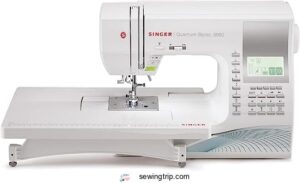
Singer Quantum Stylist 9960 is where serious sewists stop browsing and start buying.
You get 600 built-in stitches, 13 automatic buttonhole styles, and five lettering fonts — all navigated through a large LCD screen with on-screen stitch previews.
The automatic tension adjustment adjusts for your fabric, so you’re not constantly tweaking settings mid-project.
At 14.6 lb and $540.99, it’s built for people who want professional-grade control without the professional-grade price tag.
| Best For | Intermediate to advanced sewists who want a feature-packed machine for quilting, garment making, and decorative projects without jumping to an industrial price point. |
|---|---|
| Built-in Stitches | 600 |
| Buttonhole Function | 13 automatic |
| Frame Material | Metal/plastic |
| Work Lighting | Standard |
| Bobbin System | Top drop-in |
| Machine Weight | 14.6 lb |
| Additional Features |
|
- 600 stitch types plus five lettering fonts give you serious creative range — from everyday seams to monograms and decorative quilting
- Automatic needle threader, top-drop bobbin, and built-in thread cutter make setup and finishing genuinely faster
- Comes loaded with 13 presser feet and a large extension table, so you’re not hunting for add-ons right out of the box
- The throat plate is on the smaller side, which can get frustrating when you’re wrestling a big quilt through the machine
- Nearly 15 pounds means it’s not something you’ll casually move from room to room
- Warranty coverage is a bit patchwork — only 90 days on certain issues, so read the fine print before you assume you’re covered
9. Brother HC1850 Sewing and Quilting Machine
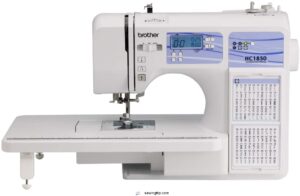
The Brother HC1850 punches well above its $299.99 price tag. You get 185 built-in stitches — 130 standard plus 55 alphanumeric — and 8 one-step buttonhole styles, all selectable through a backlit LCD push-button interface.
The drop-in bobbin and automatic needle threader cut your setup time down fast.
At 10.1 lb with a detachable wide table included, it’s genuinely portable.
Free lifetime technical support and a 25-year warranty make this a smart long-term investment for quilters and garment sewers alike.
| Best For | Hobbyists, quilters, and beginner-to-intermediate sewists who want a feature-packed machine at a mid-range price without sacrificing quality or support. |
|---|---|
| Built-in Stitches | 185 |
| Buttonhole Function | 8 one-step |
| Frame Material | Metal |
| Work Lighting | LED backlit |
| Bobbin System | Drop-in top |
| Machine Weight | 10.1 lb |
| Additional Features |
|
- 185 built-in stitches plus 8 buttonhole styles gives you plenty of creative range, from basic hemming to decorative work and simple monogramming.
- The automatic needle threader and drop-in bobbin make setup quick and frustration-free, especially for newer sewists.
- Free lifetime technical support backed by a 25-year warranty is genuinely hard to beat at this price point.
- Only works on 120V US power — not an option if you’re outside the States or travel internationally.
- Not built for heavy-duty work; thick fabrics or multiple layers may push it past its limits.
- The edge-hemming foot isn’t included, so you’ll need to budget for that separately if you need it.
10. Singer Heavy Duty 4411 Sewing Machine
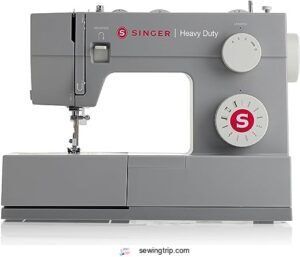
Not every machine needs a touchscreen to mean business. The Heavy Duty 4411 runs at 1,100 stitches per minute, powered by a 84W motor built to push through denim, canvas, and leather without breaking a sweat.
Its full metal frame keeps things steady at speed, and the LED work light gives you a clear view of every seam.
You get 69 stitches and a 4-step buttonhole — no frills, just function.
Manual controls, ~15 lb weight, solid 25-year warranty.
| Best For | Sewers who regularly work with heavy fabrics like denim, canvas, or leather and want a fast, reliable machine without paying for digital features they don’t need. |
|---|---|
| Built-in Stitches | 69 |
| Buttonhole Function | 4-step |
| Frame Material | Full metal |
| Work Lighting | LED |
| Bobbin System | Top drop-in |
| Machine Weight | 14.6 lb |
| Additional Features |
|
- Powerful 84W motor handles thick, layered materials without straining or skipping stitches
- Full metal frame keeps the machine stable at 1,100 stitches per minute, even during long sessions
- 25-year limited warranty gives solid long-term peace of mind for home or small-shop use
- No LCD or electronic display — stitch selection is fully manual, which can feel clunky if you’re used to digital machines
- At around 15 lbs, it’s not something you’ll want to haul around often
- US-only plug (110V), so international users will need an adapter or replacement plug
Choosing Stitch Selection Features
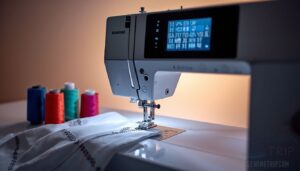
Not all stitch selection features are created equal, and the right ones can make or break a project. Before you buy, it helps to know exactly what to look for in a computerized machine.
Here are the key features worth comparing.
Built-in Stitch Count and Variety
Stitch count benchmarking separates capable machines from truly flexible ones. Entry-level models offer around 27 built-in stitches, while high-end machines like the Singer 9985 reach 960 — a full stitch library expansion covering basic, decorative, and alphanumeric categories.
Stitch density variations and stitch combination memory let you build smarter workflows. Compare built-in stitch counts before buying:
- Entry-level: 27–70 stitches
- Mid-range: 70–400 stitches
- High-end: 400–960 stitches
- Firmware stitch updates can expand options on select models
Consider the stretch stitch capability for elastic fabrics.
Utility, Stretch, Decorative, and Quilting Stitches
Beyond raw stitch count, the category breakdown is what actually matters. Utility stitches handle everyday seams, stretch stitches give your seams flexibility for knit fabrics — critical for seam flexibility with activewear — while decorative stitches add embellishment without extra tools.
For quilt making, look for machines with a dedicated quilt guide and stitch density controls that keep batting smooth.
Built-in stitches across all four categories equal real fabric compatibility.
One-step Buttonhole Options
One-step buttonhole automation is a real time-saver. You set the button size — Button Size Calibration locked in memory — and the Buttonhole Foot Design manages the rest using sensor accuracy that reads fabric position automatically. No manual stops, no guessing.
Add Fabric Stabilization Techniques on heavier materials to prevent puckering. Check Thread Tension Settings too, because inconsistent tension ruins an otherwise clean automatic buttonhole finish.
Stitch Width and Length Adjustments
Width and length are your two biggest levers. Zigzag Width Tuning runs 0–6mm, while Satin Length Ratio controls thread density for smooth fills.
For quilting, Quilt Stitch Length reduces bulk. Stretch Fabric Settings call for slightly longer length and narrower width.
Presser Foot Compatibility matters too — the wrong foot fights your stitch selection. Use digital controls and LCD display navigation to dial both in quickly.
Alphanumeric and Monogramming Capability
If monogramming is part of your workflow, Font Library Size matters more than you’d think. Top computerized sewing machines for 2026 offer 5 to 20-plus alphanumeric fonts, with Letter Height Range usually spanning 0.25 to 1.5 inches.
Kerning & Spacing controls keep initials balanced. Custom Font Import via USB expands your options further.
Monogram Stitch Style choices — satin or fill — affect the final look on any fabric.
Stitch Memory and Customization Tools
Your stitch memory function is where real control begins. Save up to 20 custom stitch patterns with preferred width, length, and tension — ready to recall instantly. Three things worth knowing:
- Custom Stitch Tags let you sort your stitch library by fabric or project.
- USB Stitch Transfer and Cloud Stitch Backup protect your digital stitch selection.
- Memory Sync Options keep custom stitch patterns consistent across compatible machines.
Controls and Display Types
The way a machine lets you interact with it matters just as much as what it can do. Some users love tapping through a bright touchscreen, while others prefer turning a physical dial and getting straight to work.
Here’s what you’ll find across the top models regarding controls and displays.
LCD Screens for Quick Stitch Selection
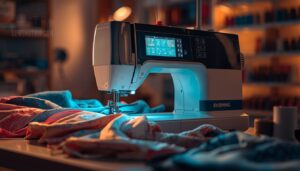
good LCD screen is basically your co-pilot at the machine.
High-contrast displays with icon clarity make digital stitch selection fast — you’re not squinting at tiny symbols mid-project. Backlight longevity keeps things readable hour after hour, and ambient light adaptation accommodates bright workshops or dim studios equally well.
Models with a custom shortcut panel and stitch pattern memory let you pull up favorites instantly.
Touchscreen Vs Button-based Navigation
Touchscreens look sleek, but they demand your eyes — high Visual Attention Load means you’re reading instead of sewing.
Glare Impact on LCD screens slows you down in bright rooms.
Physical buttons win on Tactile Feedback, letting muscle memory guide your hands.
Factor in Ergonomic Reach and Software Update Effects, too.
For quick buttonhole feature access or stitch combination memory, buttons often feel faster and more instinctive.
Manual Selectors Vs Computerized Controls
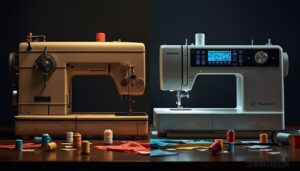
Think of a manual selector as a trusty old dial — zero User Learning Curve, instant Tactile Feedback, and Repair Simplicity that any technician can handle. But Mechanical Wear adds up.
Computerized stitch selection — whether via LCD screen or touchscreen — stores stitch combination memory and lets digital controls do the heavy lifting.
The tradeoff? Firmware Update Needs and pricier repairs when circuits fail.
Stitch Preview and On-screen Settings
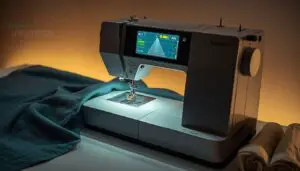
Before you sew a single stitch, your screen already knows the plan. On-screen settings and live stitch previews give you real control — no guesswork.
- Live Tension Indicators flag green, yellow, or red, so you catch problems early.
- Grid Overlay Alignment keeps patterns straight against fabric edges.
- Preset Stitch Profiles speed up setup for hems, cuffs, and quilting.
- User Favorite Management saves your go-to stitch combination memory for one-tap access.
LCD navigation and touchscreen digital sewing technology make every adjustment instant.
Speed Control and Start-stop Buttons
Once your stitch preview looks perfect, your next move is managing pace. Variable speed control lets you dial in exactly how fast the needle moves — no pedal gymnastics needed.
Soft start eases you in gently, while electronic braking stops the needle cleanly. Button debounce logic prevents accidental double-starts.
Motor PWM control keeps your speed steady, whether you’re running at a crawl or hitting top speed 850 stitches per minute.
Beginner-friendly Interface Layouts
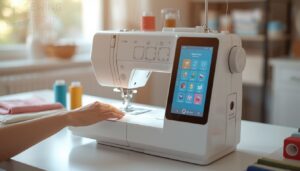
Speed sets the pace, but layout keeps beginners from quitting. A beginner-friendly sewing machine lives or dies by how fast you can find your stitch without squinting at tiny text.
Here’s what an easy-to-use interface actually looks like:
- High-Contrast UI with color-coded stitch families
- Large Icon Buttons spaced wide enough to avoid fat-finger mistakes
- Simplified Menu with a two-tap return to home
- Adjustable Brightness on the LCD screen for dim sewing rooms
- Voice Guidance in beginner mode for hands-free help
A good touchscreen with touch controls and 14-point sans-serif labels makes the whole experience feel less like programming a microwave.
Performance for Different Sewing Needs
Not every machine fits every sewer, and that gap matters more than most people realize. The right match depends on what you’re actually making — whether that’s a quilt, a pair of jeans, or an embroidered tote bag.
Here’s how the top models stack up across six key performance areas.
Best Options for Beginners
If you’re just getting started, the Brother CS7000X and Brother XM2701 are both solid beginner sewing machine picks. Both offer an easy-to-use interface, automatic needle threading, and basic stitch guides built right in.
The CS7000X adds an LCD screen for clear stitch previews, while the XM2701 keeps a compact footprint — perfect when your workspace is, well, your kitchen table.
Machines for Home Garment Sewing
For home garment sewing, fabric compatibility matters more than raw stitch count. The Brother CS7000X manages everyday fabrics well — its 70 built-in stitches cover hems, seams, and stretch panels without fuss.
Ergonomic design and quiet noise level make long sessions bearable.
Home sewers who want stitch variety and customization without a steep learning curve will feel right at home here.
Quilting-ready Models With Extension Tables
Quilting a king-size project demands real workspace. Models like the Brother CS7000X ship with a wide quilting table that expands your sewing surface considerably — and the quick-release mechanism makes setup and breakdown painless.
Look for adjustable legs, anti-skid feet for table stability, and ruler grids printed right on the surface. High-density acrylic surface materials keep fabric gliding smoothly without snagging.
Heavy-fabric Handling and Metal Frames
Denim, canvas, and leather will expose a flimsy machine fast. That’s why Frame Rigidity matters — a heavy-duty metal frame keeps needle alignment true even under pressure.
The Singer 9985’s heavy-duty metal body manages this well, backed by:
- Presser Foot Pressure that grips dense layers without slipping
- Feed Dog Strength for steady multi-layer advancement
- Heat Dissipation and Vibration Damping that protect your motor long-term
Lightweight Machines for Portability
When portability is the priority, lightweight design wins every time.
The Brother XM2701 clocks in at 12.6 lb with a compact footprint, carry handle design, and 27 built-in stitches on a simple LCD screen.
Pair it with travel case integration and foldable accessories, and you’re sewing-ready anywhere. Some portable models even support battery power options, giving you two to six hours of uninterrupted stitching on the go.
Advanced Models for Decorative Stitching
When decorative stitching is your craft, the Singer Quantum Stylist 9985 is hard to beat — 919 built-in decorative stitches, Stitch Density Control, and Border Repeat Programming let you create smooth borders without constant repositioning.
Its touchscreen interface previews Embroidery Alignment Mode in real time.
Add Dual Feed Foot support and Stabilizer Guidance, and your stitch memory and programmable functions keep every decorative sequence consistent.
Convenience Features Worth Comparing
Stitch count gets the spotlight, but the features that save your sanity are often the ones hiding in plain sight. A needle threader or auto thread cutter can quietly change how much you actually enjoy sitting down to sew.
Here’s what’s worth paying attention to before you buy.
Automatic Needle Threaders
Threading a needle by hand is basically a rite of frustration — automatic needle threading technology fixes that fast. The built‑in hook mechanism types vary, but most use a small tensioned wire that dips through the eye and pulls a thread loop through cleanly. Activation lever design matters too; smoother levers mean fewer jams.
Automatic needle threading ends the frustration of hand-threading by guiding the thread through cleanly every time
Keep these Threader Maintenance Tips in mind:
- Clean lint from the thread path before every use
- Check the wire hook for bending or dullness regularly
- Confirm Threader Compatibility with your needle size (65–90 range is standard)
- Follow Troubleshooting Threader Jams steps: re-seat the needle, then retry
- Store your machine with the presser foot up to protect the mechanism
Automatic Thread Cutters
One press, and both threads vanish — that’s what a quality automatic thread cutter delivers. Singer 9985 and 9960 nail this with cutters built near the needle plate, so Cutter Placement keeps fabric disturbance minimal. Blade Safety Mechanism prevents cuts mid-stitch.
| Feature | Singer 9985 | Singer 9960 |
|---|---|---|
| Cutting Speed Control | Auto | Auto |
| Thread Type Compatibility | Cotton/Poly | Cotton/Poly |
| Maintenance Schedule | Per 1,000 stitches | Per 1,000 stitches |
Auto-adjusting Thread Tension
Thread tension used to be the part that made beginners cry. Adaptive Tension Feedback manages it automatically.
A computerized sewing machine with Servo-driven Discs adjusts pressure in real time through Real-time Monitoring and Sensor Calibration — no manual dial needed.
automatic thread tension control does for you:
- Fabric Weight Adaptation shifts tension between chiffon and denim seamlessly.
- Sensors detect thread resistance and micro-correct instantly.
- Balanced stitches stay consistent across your built-in stitches library.
Needle Up/down Programming
Needle up/down programming puts you in command of every stop. With digital controls and stitch memory, machines like the Singer 9960 let you set Seam Start Precision and Corner Pivot Control automatically.
Fabric Lift Reduction and Stitch Endpoint Safety keep heavy fabrics aligned. For Quilt Trapunto Positioning, needle down acts like an electronic autopilot — holding your place precisely.
LED Lighting and Workspace Visibility
Good visibility is half the battle. The Singer 9960’s LED-lit work area delivers around 600–750 lux right at the needle — enough to catch every thread color accurately. A high Color Rendering Index (90+) means your fabric colors stay true.
Prioritize these three:
- Adjustable Brightness Controls for dimming
- Glare Reduction Strategies using diffused LEDs
- Smart Task Lighting Placement near the needle plate
Free Arm Design and Accessory Storage
Beyond lighting, think about access. A detachable arm mechanism — what sewers call the free arm — lets you slide sleeves and cuffs right under the needle without bunching fabric.
Look for a polished arm material finish (metal beats plastic for durability), integrated storage compartments with quick release latches, and magnetic foot holders that actually keep your presser feet from rattling loose mid-project.
Price, Accessories, and Long-Term Value
Picking the right machine isn’t just about stitch count — it’s about what you get for your money and how long it’ll last. From budget-friendly picks under $200 to premium models pushing past $700, there’s a real range here worth knowing.
Here’s how the top choices stack up across price, accessories, and long-term value.
Budget-friendly Stitch Selection Machines
You don’t need to spend a fortune to get real stitch variety. Budget-friendly computerized sewing machines usually retail between $100 and $300, offering solid Cost-Feature Balance for new sewists.
Most pack 60 to 100 built-in stitches with a decent Thread Compatibility Range across cotton and poly blends.
Key wins at this price range comparison:
- Low Noise and Vibration on standard fabrics
- Simple Beginner Setup Ease with drop-in bobbins
- Button-based stitch variety navigation
- Reliable Customer Service Access through major retailers
Mid-range Models With Quilting Features
Step up to the $200–$400 range, and quilting stops being a workaround — it becomes the whole point. These top computerized sewing machines for 2026 are built around quilting-specific sewing machine options like free motion capability, aluminum frame stability, and real Throat Space Size (6–9 inches).
| Feature | Entry-Level | Mid-Range Quilting |
|---|---|---|
| Built-in Stitches | 27–70 | 80–200 |
| Throat Space Size | Under 6 in | 6–9 in |
| Quilting Foot Variety | 1–3 feet | Full quilting set |
| Free Motion Capability | Rarely | Standard |
| Aluminum Frame Stability | Occasional | Consistent |
extension tables for quilt block alignment, a free arm, and enough stitch range for serious piecing work.
Premium Machines With Large Stitch Libraries
Once you cross the $700 mark, stitch variety and customization reach a different level entirely.
The Singer Quantum Stylist 9985 delivers 960 built-in stitches with strong Stitch Library Organization, Embroidery Motif Integration, and stitch-combination memory via its touchscreen LCD screen. Firmware Update Capability and Digital Pattern Transfer keep your library fresh.
An Enhanced Feed Mechanism processes denim and canvas without skipping a beat.
Included Presser Feet and Wide Tables
What’s in the box matters more than you’d think.
The Brother CS7000X ships with a wide quilting table, 10 presser feet, and Snap-On Foot Systems with Quick-Release Levers for tool-free swaps.
Foot Compatibility covers zipper, buttonhole, and walking feet.
A free arm manages cuffs and sleeves, while Table Extension Mechanisms and a sturdy metal frame keep large projects steady.
Hard Cases and Travel-friendly Extras
Carrying your machine shouldn’t feel like a risk. A hard case with Impact Resistant Shell protects against rough handling, while 360° Inline Wheels and a Foldable Carry Handle make travel smooth. Removable Divider Panels keep your accessory bundle organized, and a UV Resistant Finish prevents wear over time.
- Hard protective case absorbs drops and vibration
- Lightweight design fits airline overhead compartments
- Portable storage keeps feet, bobbins, and cords secure
Warranty Coverage and Support Considerations
A solid warranty is your safety net. Brother CS6000i backs you up with a 25-year limited warranty and free lifetime technical support — that’s hard to beat on warranty length alone.
Check claim documentation requirements upfront: you’ll need proof of purchase and your serial number. Service response time normally runs 30 days.
Extended coverage plans and international warranty validity vary by region, so confirm before buying.
Frequently Asked Questions (FAQs)
What is stitch selector sewing machine?
A stitch selector is your machine’s command center — a dial, button panel, or touchscreen that lets you cycle through built-in stitches and dial in stitch length and width with precision.
Is it worth it to get a computerized sewing machine?
Yes, absolutely.
Computerized machines reduce the learning curve fast and pay off with long-term savings.
You get stitch variety, automatic needle threading technology, and LCD and touchscreen interfaces built right in.
What is the difference between a sewing machine and a computerized sewing machine?
A traditional sewing machine runs on mechanical controls — dials, levers, your hands. A computerized sewing machine stores stitches in memory, uses an LCD screen, and manages tension automatically.
Less guesswork, more control.
What is the best sewing machine on the market right now?
The Brother CS7000X stands out as the best overall sewing machine for home use right now. It offers 70 stitches, strong brand reputation, and glowing user reviews — all under $
How do I maintain the stitch quality on my computerized sewing machine?
Consistent care solves most stitch problems.
Check your thread tension calibration, keep up a bobbin maintenance routine, and monitor needle condition regularly. Clean lint often, adjust presser foot pressure for thick layers, and you’ll protect stitch precision every time.
What are the benefits of computerized stitch selection over manual dials?
Computerized stitch selection beats manual dials on every front.
You get Error Reduction, Consistent Stitch Quality, and Time Efficiency built right in — plus Fabric Adaptability that adjusts automatically, boosting your User Confidence with every seam.
Can I use my computerized machine for embroidery projects?
Yes — many computerized sewing machines handle embroidery beautifully.
Load designs via USB design import support, snap on your Embroidery Hoop Compatibility-ready foot, add Stabilizer Usage beneath the fabric, and switch to Embroidery Mode.
Done.
What accessories are recommended for advanced sewing on a computerized machine?
Stock up on specialty needle sets, a stabilizer variety pack, and thread storage solutions.
Add quilting frames, foot pressure adjusters, an extension table, and a quilt table.
Features like an LED light, a USB port, and an automatic thread cutter round things out.
Can computerized machines sew through multiple fabric layers?
Absolutely — most computerized machines handle multilayer fabrics well.
A walking foot mechanism, heavy-duty feed system, and layered fabric tension control keep stitches even through denim, canvas, or quilted stacks without skipping.
How often do computerized sewing machines need servicing?
Think of it like a car — skip the oil change long enough, and you’ll pay for it.
Plan on professional servicing every 12 to 18 months for casual use, or every 6 months with heavy daily sewing.
Conclusion
A tailor once said, the right tool doesn’t just finish the job—it changes what you’re willing to attempt. That’s exactly what the best computerized sewing machines with stitch selection do.
They turn hesitation into confidence, and simple repairs into something worth keeping.
You’ve seen the specs, the price points, and the standout features. Now the only stitch left is the one you make. Pick your machine and start creating something worth showing off.