This site is supported by our readers. We may earn a commission, at no cost to you, if you purchase through links.
Most people buying their first sewing machine make the same mistake: they over-invest. They spend $300+ on features they won’t touch for years, then feel buried under complexity when they should be learning the basics.
The Brother XM1010 takes the opposite approach—10 stitches, a clean mechanical design, and a price point that won’t sting if it collects dust during the learning curve. Whether that stripped-down simplicity is its greatest strength or a dealbreaker depends entirely on what you need from a machine right now.
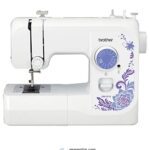
The Brother XM1010 is a solid pick if you’re just getting started with sewing and don’t want to feel overwhelmed right out of the box. The drop-in top bobbin is genuinely easy to load, and the diagram printed right on the machine for needle threading means you’re not constantly hunting for the manual. You get 10 built-in stitches — enough to cover hemming, basic repairs, and some simple decorative work — and the free arm attachment makes sewing cuffs and sleeves much less frustrating than you’d expect at this price point.
That said, it’s not without quirks. The built-in light is dim and slightly off-center, so good task lighting nearby isn’t optional. Thread tension can get fussy if you don’t thread the machine exactly right, which takes a few tries to nail down. The foot pedal cord is also on the short side, so think about where you’re placing it before you get started.
At 7 pounds, it stores easily and moves without hassle. Don’t expect it to push through canvas or upholstery — it won’t — but for everyday fabric work, it holds its own.
Best For: Beginners who want a lightweight, easy-to-use machine for everyday mending, hemming, and basic sewing projects at home.
- Drop-in top bobbin with jam-resistant design makes loading quick and straightforward
- Threading diagram printed on the machine reduces setup frustration, especially for new sewers
- Free arm design lets you work on cuffs, sleeves, and narrow fabric sections with ease
- Built-in lamp is dim and off-center, so you’ll need external lighting for detailed work
- Thread tension is sensitive to threading mistakes, which can cause skipped stitches or bunching
- Short foot pedal cord limits where you can position the machine on your workspace
Table Of Contents
Key Takeaways
- The Brother XM1010’s stripped-down design—10 stitches, 10.8 lbs, and a drop-in bobbin—makes it one of the least intimidating entry points into sewing, so you can focus on building skills instead of decoding a control panel.
- Its metal frame, LED work area, and 25-year warranty punch above its price tag, giving you a machine that won’t fall apart while you’re still figuring out tension settings.
- Where it genuinely struggles is heavy fabrics and decorative stitching—if denim, canvas, or embellishment work is on your radar soon, the XM2701 or Singer 3232 will serve you better without costing much more.
- The manual needle threader and four-step buttonhole add friction to your workflow, but they also mean fewer breakable parts near the needle—a fair trade-off for long-term reliability on a beginner budget.
Brother XM1010 Key Features and Specs
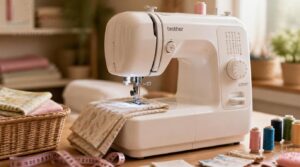
The Brother XM1010 keeps things straightforward — and that’s exactly the point. Before you decide if it belongs on your sewing table, it helps to know what you’re actually working with. Here’s a look at the key features that define this machine.
Its simplicity makes it a genuinely great starting point, especially if you’re looking for sewing machine tutorials designed for kids to help young beginners get comfortable at the machine.
10 Built-in Stitches Explained
The Brother XM1010 comes with 10 built-in stitches split between utility and decorative functions. You get essentials like straight, zigzag, blind hem, and stretch stitches for knits, plus a four-step automatic buttonhole. Edge finishing stitches lock raw edges without a serger.
It’s a focused, practical set — enough to handle real projects without overwhelming you. Understanding common built-in stitches is essential for achieving professional results.
Lightweight Portable Design
The XM1010 weighs just 10.8 pounds, so carrying it between rooms — or tossing it in a bag for a class — isn’t a workout. Its compact 15.4" x 5.8" x 12.1" footprint fits easily into small craft spaces. The internal metal frame keeps it sturdy without adding bulk, making it genuinely travel-ready for beginners who sew on the go.
LED-Lit Work Area
The LED-illuminated work area makes a real difference when you’re squinting at tiny stitches or threading dark fabric. It delivers a color temperature of 4000K–5000K, giving you clean, daylight-quality light without harsh glare. That means fewer mistakes and less eye strain during long sessions.
It also consumes minimal power, with LED efficiency running up to 80% better than older incandescent setups.
Durable Internal Metal Frame
Good lighting only helps if the machine underneath can hold its ground.
The durable internal metal frame on the XM1010 is built from cold-rolled steel rated at a minimum yield strength of 210 megapascals — it won’t flex or warp under repeated use. Integrated dampening pads reduce vibration, and the corrosion-resistant coating holds up for years of regular sewing.
Maximum Speed and Stitch Dimensions
The XM1010 tops out at 750 stitches per minute — steady and controlled, not blazing fast. That’s actually a good thing for beginners.
Your stitch length adjusts up to 4 mm, while zigzag width reaches 5 mm. Together with the stitch selection dial and adjustable thread tension, you get reliable stitch quality across all 10 built-in stitches without overwhelming yourself.
Bobbin and Threading System Breakdown
The bobbin and threading system is where a lot of beginners run into frustration—so it’s worth knowing exactly what you’re working with before you sit down to sew. The XM1010 keeps things pretty straightforward, which is good news if you’ve tangled with finicky bobbins before. Here’s a closer look at how each part of the system works.
If you want to nail it from the start, this guide on how to thread a bobbin walks you through the process step by step.
Jam-Resistant Drop-in Top Bobbin
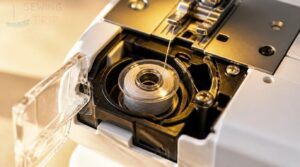
The jam-resistant drop-in top bobbin on the Brother XM1010 is one of its most beginner-friendly features. You simply drop the bobbin in from the top — no fumbling underneath.
The bobbin alignment system guides thread through fixed channels automatically, keeping tension consistent. Corrosion-resistant materials mean it holds up over time, and the top-loading design dramatically reduces frustrating mid-project thread jams.
Automatic Bobbin Winding System
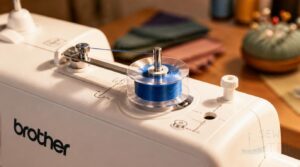
Winding your own bobbin doesn’t have to be a hassle. The automatic bobbin winding system on the XM1010 manages the heavy lifting for you. Drop the thread in, press the spindle, and the machine takes over — using a traverse guide to distribute thread evenly across the bobbin face and a tension control mechanism to keep fill consistent.
- Maintains steady tension across light to medium threads
- Traverse motion prevents uneven buildup on bobbin edges
- Automatic stop feature halts winding when the bobbin is full
- Spindle precision design keeps runout under 0.05 mm for clean winding
- Winding speed adjustment protects delicate threads from snapping
Clear-View Bobbin Cover
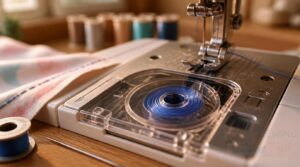
The clear-view bobbin cover on the Brother XM1010 is one of those small details that makes a real difference. It’s fully transparent, so you can monitor thread levels mid-project without stopping to lift anything.
The cover snaps firmly into place, resists yellowing over time, and wipes clean with a damp cloth. Just avoid harsh solvents — they’ll cloud it fast.
Manual Needle Threading Process
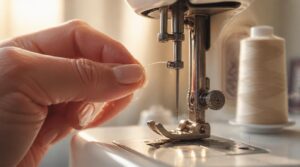
Threading by hand takes patience, but it’s manageable once you know the steps. The XM1010 uses a manual needle threading system, so you’ll guide the thread yourself.
Cut a clean, straight tip, wet it slightly, and aim directly through the eye. Pull a 1–2 inch tail after threading to seat it properly and reduce skipped stitches.
Presser Feet and Sewing Capabilities
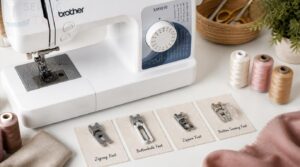
The XM1010 comes with four presser feet, and each one opens up a different type of sewing task. Knowing what’s included helps you understand exactly what this machine can handle out of the box. Here’s a look at what you get.
Included Presser Feet Options
The XM1010 ships with five presser feet.
The all-purpose foot manages straight and zigzag stitches on light to medium fabrics. The zipper foot lets you stitch close to zipper teeth for clean insertion. The buttonhole foot produces consistent buttonholes. The overedge foot finishes raw edges to stop fraying. The walking foot feeds multiple layers evenly without shifting.
Free Arm for Cuffs and Sleeves
The removable free arm is one of those small features that quietly changes how you sew. Slide off the accessory plate and you expose a narrow tubular surface perfect for sewing cuffs and sleeves.
- Slide the sleeve over the arm instead of fighting flat fabric
- Keep curved edges aligned with less pinning
- Finish sleeve hems and cuffs with consistent seam allowances
Twin Needle Compatibility
The Brother XM1010 features twin needle capability, which lets you sew two parallel rows simultaneously. It has adequate needle plate clearance for twin needles up to 5.0 mm wide.
Use an appropriate presser foot with an elongated slot. Each needle needs its own thread path management from separate spools to prevent tension issues.
Buttonhole and Zipper Techniques
The four-step buttonhole process on the XM1010 is straightforward once you attach the buttonhole foot and mark your fabric. Use a stabilizer underneath to keep the opening from distorting.
For zippers, swap in the zipper foot for clean zipper insertion along either seam edge. Always test both techniques on scrap fabric first.
Limitations of The Brother XM1010
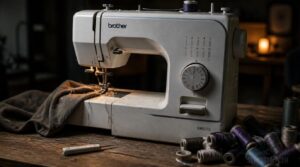
The Brother XM1010 is a solid starter machine, but it’s not perfect for everyone. Before you buy, it’s worth knowing where it falls short. Here’s what to watch out for.
Very Limited Built-in Stitches
Ten stitches sounds like plenty — until you actually sit down to sew. The Brother XM1010 gives you 10 built-in stitches, but the stitch variety constraints become clear fast. Here’s what you’re working with:
- Basic straight and zigzag stitches
- Stretch stitch for light knits
- Blind hem for clean finishes
- One automatic buttonhole style
There are no decorative stitch options — no satin, no cross stitch, nothing for embellishment. Stitch customization limits are equally tight: width tops out at 5mm and length at 4mm. For a beginner model, that’s workable. But if your goals grow, this 10-stitch sewing machine will feel small quickly.
No Automatic Needle Threader
Threading a needle by hand is one of those small tasks that slows you down more than you’d expect. The Brother XM1010 has no automatic needle threader — you guide the thread through the eye manually every time. For a beginner-friendly mechanical sewing machine, that adds setup time.
The upside? Fewer moving parts near the needle means greater long-term durability on this entry-level sewing machine.
Fewer moving parts near the needle means greater long-term durability on this entry-level machine
Struggles With Heavy Fabrics
Heavy fabrics like denim or canvas can push the XM1010 to its limits. At 750 stitches per minute max, the motor strains under bulk, increasing wear over time. Here’s what to watch:
- Use a size 90/14 or 100/16 needle to prevent deflection
- Slow your speed for motor load management
- Increase stitch length to avoid fabric tearing
- Clip layers to reduce fabric slippage
Manual Buttonhole Process
The Brother XM1010’s four-step buttonhole requires hands-on attention. Unlike automated machines, you’ll manually control each phase using the buttonhole foot and stitch selection dial. Keep stitch density tight — around 1–2mm spacing per side — and choose waxed polyester thread for clean edges.
| Step | Key Action |
|---|---|
| Mark fabric | Apply interfacing first |
| Stitch edges | 10–15 passes per side |
| Cut center slit | Use sharp scissors carefully |
| Reinforce edges | Apply fray check sealant |
Brother XM1010 Vs. Comparable Machines
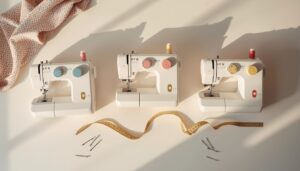
The XM1010 doesn’t exist in a vacuum — there are other beginner machines sitting in the same price range, and the differences matter. Before you decide, it helps to see how it stacks up against two close competitors. Here’s a side-by-side look at what each machine brings to the table.
Brother XM1010 Vs. XM2701
If you’re choosing between these two, the core trade-off is clear. The XM1010 gives you 10 built-in stitches and a lightweight and portable design, while the XM2701 adds 27 stitches, an automatic needle threader, and a one-step buttonhole — making it noticeably more beginner-friendly for anyone who wants less manual fuss from the start.
| Feature | XM1010 vs XM2701 |
|---|---|
| Stitch Variety | 10 vs 27 stitches |
| Buttonhole Automation | Manual 4-step vs automatic |
| Needle Threader | None vs automatic |
| Presser Feet | 4 vs 6 included |
Brother XM1010 Vs. Singer Simple 3232
Two machines, two philosophies. The XM1010 keeps things simple with 10 built-in stitches and a lightweight build, while the Singer Simple 3232 gives you 32 stitches and a built-in needle threader for faster setup.
| Feature | XM1010 | Singer 3232 |
|---|---|---|
| Built-in Stitches | 10 | 32 |
| Needle Threader | Manual | Automatic |
| Bobbin System | Drop-in top | Front-loading |
Which Beginner Machine Wins
No single machine wins for everyone. The Brother XM1010 fits beginners who want portability and simplicity at a lower cost. The XM2701 and Singer 3232 suit those ready for more stitch variety. Here’s a quick comparison:
| Feature | XM1010 | XM2701 | Singer 3232 |
|---|---|---|---|
| Built-in Stitches | 10 | More | 32 |
| Needle Threader | Manual | Automatic | Automatic |
| Portability | Lightest | Moderate | Moderate |
| Best For | Beginners | Intermediate | Feature-seekers |
Frequently Asked Questions (FAQs)
How do I connect my Brother Brother printer to WIFI?
The XM1010 is a sewing machine, not a printer — it doesn’t connect to Wi-Fi. For wireless Brother printer setup, use the Wireless LAN setup wizard or the Brother iPrint&Scan app.
How do I set my Brother’s sewing machine to straight stitch?
Turn the stitch selection dial to the straight stitch setting. Set thread tension to mid-range, align your needle, lower the presser foot, and run a test stitch on scrap fabric first.
Is Brother a Chinese company?
No, Brother isn’t a Chinese company. It’s Japanese-owned, founded in 1908 and headquartered in Nagoya, Japan. Manufacturing happens globally, including China, but Japanese leadership drives all strategy and brand decisions.
How do I reset my Brother fax machine?
This review covers the Brother XM1010 sewing machine. To reset a Brother fax machine, go to Menu > Reset, choose your reset type, confirm, then power cycle the device to reinitialize settings.
Can it sew thick fabrics?
It can handle light to medium fabrics well. For thick layers, use a heavy fabric needle (90/14–100/16), slow to stitch length 5mm, and buy a walking foot separately — the motor struggles otherwise.
What types of needles does it use?
It uses standard home sewing needles, usually sizes 9– The included three-piece needle set covers everyday fabrics. Use ballpoint or stretch needles for knits. No automatic threader — you thread it manually.
Does it have a reverse stitch button?
Like hunting for a light switch in a dark room, you won’t find a reverse stitch button here. The XM1010 uses a reverse sewing lever instead for seam reinforcement.
How easy is it to clean?
Cleaning this machine is quick. Top panel access and a clear-view bobbin cover make inspection simple. Wipe the exterior down with a damp cloth. Most maintenance tasks take under five minutes.
Whats the warranty period?
The 25-year limited warranty covers defects in materials and workmanship. Check your User Guide for claim steps and exclusions. Normal wear and unauthorized repairs void coverage. Contact Brother technical support to start a claim.
What warranty does the Brother XM1010 come with?
The Brother XM1010 comes with a 25-year limited warranty covering defects in materials and workmanship. It’s non-transferable and requires proof of purchase. Normal wear parts like needles aren’t covered.
Conclusion
What does a beginner actually need—every feature imaginable, or just enough to start building real skills? The Brother XM1010 answers that question honestly.
It won’t embroider your ambitions or power through heavy denim, but it will teach you to sew without drowning you in options. If you’re still finding your footing with fabric, that stripped-down simplicity isn’t a limitation—it’s the whole point.
Start here, build your confidence, and outgrow it when you’re ready.