This site is supported by our readers. We may earn a commission, at no cost to you, if you purchase through links.
seam sewn a millimeter off-center ruins an otherwise perfect garment. That’s not a beginner’s mistake—it’s a machine problem.
older mechanical models drift under pressure, lose tension mid-stitch, and leave you compensating by hand for what the hardware should handle automatically.
Computerized sewing machines with precision sewing capabilities solve this at the hardware level: sensor-driven tension, LCD stitch feedback, and speed control that holds consistency whether you’re stitching silk or stacking denim.
The ten machines ahead cover the full range—from featherweight portables to steel-framed workhorses—so you can match the right tool to the work you’re actually doing.
Table Of Contents
- Key Takeaways
- Top 10 Computerized Sewing Machines
- 1. Brother XM2701 Lightweight Sewing Machine
- 2. Brother CP60X 60 Stitch Sewing Machine
- 3. Singer Quantum Stylist 9960 Sewing Machine
- 4. Brother HC1850 Sewing and Quilting Machine
- 5. Singer Heavy Duty 4411 Sewing Machine
- 6. Brother XR3774 Sewing Quilting Machine
- 7. Singer C5200 Computerized Sewing Machine
- 8. Brother Strong Tough Heavy Duty Sewing Machine
- 9. Singer Quantum Stylist 9985 Sewing Machine
- 10. Feiyue FY710 Computerized Sewing Machine
- Precision Sewing Benefits
- Key Precision Features
- Beginner Vs Advanced Machines
- Choosing The Right Machine
- Keeping Stitching Accurate
- Frequently Asked Questions (FAQs)
- Conclusion
Key Takeaways
- Computerized sewing machines solve mechanical drift at the hardware level through sensor-driven tension, LCD feedback, and consistent speed control — so you stop compensating and start creating.
- Matching the right machine to your work matters more than chasing specs: lightweight portables suit beginners and travel, while metal-framed heavy-duty models handle denim, leather, and canvas without skipping a beat.
- Features like automatic needle threading, one-step buttonholes, and adjustable stitch length and width aren’t just conveniences — they’re what separates clean, repeatable results from constant rework and wasted fabric.
- Even the most precise machine regular maintenance without regular maintenance: clean the bobbin area after every session, replace needles every 4–8 hours, and match your stitch settings to the fabric you’re actually sewing.
Top 10 Computerized Sewing Machines
Finding the right computerized sewing machine comes down to knowing what each one actually does well. Whether you’re chasing precision on delicate fabrics or pushing through heavy-duty projects, the options below cover real ground.
If you’re still figuring out where to start, this guide to computerized sewing machines with easy operation helps match the right features to your actual skill level.
Here are the top 10 machines worth your attention in 2026.
1. Brother XM2701 Lightweight Sewing Machine
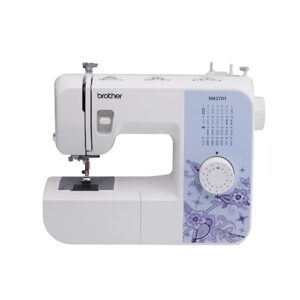
The Brother XM2701 is a solid starting point if you want reliable results without a steep learning curve. At just 12.6 pounds, it’s easy to move around and store.
You get 27 built-in stitches, a drop-in bobbin that loads in seconds, and an automatic needle threader that saves real frustration.
The free arm accommodates cuffs and sleeves cleanly.
Backed by a 25-year warranty and lifetime support, it’s built to grow with your skills.
| Best For | Beginners and hobbyists who want an easy-to-use, reliable machine for everyday sewing projects like garments, quilts, and home décor. |
|---|---|
| Built-in Stitches | 27 |
| Bobbin System | Drop-in top bobbin |
| Auto Needle Threader | Yes |
| Free Arm | Yes |
| Machine Weight | 12.6 lb |
| Warranty | 25-year limited |
| Additional Features |
|
- Automatic needle threader and drop-in bobbin make setup quick and frustration-free
- 27 built-in stitches cover everything from basic hems to decorative work
- Lightweight at 12.6 lbs with a 25-year warranty and lifetime support
- Struggles with heavy fabrics like denim or upholstery
- No advanced computerized features like stitch memory or LCD editing
- Only works with US voltage — using it abroad voids the warranty
2. Brother CP60X 60 Stitch Sewing Machine
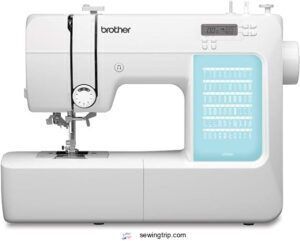
Step up from the basics, and the CP60X gives you real room to grow.
It packs 60 built-in stitches — utility, decorative, and heirloom — into a metal-framed machine that weighs just 14 pounds.
The backlit LCD makes stitch selection quick, and the automatic needle threader cuts your setup time in half.
Seven presser feet come included, so you’re ready for everything from buttonholes to quilting right out of the box.
Solid, capable, and surprisingly approachable.
| Best For | Beginners and hobbyists ready to move past entry-level machines without jumping into anything too complicated. |
|---|---|
| Built-in Stitches | 60 |
| Bobbin System | Quick-Set drop-in |
| Auto Needle Threader | Yes |
| Free Arm | Yes |
| Machine Weight | 14 lb |
| Warranty | Limited US only |
| Additional Features |
|
- 60 built-in stitches plus an LCD screen make it easy to find and switch between options without digging through a manual
- The automatic needle threader and quick-set bobbin save real time, especially if you sew regularly
- Metal frame gives it enough stability to handle mid-weight fabrics like denim and quilting cotton
- The plastic housing can feel a bit flimsy if you’re sewing for hours at a stretch
- Struggles with very thick layers or heavy-duty materials, so it’s not ideal for upholstery or canvas work
- Twin needles aren’t included, so specialty techniques like pintucking cost you extra right out of the box
3. Singer Quantum Stylist 9960 Sewing Machine
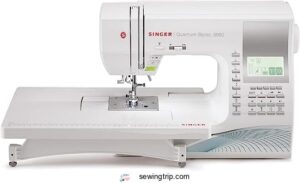
Ready to go further? The Singer Quantum Stylist 9960 takes everything up a notch.
You get 600 built-in stitches, 13 automatic one-step buttonhole styles, and a full-color LCD that makes navigation feel smooth.
The metal frame supports heavy fabrics without flinching, and the automatic needle threader plus integrated thread cutter keep your workflow moving.
At $540.99, it’s a serious machine for serious work — built for sewists who want precision, not guesswork.
| Best For | Intermediate to advanced sewists who want a feature-packed machine that can handle everything from garment sewing and quilting to decorative work and monogramming. |
|---|---|
| Built-in Stitches | 600 |
| Bobbin System | Top drop-in bobbin |
| Auto Needle Threader | Yes |
| Free Arm | Yes |
| Machine Weight | 14.6 lb |
| Warranty | 25-year limited |
| Additional Features |
|
- 600 stitch types and 13 automatic buttonhole styles give you serious creative range without needing a second machine
- The automatic needle threader, integrated thread cutter, and top-drop bobbin make setup and mid-project interruptions way less annoying
- Comes loaded with 13 presser feet plus a walking foot and extension table, so you’re not buying extras right out of the box
- The throat space is on the smaller side, which can make maneuvering big quilt layers a bit of a wrestling match
- At nearly 15 pounds, it’s not something you’ll want to lug around without a dedicated cart or case
- Beginners might feel overwhelmed by the sheer number of features — there’s a real learning curve before it all clicks
4. Brother HC1850 Sewing and Quilting Machine
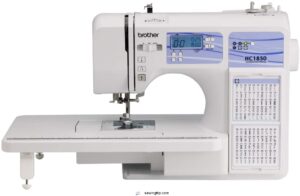
If the 9960 is your workhorse, the Brother HC1850 is your adaptable everyday companion — lighter, friendlier, and surprisingly capable.
You get 185 built-in stitches, eight presser feet, and a drop-in bobbin that practically loads itself. The automatic needle threader alone saves your sanity during long sessions.
At just 10.1 pounds and $299.99, it’s easy to carry to classes or workshops without breaking your back.
Quilters especially love the spring-action quilting foot and detachable wide table included right out of the box.
| Best For | Hobbyists, quilters, and beginners who want a versatile, easy-to-use machine for everyday sewing, garment work, and light quilting without spending a fortune. |
|---|---|
| Built-in Stitches | 185 |
| Bobbin System | Drop-in top bobbin |
| Auto Needle Threader | Yes |
| Free Arm | Yes |
| Machine Weight | 10.1 lb |
| Warranty | 25-year limited |
| Additional Features |
|
- 185 built-in stitches plus automatic needle threading and a drop-in bobbin make setup fast and frustration-free
- Comes loaded with accessories — 8 presser feet, a wide table, and a quilting foot — so you’re ready to go right out of the box
- Lightweight and portable enough to toss in the car for classes or sewing groups
- Only works on 120V power, so it’s strictly a US machine — using it abroad voids the warranty
- Not built for heavy-duty work; thick fabrics or multiple layers can push it to its limits
- The edge-hemming foot isn’t included, so that’s an extra purchase if you need it
5. Singer Heavy Duty 4411 Sewing Machine
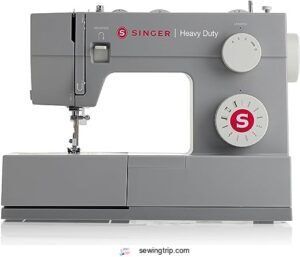
When raw power matters, the Singer Heavy Duty 4411 steps up.
Its 50% stronger motor tears through denim, canvas, and leather at up to 1,100 stitches per minute — no strain, no skipped stitches.
You get 69 built-in stitches, a full metal frame, and a stainless steel bed plate built for long-term use.
The automatic needle threader and LED lighting keep your workflow moving.
At 14.6 lb with a 25-year head warranty, it’s built to last.
| Best For | Sewers who regularly work with heavy fabrics like denim, leather, or canvas and need a machine that can keep up without breaking a sweat. |
|---|---|
| Built-in Stitches | 69 |
| Bobbin System | Top drop-in bobbin |
| Auto Needle Threader | No |
| Free Arm | No |
| Machine Weight | 14.6 lb |
| Warranty | 25-year limited |
| Additional Features |
|
- The 50% stronger motor handles thick, layered materials at up to 1,100 stitches per minute — fast and strain-free.
- A full metal frame and steel bed plate mean this thing is built to last, backed by a 25-year head warranty.
- 69 built-in stitches plus LED lighting and a clear bobbin view make it easy to stay accurate on any project.
- It’s US-only out of the box — if you’re outside North America, you’ll need an adapter or plug swap.
- No display screen means stitch selection is all manual, which takes some getting used to.
- At nearly 15 lb, it’s not the easiest machine to move around or tuck away between uses.
6. Brother XR3774 Sewing Quilting Machine
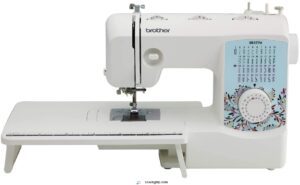
If quilting is your passion, the Brother XR3774 is built to keep up with your ambition. It delivers 37 built-in stitches covering utility, decorative, and quilting applications — plus a one-step automatic buttonhole for clean, consistent results every time.
The included wide table extension gives you real workspace when managing larger fabric pieces.
Eight presser feet, a jam-resistant drop-in bobbin, and an automatic needle threader mean less setup hassle and more actual sewing.
At around 15 lb, it’s sturdy yet manageable.
| Best For | Beginners and intermediate sewers or quilters who want a reliable, feature-packed machine without a steep learning curve. |
|---|---|
| Built-in Stitches | 37 |
| Bobbin System | Top-loading drop-in |
| Auto Needle Threader | Yes |
| Free Arm | Yes |
| Machine Weight | 15 lb |
| Warranty | US only limited |
| Additional Features |
|
- 37 built-in stitches plus a one-step buttonhole give you plenty of options for everyday sewing and quilting projects.
- The automatic needle threader and drop-in bobbin make setup quick and frustration-free.
- Comes loaded with accessories — 8 presser feet, a wide table extension, and an instructional DVD — so you’re ready to go right out of the box.
- It gets noisy and vibrates noticeably at higher speeds or with heavier fabrics.
- Struggles with very thick materials like plush fleece or heavy upholstery, so it’s not ideal for serious heavy-duty work.
- The extension table can shift under large projects, and the needle threader can be finicky if you’re not gentle with it.
7. Singer C5200 Computerized Sewing Machine
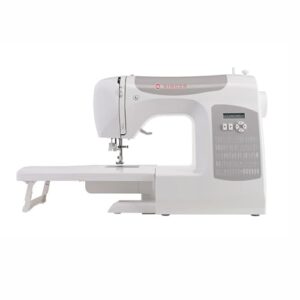
The Singer C5200 means business.
You get 180 built-in stitches, six one-step buttonhole styles, and a touch-button selector with an LCD that shows exactly what you’re working with — stitch type, length, and width, all at a glance.
The heavy-duty metal frame manages multiple fabric layers without flinching, while the built-in needle threader and LED lighting keep your workspace sharp.
Add the removable extension table and free-arm capability, and you’ve got a machine that adjusts for nearly any project you throw at it.
| Best For | Home sewers and hobbyists who work across a range of projects — from quilting and apparel to home décor — and want a reliable, feature-rich machine without jumping to industrial-grade equipment. |
|---|---|
| Built-in Stitches | 180 |
| Bobbin System | Drop-in bobbin |
| Auto Needle Threader | Yes |
| Free Arm | Yes |
| Machine Weight | 13.8 lb |
| Warranty | Limited warranty |
| Additional Features |
|
- 180 built-in stitches with touch-button selection make it easy to switch between projects without a lot of fuss
- The heavy-duty metal frame holds steady on thick fabrics and multiple layers, so your stitching stays consistent
- The removable extension table and free-arm setup give you real flexibility — whether you’re hemming jeans or piecing together a quilt
- Some users run into bobbin issues and thread jams, which can mean downtime or a trip to the service center
- The needle threader can be hit or miss on certain units, so you might end up threading by hand anyway
- There’s no solid printed manual in the box, so expect to lean on YouTube if something goes sideways
8. Brother Strong Tough Heavy Duty Sewing Machine
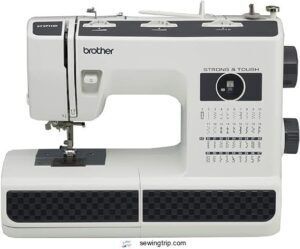
Built for the jobs that break lesser machines, the Brother Strong & Tough doesn’t apologize for its ambition. Its metal interior frame holds steady through denim stacks, canvas layers, and thick sherpa — no skipped stitches, no drama.
You get 37 built-in stitches, an automatic needle threader, and a jam-resistant drop-in bobbin that keeps your momentum going. The free-arm design manages cuffs and sleeves cleanly, while the LED-lit workspace keeps every stitch visible.
At 800 stitches per minute, this machine means serious output.
| Best For | Sewists who regularly tackle heavy fabrics like denim, canvas, or sherpa and need a machine that can keep up without fussing. |
|---|---|
| Built-in Stitches | 37 |
| Bobbin System | Quick-set drop-in |
| Auto Needle Threader | Yes |
| Free Arm | Yes |
| Machine Weight | 18.4 lb |
| Warranty | 25-year limited |
| Additional Features |
|
- Metal frame and heavy-duty construction handle thick, layered fabrics without skipping stitches
- 37 built-in stitches plus an automatic needle threader and drop-in bobbin make setup fast and easy
- Free-arm design and 800 stitches per minute keep projects moving at a solid pace
- No adjustable presser-foot pressure, so very thin or delicate fabrics can be tricky
- The automatic buttonhole function is reported as finicky and often needs repeated tweaking
- Some buyers find advertised accessories missing from the box, and real-world speed falls short of the listed spec
9. Singer Quantum Stylist 9985 Sewing Machine
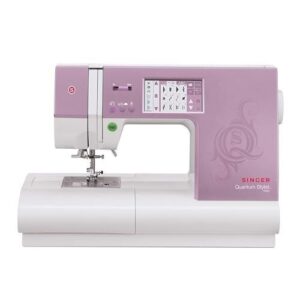
When precision is non-negotiable, the Quantum Stylist 9985 delivers. With 960 built-in stitches, a color LCD touchscreen, and 13 one-step buttonholes, it’s built for sewists who don’t settle.
You get mirror imaging, stitch elongation, and 60 memory slots for custom sequences — tools that genuinely speed up complex work.
The metal frame holds steady through denim and upholstery, while the automatic needle threader and thread cutter keep your workflow tight.
At $629.99, it’s serious value for serious sewing.
| Best For | Sewists who tackle a wide range of projects — from garment construction to quilting to home décor — and want one machine that can handle it all without cutting corners. |
|---|---|
| Built-in Stitches | 1000+ |
| Bobbin System | Class 15 drop-in |
| Auto Needle Threader | Yes |
| Free Arm | Yes |
| Machine Weight | 14 lb |
| Warranty | Not specified |
| Additional Features |
|
- Over 1,000 built-in stitches with mirror imaging and elongation, plus 60 memory slots for custom sequences — serious creative range in one machine.
- The color LCD touchscreen shows real-size stitch previews and walks you through setup, so you spend less time guessing and more time sewing.
- Full metal frame keeps things stable on heavy fabrics like denim and upholstery, and the 15 included presser feet mean you’re ready for almost any job out of the box.
- Only works with Singer-brand Class 15 bobbins — standard 15J bobbins won’t fit, which limits your options and adds a recurring cost.
- No knee-lifter included, which is a notable omission for quilters or anyone working with bulky materials.
- The plastic housing around certain parts feels a bit flimsy compared to all-metal competitors, and some users find the thread-cutter button light dim and the beeping a little annoying.
10. Feiyue FY710 Computerized Sewing Machine
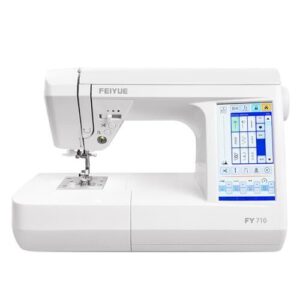
The Feiyue FY710 is a quiet contender worth knowing. It packs 180 built-in stitches — utility, decorative, and monogram patterns — into a metal-frame body that accommodates denim and quilt layers without fuss.
You get automatic thread trimming, a lever-action needle threader, and a smart LCD that shows stitch settings at a glance.
The drop-feed function opens the door to free-motion quilting. Stitch memory lets you save custom sequences for repeat projects. Solid, practical, and built for those who mean business.
| Best For | Home sewers and hobbyists who want a versatile, feature-rich machine that can handle everything from everyday mending to decorative projects and free-motion quilting. |
|---|---|
| Built-in Stitches | 180 |
| Bobbin System | Drop-in guided bobbin |
| Auto Needle Threader | Yes |
| Free Arm | Yes |
| Machine Weight | 19.84 lb |
| Warranty | Not specified |
| Additional Features |
|
- 180 stitch patterns with memory storage means you can get creative and pick up right where you left off on repeat projects.
- Automatic thread trimming and a lever-action needle threader cut down on the little frustrations that slow you down.
- Drop-feed function and adjustable presser-foot pressure make it genuinely capable on heavier fabrics and layered quilt tops.
- At nearly 20 lbs, it’s not something you’ll want to lug around or shuffle in and out of storage regularly.
- Motor power and max fabric thickness aren’t listed, so it’s hard to know exactly where the machine hits its limits on very dense materials.
- The overheat protection kicks in after long sessions and makes you wait about 10 minutes — not ideal if you’re in the middle of a big project.
Precision Sewing Benefits
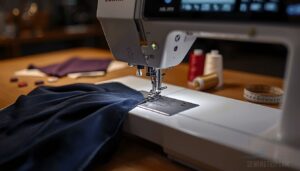
Precision sewing isn’t just about being careful — it’s about having a machine that works with you, not against you. The right computerized sewing machine gives you real control over every stitch, seam, and detail.
that kind of precision actually does for your sewing.
Accurate Stitch Length and Width Control
Control is everything in precision stitching — and modern machines give you a lot of it.
Your digital control panel shows exact stitch gauge display readings, so you’re never guessing. Motor calibration keeps needle movement accurate to within 0.1 mm.
Sensor feedback adjusts the continuous feed adjustment in real time, while microadjustable feet and stitch length adjustment paired with stitch width adjustment let you dial in every detail through the touchscreen interface.
electronic displays achieve precision within 0.1 mm.
Neat Seams and Cleaner Edge Finishing
Stitch length adjustment and stitch width adjustment don’t just affect how a seam looks — they determine how long it lasts.
Precision stitching transforms raw edges into finished work worth keeping:
- French Seam Tips keep sheer fabrics clean inside and out.
- Bias Binding Techniques wrap edges with flexible, durable coverage.
- Overlock Edge Control seals knit and woven seams without bulk.
- Rolled Hem Methods create delicate, narrow finishes on lightweight fabric.
- Pinking Shear Use reduces fraying quickly on woven edges.
Automatic needle threading gets you to the fabric faster, and stitch quality does the rest.
Less Fabric Waste During Detailed Projects
Clean seams cut down on rework — and rework is where fabric disappears. With precise stitch control and digital stitch selection, you’re not guessing on placement.
Pair that with pattern nesting, zero waste drafting, and modular block design, and scraps shrink fast.
Optimized marker making alone saves 8–12 percent per run.
Scrap upcycling manages what’s left — turning offcuts into binding, patches, or pocket linings.
Faster Sewing With Consistent Results
Speed without consistency is just chaos on fabric. That’s where Motor Torque Management and Feed Dog Synchronization change everything — your machine holds pace without skipping a beat.
Speed without consistency is just chaos on fabric
Here’s what drives faster, cleaner results:
- High speed motor maintains power through dense layers
- Presser Foot Pressure keeps slippery fabrics locked in place
- Automatic tension prevents puckering mid-seam
- Stitch Density Calibration auto-adjusts across fabric weights
- Automatic needle threading cuts setup time instantly
Better Control for Intricate Garment Work
Intricate garment work demands tools that respond to your intent, not fight it. Micro Stepper Control lets you place stitches in 0.1 mm increments — essential for collar points and curved hems.
Laser Alignment Guides, Differential Feed Systems, and Real-Time Tension Monitoring work together so every seam holds.
| Feature | Benefit |
|---|---|
| Precision Foot Pressure | Flat seams on layered fabrics |
| Touch Button Stitch Selection | Instant access to sophisticated stitch library |
| Precise Stitch Control | Precision stitching for intricate projects |
| Refined Stitch Control | Garment construction with confidence |
Key Precision Features
Precision sewing comes down to having the right tools at your fingertips. The best computerized machines pack in features that keep your stitches consistent, your setup quick, and your results looking professional.
Here’s what to look for.
LCD Screens for Stitch Selection and Adjustment
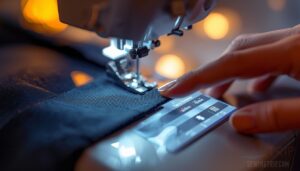
Your LCD screen is the cockpit of your machine.
With Touch Navigation UI and Touch Button Stitch Selection, you pick stitches instantly using Iconic Stitch Icons — no guesswork.
Real-time Length Feedback updates as you adjust.
Presser Foot Alerts remind you which foot fits the job.
An Error Code Display flags threading issues fast.
The Benefits of LCD displays in sewing machines are clear: total control, right in front of you.
Adjustable Speed Control for Detailed Stitching
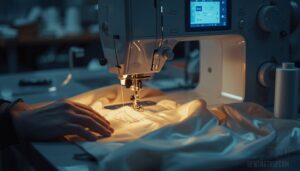
When precision matters most, your speed control becomes everything. Computerized sewing machines with Soft-Start Calibration ramps gently from zero, so fabric never jerks.
Adaptive Motor Torque holds steady within ±3 percent, keeping stitch density consistent.
Responsive Pedal Sensitivity gives you finer control at low speeds, while Programmable Acceleration Profiles and Real-time Speed Feedback through digital control panels let you master precision stitching on any detailed sewing project.
Automatic Needle Threaders for Faster Setup
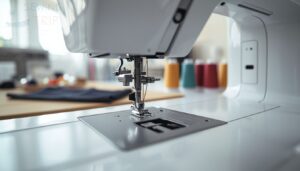
Threading a needle by hand is a small task that quietly eats your time. Automatic needle threading technology fixes that in under 2 seconds flat.
With ergonomic design, magnetic guidance, and self-cleaning mechanism built in, your computerized sewing machine manages setup so you don’t have to.
- Threader Speed: One button replaces several manual steps
- Compatibility Range: Works across needle sizes 60 to 90 gauge
- Magnetic Guidance: Aligns thread accurately every time
- Automatic Thread Cutter: Keeps your digital sewing machine workflow uninterrupted
Automatic Buttonholes for Professional Results
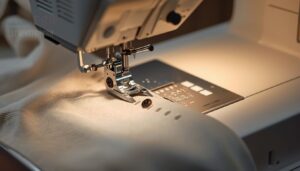
Buttonhole functions in sewing machines have quietly become one of the most impressive leaps in professional tailoring equipment.
Your computerized sewing machine uses Buttonhole Sensors and Fabric Thickness Detection to measure fabric in real time, automatically adjusting stitch density control and tension for a clean, consistent result every time. Automatic needle positioning locks each pass, while Buttonhole Reinforcement bar tacks both ends — delivering automatic buttonhole precision that rivals any professional tailor.
Built-in Stitch Variety for Creative Precision
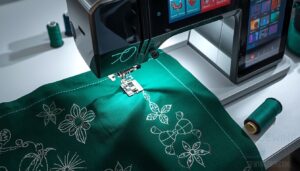
Think of built-in stitches as your creative toolkit — the wider it is, the more you can do.
Your computerized sewing machine’s Multi-Function Stitch Sets cover everything from precision quilting to creative stitching, while Decorative Pattern Diversity, Mirror Flip Options, and Stitch Memory Recall keep your work sharp and repeatable.
With built-in stitches variety and Specialty Foot Compatibility, every seam becomes intentional.
Beginner Vs Advanced Machines
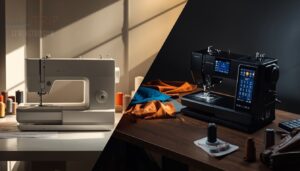
Not every sewing machine is built for the same hands.
Whether you’re threading your first bobbin or chasing perfect topstitching on a leather jacket, the right machine makes all the difference.
Here’s how beginner and sophisticated options stack up across the features that matter most.
Simple Controls for First-time Sewists
Starting out doesn’t have to feel overwhelming. Today’s Large Button Labels, Color-Coded Dials, and One-Touch Threading strip away the guesswork and get you stitching in seconds.
Audible Setup Confirmation tells you everything’s ready before you sew a single stitch. Foot Pedal Alternatives let you control speed with a button instead.
| Feature | What It Does | Who It Helps |
|---|---|---|
| Color-Coded Dials | Match stitch to fabric fast | Total beginners |
| LCD Display | Shows real-time stitch data | Visual learners |
| Audible Setup Confirmation | Signals correct machine setup | First-time sewists |
Beginner-friendly interfaces for beginners make choosing the best computerized sewing machine far less intimidating.
Touch Controls for Experienced Users
Once you’ve outgrown basic dials, high-end touch controls open a smarter way to work. Enhanced touch controls for precision stitching let you tap for basics and long-press for deeper settings — no hunting through menus.
| Touch Feature | What It Does |
|---|---|
| Haptic Feedback | Confirms stitch changes instantly |
| Pressure Sensitive Input | Adjusts speed by finger pressure |
| Gesture Customization | Maps swipes to your frequent tasks |
| Floating Control Panels | Keeps tools accessible mid-project |
Multi-Level Shortcuts and touchscreen navigation keep your hands moving and your focus where it belongs — on the fabric.
Lightweight Models for Easy Portability
Speed and control matter — but so does where you sew. lightweight portable sewing machine changes that equation completely.
Models with aluminum frames and compact footprints weigh under 1.5 kg, folding into your bag alongside your thread kit.
| Feature | Benefit | Best For |
|---|---|---|
| Foldable Stands | Saves pack space | Travel sewers |
| Battery Power | No outlet needed | Field or classroom use |
| Quiet Operation | 50–60 dB range | Shared spaces |
Your LCD screen and computerized sewing machine features go wherever you do.
Heavy-duty Options for Thick Fabrics
Portability is great — until you’re wrestling with denim or leather. That’s where heavy-duty machines earn their keep.
| Feature | Machine | Benefit |
|---|---|---|
| Full Metal Frame | SINGER Heavy Duty 4411 | Sturdy Frame Construction |
| Heavy-duty Presser Foot | Brother ST371HD | Manages layered canvas |
| Reinforced Bobbin Capacity | Both models | Fewer thread interruptions |
High Motor Torque and Thick Fabric Needles make handling heavy-duty fabrics feel smooth.
Quilting and Embroidery Capability Differences
Quilting and embroidery look similar — but they pull your machine in opposite directions. Quilting demands harp width, layer capacity, and long stitches to handle quilt bulk. Embroidery needs tight stitch density and fine thread type for surface detail.
| Capability | Quilting | Embroidery |
|---|---|---|
| Stitch Focus | Long, durable | Fine, dense |
| Fabric Handling | Multiple layers | Single surface |
Top reviewed computerized sewing machines 2026 balance both — but knowing your priority helps you choose smarter.
Choosing The Right Machine
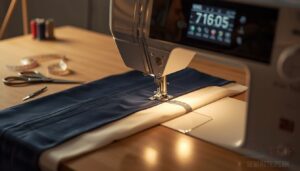
Picking the right sewing machine isn’t just about specs — it’s about finding the one that actually fits how you work.
A few key factors will help you cut through the noise and land on the best match for your projects and budget. Here’s what to look at before you decide.
Compare Stitch Counts and Stitch Types
Not all stitch counts are created equal — and your choice here shapes everything. A computerized sewing machine with 960 built-in stitches gives you room to experiment; one with 60 keeps things focused. Compare these before deciding:
- Fill vs Outline — fill stitches cover area; running stitches define edges.
- Satin vs Bean — satin gives smooth coverage; bean stitches add bold texture.
- Stitch Count Impact — higher counts increase detail but raise thread consumption metrics.
Review Included Presser Feet and Accessories
What’s in the box matters more than you’d think.
Brother HC1850 includes 8 included feet — from buttonhole foot options for clean closures to overcasting edge foot for fringe-free seams.
The XM2701 offers 6 sewing feet, while the XR3774 packs 7 different feet plus a wide table.
Walking foot benefits shine on quilts.
Don’t overlook zipper foot variety, blind hem foot, and free arm option when comparing sewing machine accessories and feet.
Look for Metal Frames and Durability
A machine’s frame is its skeleton — and a weak one will cost you.
Steel Frame Strength keeps needle alignment true under pressure, while Aluminum Frame Benefits give you a lighter build without sacrificing rigidity. Both deliver real Frame Longevity when Protective Coatings guard against humidity and wear.
Look for these before buying:
- Full metal frame construction for Durability, with full metal frames on heavy duty fabrics.
- Joint Fastener Durability — tight bolts and welds that won’t loosen mid-project.
- Corrosion-resistant Protective Coatings that extend Metal frame life for years.
Check Free Arm and Extension Table Options
Your workspace expands — or shrinks — based on these two features alone. A free arm option lets you slide fabric around cuffs and sleeves with ease, while extension tables for large projects give you the surface control you need.
Look for slide-on compatibility, quick release switching, and aluminum table material.
Lighting integration near the needle area is a bonus worth having.
Balance Budget, Features, and Warranty Coverage
Budget doesn’t have to mean compromise — it means knowing what matters most. A computerized sewing machine with solid stitch quality and budget-friendly features can outperform pricier options when you prioritize smartly.
- Warranty and build quality considerations: look for 2–3-year coverage on internal components
- Cost feature tradeoffs: automatic threaders and LCD screens save real time daily
- Coverage price balance: registered units often access extended repair support
Keeping Stitching Accurate
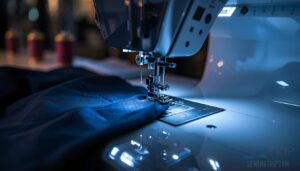
Even the best machine won’t perform well if you’re not taking care of it. Accurate stitching comes down to a few consistent habits that are easy to build once you know what to focus on.
Here’s what actually matters.
Maintain Bobbin and Threading Systems Regularly
Your bobbin cleaning routine sets the foundation for every stitch you sew. After each session, clear lint from the shuttle race and inspect your thread path for kinks or sharp bends — skipped stitches start here.
Keep a lubrication schedule, store spare bobbins in a lined container, and calibrate tension monthly. Consistent threading and bobbin maintenance tips like these protect your machine’s automatic thread cutter and thread tension control long-term.
Use Quality Thread for Cleaner Stitches
Clean bobbins matter, but the thread you load into them matters just as much. Premium Thread Materials with Consistent Thread Diameter keep the Thread Tension Balance stable, which your thread tension control system depends on to deliver reliable stitch quality.
- Thread Friction Reduction prevents puckering along seams
- Thread Luster Preservation keeps finished work looking polished through washes
- High-end touch controls and LCD display settings work best with quality thread
- Automatic needle threader performs smoothly when thread diameter stays uniform
Match Stitch Settings to Fabric Type
Thread quality sets the foundation, but stitch settings seal the deal. Needle Size Matching, Fabric Tension Tuning, and Presser Foot Selection work together to deliver stitch quality across different fabric types.
For knits, try a 2.0–3.0 mm stitch with Stabilizer Application skipped entirely. Dense denim needs 3.0–3.5 mm.
Thread Weight Pairing and stitch selection control to your machine’s full fabric handling capability.
Clean and Oil The Machine as Needed
Even perfect stitch settings fall apart on a neglected machine. Unplug before you start — that’s your first Safety Precaution.
Cleaning Tools like a soft brush and lint-free cloth to clear the bobbin area and feed dogs.
Oil Point Identification matters: hit the hook race and needle bar only. One drop per point.
Post-Oil Testing keeps long-term reliability locked in.
Practice Control for Smoother Precision Sewing
Control is a skill you build, not a setting you find.
Start slow — ease into pedal feathering rather than jabbing the accelerator. Keep foot pressure steady so stitch quality stays consistent lap after lap. Let the machine handle fabric feed while your hand coordination guides direction. Dial in thread tension on scrap first, then trust the LCD screen and high-end touch controls to hold your adjustments.
Frequently Asked Questions (FAQs)
What sewing machine has the least problems?
Machines with full metal frames and long warranties—like the Bernette 38 with its 10-year mechanical warranty—top reliability ratings.
Strong service support and parts availability keep failure frequency low over years of heavy use.
What is the price range of computerized sewing machines?
Computerized sewing machines range from about $150 for entry-level pricing up to $5,000 for high-end pricing. Mid-range costs usually land between $700 and $1,500, while used market values offer solid budget options around $100 to $
Are computerized machines suitable for beginners?
Yes, they’re surprisingly approachable. Threading Automation, Interface Simplicity, and built-in Support Resources flatten the Learning Curve quickly.
Safety Features and intuitive interfaces make beginner-friendly computerized sewing machines genuinely welcoming for anyone just starting out.
How do computerized machines handle thick fabrics?
Thick fabrics don’t have to slow you down.
Servo motor torque keeps needle speed steady through denim, while a walking foot mechanism, dual feed system, heavy duty needles, and automatic thread tension locks in stitch quality.
Can computerized sewing machines create custom designs?
Absolutely — your creativity isn’t limited to pre-loaded patterns.
Through embroidery design import, on-screen design editing, and wireless design transfer, you can personalize every stitch with stitch density adjustment and multi-head color management built right in.
What maintenance is required for computerized machines?
Keep your machine running like clockwork: stick to a regular dust removal routine and follow a lubrication schedule.
needle replacement every 8–12 hours, check firmware updates, and don’t skip sensor calibration or thread tension adjustment.
Can computerized machines sew leather or vinyl materials?
Leather and vinyl don’t have to stop you in your tracks.
Computerized sewing machines handle both using High Torque Motors, Metal Internal Components, and Specialty Leather Feet for clean, confident results every time.
How do servo motors improve stitching accuracy?
Servo motors improve stitching accuracy through closed-loop feedback, torque modulation, and real-time speed adjustments. Vibration damping keeps seams straight, while energy-efficient motion ensures consistent stitch quality from start to finish.
What presser feet improve precision on curves?
Curves expose every shortcut.
A Walking Foot feeds layers evenly, while a Curved Guide Foot matches garment arcs naturally.
Your Roller Foot, Edge Guide Foot, and Narrow Edge Foot handle the rest.
How often should needles be replaced for precision?
Replace your needle every 4 to 8 hours of stitching. Switch it between projects when working heavy fabrics. Dull needles cause skipped stitches and puckering — fresh ones keep your precision tight.
Conclusion
Think of your sewing machine as the foundation beneath every seam—invisible when it’s right, glaring when it’s wrong. Computerized sewing machines with precision sewing capabilities remove the guesswork that older mechanical models quietly introduce.
Sensor-driven tension, consistent speed, and reliable stitch feedback don’t just improve your work—they change how you approach it. You stop compensating and start creating. The right machine doesn’t follow your lead; it earns it.