This site is supported by our readers. We may earn a commission, at no cost to you, if you purchase through links.
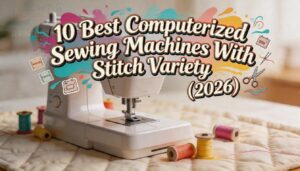
A single machine once meant a single purpose—straight seams, maybe a zigzag for raw edges, and not much else. Computerized sewing machines with stitch variety changed that equation completely. The Singer 9960 alone ships with 600 built-in stitches, covering everything from lightning bolt stretch patterns to satin monograms.
That range isn’t marketing padding—it’s the difference between a machine that accommodates one project type and one that grows with your skills. Whether you’re hemming knits, finishing quilt borders, or attaching elastic, the right stitch library keeps you from hitting a wall mid-project.
Table Of Contents
- Key Takeaways
- Why Stitch Variety Matters
- Key Stitch Features to Compare
- Digital Controls That Improve Sewing
- 10 Best Stitch-Rich Computerized Sewing Machines
- 1. Brother CS7000X Computerized Sewing Quilting Machine
- 2. Singer Quantum Stylist 9960 Sewing Machine
- 3. Brother SE600 Sewing Embroidery Machine
- 4. Brother XM2701 Lightweight Sewing Machine
- 5. Brother CP60X 60 Stitch Sewing Machine
- 6. Brother HC1850 Sewing and Quilting Machine
- 7. Singer Heavy Duty 4411 Sewing Machine
- 8. Brother XR3774 Sewing Quilting Machine
- 9. Singer C5200 Computerized Sewing Quilting Machine
- 10. Brother Strong Tough Heavy Duty Sewing Machine
- Choosing by Skill and Projects
- Buying Tips for Long-Term Value
- Frequently Asked Questions (FAQs)
- Conclusion
Key Takeaways
- Stitch count only matters if the mix is right — you need utility, stretch, decorative, and quilting options working together, not just a big number on the box.
- Your fabric weight and project type should drive your machine choice more than any single feature, since a powerful motor and metal frame decide what you can actually sew through.
- Digital controls like LCD screens, needle up/down, and automatic thread cutters aren’t luxury add-ons — they’re the difference between a smooth workflow and constant interruptions.
- Match your skill level to the machine: beginners win with simplicity and clarity, while intermediate and advanced sewists unlock real creative range with 185 to 600+ built-in stitches and customizable stitch memory.
Why Stitch Variety Matters
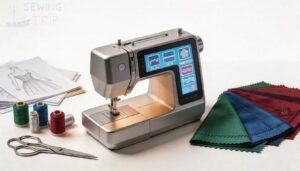
Not all stitches do the same job, and that gap matters more than most people realize. Your machine’s stitch library shapes what you can make, how it holds up, and how much creative control you actually have.
A budget-friendly quilting sewing machine can still pack a surprisingly versatile stitch library, giving you real creative range without the premium price tag.
Here’s a closer look at the stitch types worth understanding before you buy.
Utility Stitches for Everyday Sewing
Utility stitches are the backbone of everything you make. Short straight stitches lock seams tight on woven fabrics. Long straight stitches ease, baste, and gather. Wide zigzag and stretch zigzag handle knits and raw edges. Blind hem keeps your finish clean.
With stitch variety, built-in stitch options, and the ability to adjust stitch length and width digitally via LCD display, your machine works smarter.
A zigzag stitch can enclose raw edges to prevent fraying when a serger isn’t available.
Decorative Stitches for Creative Projects
Beyond the basics, decorative stitches are where your creative vision takes over. Satin Monograms, Floral Motifs, and Appliqué Borders become clean and polished with the right Custom stitch library.
Metallic Threadwork and Textural Stitching shine brightest on stable fabrics.
Machines offering Hundreds of decorative stitches — like the Singer 9960’s 600 built-in stitches — give you real Stitch variety and decorative options for any project.
Stretch Stitches for Knit Fabrics
Knit fabrics demand stitches that move with them — straight stitches simply break under stretch. A narrow zigzag adds just enough flex for stable jerseys, while the lightning bolt stitch accommodates high-stretch knits with spandex.
For hems, twin needle hem work keeps edges clean and flexible. The three-step zigzag manages elastic attachment, ensuring functional durability.
Watch for knit tunneling — stitch length and width adjustments fix it fast, preventing fabric distortion and maintaining stitch integrity.
Quilting Stitches for Patchwork and Finishing
Quilting stitches work differently than stretch stitches — here, control and precision take over. Straight line quilting locks layers together cleanly, especially with seam-guided stitching along patchwork seams.
A quilt guide ensures consistent spacing, while marking and guides help map out the layout before starting.
Dense texture quilting adds firmness where needed, enhancing both structure and design.
Finishing edge stitches seal the quilt neatly, completing the process with a polished look.
Buttonhole Options for Garment Making
Proper Size Calculation — half the button’s circumference plus ⅛ inch — determines your opening. Fabric Stabilization prevents stretching during stitching. Foot Selection and Buttonhole Positioning lock in consistency.
Automatic buttonholes eliminate guesswork, and machines offering 13 one-step buttonholes give you real range.
Cutting Methods finish the job cleanly without damaging bar tacks.
Matching Stitch Types to Project Goals
Every project tells you what it needs — if you listen. Straight stitches handle woven seams and pattern alignment with clean precision. Zigzag locks down edge stability on raw fabric. Stretch stitches protect seam elasticity on jerseys and spandex. Decorative options transform plain hems into finished work.
Your stitch selection menu, especially on machines with 600 built-in stitches, puts the right tool one tap away.
Key Stitch Features to Compare
Not all stitch counts tell the whole story. Before you pick a machine, there are a few key features worth sizing up side by side. Here’s what to look at.
Built-in Stitch Counts Across Models
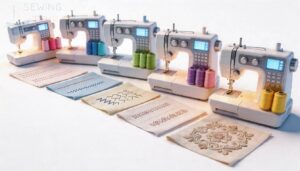
Built-in stitch counts vary widely across stitch count tiers—from 60 on entry models to 960 on the Singer Quantum Stylist 9985. A model count comparison reveals a clear count-price correlation: midrange machines like the Brother HC1850 offer 185 built-in stitches, while the Singer 9960 offers 600.
High-count benchmarks signal serious stitch variety and built-in options for expert work.
Variety of Utility, Decorative, and Heirloom Stitches
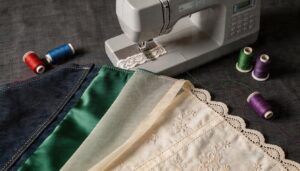
Stitch variety is where a machine demonstrates its range. Raw counts mean little without the right mix — utility stitches for seams, decorative and heirloom motifs for stitch contrast across fabric pairings, and seasonal embellishments that follow pattern evolution project to project.
Stitch variety means nothing without the right mix of utility, heirloom, and decorative options
- 600 built-in stitches on the Singer 9960 cover everyday to sophisticated needs
- 185 built-in stitches on the HC1850 handle most mid-level work
- Alphanumeric stitch options for monogramming add personalization
- 69 stitch applications span garments, quilts, and décor
One-step Buttonhole Styles and Consistency
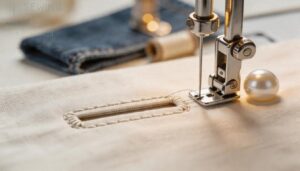
The Singer 9960 delivers 13 one-step buttonholes with sensor foot mechanics that physically measure your button for exact length calibration — eliminating guesswork. This feature separates capable machines from truly reliable ones.
Corner stitch uniformity remains consistent across every buttonhole, while bar tack precision automatically reinforces each end. These details ensure durability and professional-quality results.
Fabric-specific styles accommodate knits, denim, and wovens, adapting to diverse materials seamlessly.
The memory buttonhole function retains your settings, guaranteeing consistency across repeated runs.
Adjustable Stitch Length and Width
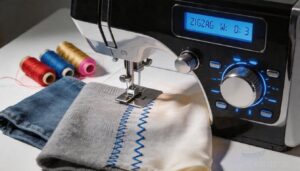
Two numbers control everything: length and width. Master them, and you control your seams.
- Variable Length Adjustment runs from 0.5 mm to 5.0 mm — short for strength, long for basting
- Width-Based Density shapes zigzags from straight (0 mm) up to 7 mm on sophisticated models
- Fabric-Specific Settings pairs shorter lengths with knits, longer with denim
- Computerized machines let you adjust stitch length and width digitally with plus/minus keys instantly
Mirror, Elongation, and Customization Options
Beyond adjusting length and width, sophisticated machines let you flip, stretch, and own your stitches.
| Feature | What It Does | Why It Matters |
|---|---|---|
| Mirror Stitch Preview | Flips patterns horizontally | Creates symmetrical designs |
| Extended Stitch Range | Expands stitch variety and built-in stitch options | More creative control |
| Customizable Stitch Profiles | Builds tailored stitch libraries | Faster project setup |
Mirror imaging and stitch elongation turn basic patterns into something entirely yours.
Memory Functions for Saved Stitch Settings
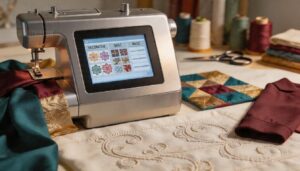
Memory functions enhance customization by allowing you to save custom stitch settings temporarily for a single session or use Permanent Storage to retain them after power-off.
Program Folders enable organization of a custom stitch library by project type, such as quilting, garments, or décor.
Features like Buttonhole Memory and Decorative Combinations store frequently used setups, eliminating the need to rebuild them repeatedly.
Some machines support up to 15 saved patterns, ensuring efficient access to your most-used designs.
Digital Controls That Improve Sewing
The controls on your machine shape every stitch you make. Knowing what each feature does helps you pick the right tool and use it well.
Here’s what to look at when comparing digital controls.
LCD Screens Versus Manual Selectors
LCD displays change how you interact with your machine, delivering instant visual feedback — stitch number, width, and length at a glance — which cuts the learning curve dramatically. Manual selectors prioritize reliability and simplicity, maintaining mechanical functionality, but offer less setup guidance and complicate navigation through extensive stitch libraries.
If stitch variety matters to you, interface complexity tips the scales toward LCD every time.
Touch Controls for Faster Stitch Selection
Touchscreen interface replaces dial-spinning with direct tapping.
Category Tabs organize utility, decorative, and quilting groups, eliminating endless scrolling.
Preview Thumbnails display stitch shapes before commitment.
Gesture Navigation and Default Stitch Memory let you save favorites and quickly return to them.
- Tap a stitch directly from the color touchscreen.
- Browse Category Tabs for faster digital stitch selection.
- Save defaults for repeat-use stitch variety.
Speed Control for Precision Sewing
Slowing down isn’t weakness — it’s precision. A speed control slider lets you set a ceiling before your foot ever hits the pedal, so fabric-based pacing becomes second nature.
Closed-loop control and tachometer feedback maintain consistent speed through thick layers. Pedal sensitivity tuning and speed reducer torque further refine this system, delivering adjustable sewing speed control for true variable regulation on every seam.
Automatic Needle Threader Convenience
Threading by hand slows everything down. Automatic needle threading technology fixes that quickly—and it’s built into standout models like the Singer 9985.
Here’s what it does for you:
- Threader setup speed — thread loads in seconds, not minutes
- Vision relief — no more squinting at tiny needle eyes
- Needle thread matching — works best with standard sizes like 80/12
Maintaining a regular cleaning routine ensures the mechanism’s reliability remains consistent.
Needle Up/down Positioning Accuracy
Needle stop defaults shape how accurately you control every seam. With programmable needle up/down control, you set exactly where the needle lands when you pause — and that needle placement precision makes pivot control smooth at corners.
The Singer 9960’s needle up/down positioning keeps fabric anchored mid-seam, improving sewing accuracy across its 600 built-in stitches.
Adjust control settings once; your positioning speed stays consistent.
Automatic Thread Cutter Time Savings
Every second you spend reaching for scissors is a second your machine isn’t running. An automatic thread cutter eliminates that pause — keeping seam shift speed remains smooth and your workflow efficiency gains real. For long session benefits, this adds up fast.
The Singer 9960’s 600 built-in stitches paired with automatic features means less interruption, better production throughput boost, and measurable labor cost reduction over time.
10 Best Stitch-Rich Computerized Sewing Machines
Here are ten computerized sewing machines that stand out for stitch variety, reliability, and smart features. Each one brings something different to the table — whether you’re quilting, garment-making, or just getting started.
Find the one that fits how you sew.
1. Brother CS7000X Computerized Sewing Quilting Machine
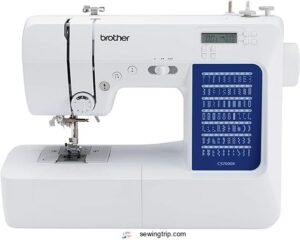
The Brother CS7000X punches above its price tag at $279.99. It offers 70 built-in stitches — utility, decorative, heirloom, and quilting — plus 7 auto-size buttonhole styles. The LCD screen keeps stitch selection simple and fast.
Its metal frame holds steady on denim and thick seams. You also get a detachable wide table, 10 presser feet, and a hard case.
For beginners and quilters who want room to grow, it’s a solid, no-fuss starting point.
| Best For | Beginners and home quilters who want a durable, feature-packed machine without spending a fortune. |
|---|---|
| Built-in Stitches | 70 stitches |
| Buttonhole Styles | 7 auto-size |
| Needle Threader | Automatic |
| Bobbin System | Drop-in top |
| Machine Weight | 14 lb |
| Free Arm | Yes |
| Additional Features |
|
- Automatic needle threader and drop-in bobbin make setup quick and frustration-free
- Metal frame handles heavy fabrics like denim with ease, giving you consistent results
- Detachable wide table and 70 built-in stitches give you real room to grow into bigger projects
- US-only voltage means international users need an adapter or step-down transformer
- No automatic bobbin threading — you still have to insert it by hand
- No built-in embroidery, so it won’t satisfy anyone looking to branch into that territory
2. Singer Quantum Stylist 9960 Sewing Machine
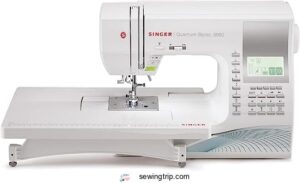
The Singer Quantum Stylist 9960 marks the beginning of serious sewing. Priced at $540.99, it offers 600 built-in stitches, 13 automatic buttonhole styles, and five lettering fonts—all supported by a durable metal frame designed to handle heavy layers without flinching.
The machine features an LCD screen for clear setting adjustments and an automatic thread cutter to streamline workflow between seams.
With a sewing speed of 850 stitches per minute and needle up/down control, it empowers users to command every stitch with precision, transforming sewing into a controlled, efficient process.
| Best For | Intermediate to advanced sewists who want a feature-rich machine that can handle everything from garment construction and quilting to decorative projects and monogramming. |
|---|---|
| Built-in Stitches | 600 stitches |
| Buttonhole Styles | 13 automatic |
| Needle Threader | Automatic |
| Bobbin System | Top drop-in |
| Machine Weight | 14.6 lb |
| Free Arm | Not specified |
| Additional Features |
|
- Massive stitch library with 600 stitch types and 1,172 applications gives you serious creative range for apparel, quilting, and home décor
- Automatic features like the needle threader, thread cutter, and top-drop bobbin make setup and finishing genuinely faster
- Comes loaded with 13 presser feet and a large extension table, so you’re not constantly hunting for add-ons
- The feature set has a real learning curve — beginners might feel overwhelmed before they hit their stride
- At 14.6 lbs, it’s not something you’ll want to lug around without a dedicated cart or carrying case
- The 90-day limited warranty is pretty short for a $540 machine, and the longer coverage requires registration and only applies to specific components
3. Brother SE600 Sewing Embroidery Machine
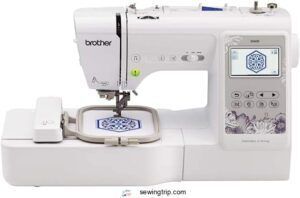
The Brother SE600 emphasizes embroidery integration, offering 103 built-in stitches, 80 embroidery designs, and 6 lettering fonts. Controlled via a 3.2-inch color touchscreen, it retails for $589.99. This machine combines versatility with user-friendly technology, catering to both decorative and functional sewing needs.
Its 4×4 inch hoop efficiently handles monograms, patches, and small motifs, ensuring clean execution for detailed projects. The inclusion of USB import functionality allows users to expand their design library beyond preloaded options, enhancing creative flexibility.
Automatic needle threading and thread cutting streamline workflows, reducing manual interruptions. With a maximum speed of 710 stitches per minute, the SE600 balances precision and efficiency, making it ideal for intricate embroidery and general sewing tasks alike.
| Best For | Hobbyists and beginners who want to explore embroidery and everyday sewing without a steep learning curve. |
|---|---|
| Built-in Stitches | 103 stitches |
| Buttonhole Styles | 10 auto-size |
| Needle Threader | Automatic |
| Bobbin System | Drop-in top |
| Machine Weight | 26.24 lb |
| Free Arm | Not specified |
| Additional Features |
|
- The color touchscreen and automatic needle threading make setup quick and frustration-free, even if you’re just starting out.
- USB support lets you import custom designs, so you’re not stuck with just the 80 built-in options.
- Handles a solid range of fabrics and sewing tasks with 103 built-in stitches and 10 buttonhole styles.
- The 4×4 inch embroidery area is pretty limiting — anything larger just won’t fit.
- It’s a big machine at over 26 lbs, so don’t count on tucking it away easily between uses.
- Switching between sewing and embroidery mode requires manual steps, which can interrupt your flow.
4. Brother XM2701 Lightweight Sewing Machine
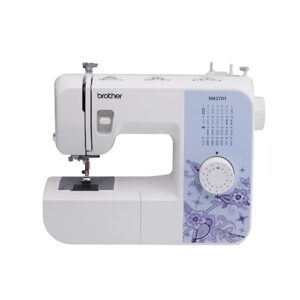
Not every sewing machine needs a touchscreen to earn its place. The Brother XM2701 keeps things simple — 27 built-in stitches, a manual dial selector, and no digital frills.
At $149, it covers the basics well: zigzag, blind hem, stretch, and one auto-size buttonhole. The automatic needle threader and Quick-Set drop-in bobbin cut setup time fast.
Compact at 12.6 pounds, it moves easily between spaces. It won’t handle heavy denim, but for everyday garment work, it delivers.
| Best For | Beginners and hobbyists who want a reliable, easy-to-use machine for everyday sewing projects like garments, quilts, and simple alterations. |
|---|---|
| Built-in Stitches | 27 stitches |
| Buttonhole Styles | 1 auto-size |
| Needle Threader | Automatic |
| Bobbin System | Quick-Set drop-in |
| Machine Weight | 12.6 lb |
| Free Arm | Yes |
| Additional Features |
|
- 27 built-in stitches cover everything from basic hems to decorative work, all at an accessible $149 price point
- Automatic needle threader and drop-in bobbin make setup quick and frustration-free
- Lightweight and compact enough to move around easily, with a 25-year limited warranty and lifetime support to back it up
- Struggles with heavy or thick fabrics like denim and upholstery — not built for demanding projects
- No advanced computerized features like stitch memory or LCD editing for users who want more control
- US-only voltage means using it abroad requires a converter, which also voids the warranty
5. Brother CP60X 60 Stitch Sewing Machine
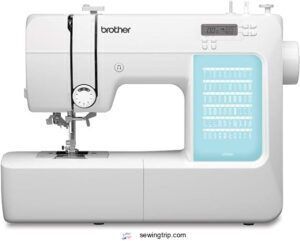
Step up from the XM2701’s 27 stitches, and the Brother CP60X doubles your options — offering 60 built-in stitches spanning utility, decorative, and heirloom styles, all selectable via a sharp LCD screen.
The 2-step automatic needle threader streamlines setup, while drop-feed dogs and a free arm enable seamless work on cuffs, sleeves, and free-motion projects without table rearrangement.
Built with a metal frame, LED lighting, and seven included presser feet, this machine confidently handles sturdy fabrics like denim and tweed.
| Best For | Hobbyists and intermediate sewers who want more stitch variety and reliable performance across a range of fabrics without jumping to a fully professional machine. |
|---|---|
| Built-in Stitches | 60 stitches |
| Buttonhole Styles | 7 auto-size |
| Needle Threader | 2-step automatic |
| Bobbin System | Quick-Set drop-in |
| Machine Weight | 14 lb |
| Free Arm | Yes |
| Additional Features |
|
- 60 built-in stitches plus a clear LCD screen make it easy to find and switch between utility, decorative, and heirloom options
- Metal frame holds up well with medium-weight fabrics like denim and tweed, and the fixed needle bar keeps stitches consistent
- Drop-feed dogs, free arm, and seven included presser feet give you a lot of flexibility for garments, repairs, and small projects
- Plastic housing can feel a bit flimsy if you’re running it hard for long stretches
- Struggles with very thick materials or multiple heavy layers stacked together
- Twin needles aren’t included, and the fixed needle bar limits some advanced free-motion techniques
6. Brother HC1850 Sewing and Quilting Machine
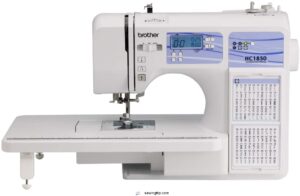
The Brother HC1850 pushes further with 185 built-in stitches, split between 130 sewing stitches and 55 alphanumeric characters for basic monogramming. That’s nearly triple what the CP60X offers.
You also get 8 one-step auto-size buttonhole styles, a backlit LCD selector, and an automatic needle threader. These features streamline precision and efficiency for diverse projects.
The detachable wide table and spring-action quilting foot make it genuinely quilting-ready, enhancing stability and control for larger tasks.
At $299.99, it covers garments, quilts, and decorative work without requiring separate accessory purchases, delivering exceptional versatility and value.
| Best For | Hobbyists and home sewists who want one machine that handles quilting, garments, and decorative projects without buying a bunch of extras. |
|---|---|
| Built-in Stitches | 185 stitches |
| Buttonhole Styles | 8 auto-size |
| Needle Threader | Advanced automatic |
| Bobbin System | Drop-in top |
| Machine Weight | 10.1 lb |
| Free Arm | Not specified |
| Additional Features |
|
- 185 built-in stitches plus 8 buttonhole styles give you serious range for everything from basic hems to monogramming
- Automatic needle threader and drop-in bobbin make setup quick and frustration-free
- Comes ready to quilt out of the box with the wide table and spring-action quilting foot included
- Only works on 120V, so it’s a no-go outside the US without voiding the warranty
- Not built for heavy-duty work — thick layers or industrial-scale projects will push its limits
- The edge-hemming foot isn’t included, so that’s an extra purchase if you need it
7. Singer Heavy Duty 4411 Sewing Machine
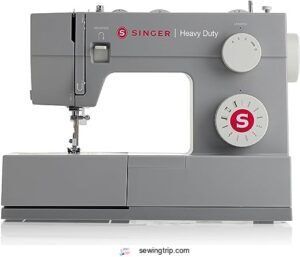
The Singer Heavy Duty 4411 prioritizes power over extensive stitch variety, offering 11 built-in stitches—including basic, decorative, and a 4-step buttonhole.
Its defining feature is raw power: a 60% stronger motor drives up to 1,100 stitches per minute, effortlessly handling denim, canvas, and leather. This robust performance is supported by a full metal frame that ensures precise alignment during operation.
Practical design elements enhance usability, such as the top drop-in bobbin for quick reloads. The machine forgoes digital screens or complex features, focusing instead on durability and consistent functionality.
Ultimately, it’s a reliable mechanical workhorse engineered for heavy-duty projects, prioritizing strength and longevity over decorative frills.
| Best For | Sewists who regularly work with heavy fabrics like denim, canvas, or leather and want a fast, dependable machine without the bells and whistles of a digital model. |
|---|---|
| Built-in Stitches | 69 stitches |
| Buttonhole Styles | 4-step |
| Needle Threader | Manual |
| Bobbin System | Top drop-in |
| Machine Weight | 14.6 lb |
| Free Arm | Not specified |
| Additional Features |
|
- Powerful motor handles tough materials like denim and canvas without bogging down
- Fast stitching at 1,100 spm helps you get through projects quickly
- Simple, straightforward controls make it easy to pick up for beginners and pros alike
- Only 11 built-in stitches, so it’s limited if you want decorative or specialty options
- No digital screen or advanced features — everything is manual
- At nearly 15 lbs, it’s not something you’ll want to lug around often
8. Brother XR3774 Sewing Quilting Machine
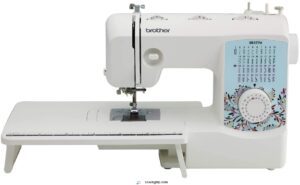
Where the Singer 4411 demands raw power, the Brother XR3774 trades brute force for versatility. It offers 37 built-in stitches—quilting, decorative, and utility—along with a one-step auto-size buttonhole.
The machine streamlines setup with an automatic needle threader, a top-loading jam-resistant bobbin, and a free-arm design, greatly cutting setup time.
Included are eight presser feet and a wide extension table, enabling quilting and garment work from day one.
At 12.3 pounds, the XR3774 moves easily between spaces while maintaining stability, avoiding compromise.
| Best For | Beginners to intermediate sewers and quilters who want an easy-to-use, versatile machine without a steep learning curve. |
|---|---|
| Built-in Stitches | 37 stitches |
| Buttonhole Styles | 1-step |
| Needle Threader | Automatic |
| Bobbin System | Top-loading drop-in |
| Machine Weight | 15 lb |
| Free Arm | Yes |
| Additional Features |
|
- 37 built-in stitches plus a one-step buttonhole give you plenty of options for garments, quilts, and home décor projects.
- The automatic needle threader and drop-in bobbin make setup quick and frustration-free.
- Comes ready to go with eight presser feet and a wide extension table — no extra shopping needed.
- Gets noisy and vibrates noticeably at higher speeds or with heavier fabrics.
- Struggles with thick materials like plush fleece, minky, or heavy layers of upholstery.
- The extension table can loosen under big, heavy projects, so a non-slip mat is a smart addition.
9. Singer C5200 Computerized Sewing Quilting Machine
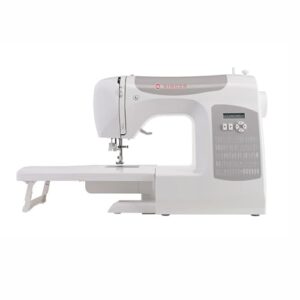
With 180 stitch applications packed into a metal-frame body, the Singer C5200 punches well above its size. It offers 80 built-in stitches, 6 one-step buttonhole styles, and intuitive touch-button controls with an LCD display that shows stitch length and width at a glance.
The machine streamlines workflow with a built-in needle threader, LED lighting, and a removable extension table. Its Free-arm access simplifies sewing cuffs and sleeves without repositioning, while the robust design minimizes adjustment stops.
Built for versatility, the C5200 excels at quilts, garments, and home décor—delivering professional results across projects.
| Best For | Home sewists and quilters who want a versatile, computerized machine that handles everything from lightweight garments to heavy-duty denim without breaking the bank. |
|---|---|
| Built-in Stitches | 180 stitches |
| Buttonhole Styles | 6 one-step |
| Needle Threader | Built-in |
| Bobbin System | Bottom-loading |
| Machine Weight | 13.8 lb |
| Free Arm | Yes |
| Additional Features |
|
- 180 built-in stitches plus 6 one-step buttonholes give you serious variety for quilting, apparel, and home décor projects
- The LCD touch controls, LED lighting, and built-in needle threader make setup fast and easy on your eyes
- Solid metal frame keeps things steady when you’re pushing through thick or layered fabrics
- Some units have reported bobbin instability and needle-threading issues straight out of the box
- Thread jamming can be a headache with very heavy fabrics, and the accessory compartment lid may get stiff over time
- A printed manual often isn’t included, so expect a bit of a learning curve navigating the touch menu on your own
10. Brother Strong Tough Heavy Duty Sewing Machine
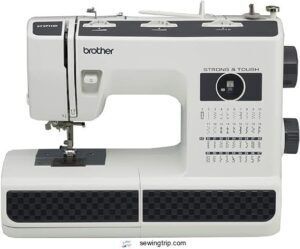
The Brother ST371HD handles demanding projects with ease, managing everything from delicate silks to stacked denim layers. Its 37 built-in stitches, metal needle plate, and 7-point feed dogs ensure precise fabric control at speeds of up to 800 stitches per minute.
The free-arm design simplifies sewing cuffs and sleeves, while the automatic needle threader and drop-in bobbin streamline setup for efficiency.
Backed by a 25-year warranty and lifetime support, the machine is engineered for durability and long-term performance.
| Best For | Sewists of all skill levels who regularly work with heavy or mixed-weight fabrics and want a durable, feature-packed machine that’ll last for years. |
|---|---|
| Built-in Stitches | 37 stitches |
| Buttonhole Styles | 1 auto-size |
| Needle Threader | Automatic |
| Bobbin System | Quick-set drop-in |
| Machine Weight | 18.4 lb |
| Free Arm | Yes |
| Additional Features |
|
- Handles everything from lightweight silks to thick denim and sherpa without breaking a sweat
- Automatic needle threader and drop-in bobbin make setup quick and painless
- 25-year warranty plus lifetime technical support gives you real peace of mind
- Presser-foot pressure isn’t adjustable, so very thin or delicate fabrics can be tricky
- The automatic buttonhole function can be finicky and may need a few tries to get right
- Some users report uneven stitch length on curves, especially with mixed-weight fabrics
Choosing by Skill and Projects
The right machine depends on where you are in your sewing journey and what you’re making.
A quilter, a garment sewer, and someone just starting out all need different things from their machine.
Here’s how the top picks break down by skill level and project type.
Beginner-friendly Machines With Simple Stitch Selection
Your first machine doesn’t need 960 stitches — it needs clarity. Beginner-friendly sewing machines win with easy-to-use interfaces and LCD displays, a simplified stitch library, and one-click selection via simple dial or iconic stitch icons.
- Automatic needle threading removes frustrating manual steps
- One-step buttonholes keep garment closures consistent
- A beginner’s stitch guide helps match stitches to fabric
- Simple stitch selection menu speeds up project starts
Intermediate Options With Broader Stitch Libraries
Brother CS7000X and Singer Quantum Stylist 9960 deliver serious stitch variety, offering 130 to 240+ stitches with features like stitch category navigation, font stitch options, and color sequencing controls.
A custom stitch library enhances efficiency, while Cross-Model Stitch Sync and Library Expansion Packs ensure scalability as skills advance.
Advanced Models for Customization and Speed
Once you move past intermediate territory, the Singer 9985 and Singer 9960 dominate. Both models feature metal frames, achieve 850 stitches per minute, and enable digital adjustment of stitch length and width, alongside adjustable sewing speed control.
These machines further enhance functionality with USB import capabilities, access to custom stitch libraries, and advanced AI Stitch Optimization features. Key technologies include Real Time Tuning, Adaptive Speed Profiling, Low Latency Firmware, and Edge Acceleration, ensuring high-speed sewing performance remains precise and consistent.
Best Choices for Quilting Projects
Quilting demands precision—steady thread tension, reliable fabric compatibility, and room to maneuver large layers.
The Janome 3160QDC delivers 60 stitches optimized for quilting projects, offering versatility for intricate designs.
For expanded workspace and specialized tools, the Brother XR3774 includes a wide table and eight quilting presser feet, streamlining layered stitching.
The Singer 9960 excels in heavy-duty metal frame stability and stitch density control, making it ideal for managing king-sized quilts with consistent results.
Best Choices for Embroidery-capable Sewing
Embroidery-capable sewing demands more than stitch variety—hoop size, design library depth, and built-in fonts all shape what’s possible.
The Brother SE600 manages basic personalization well, while the SE2000’s WiFi transfer and color touchscreen give you real control.
For serious work, the Janome Memory Craft 9850 offers a wider embroidery field, faster speeds, and tighter thread tension in both embroidery and sewing combo machines.
Machines for Garments, Crafts, and Home Décor
Beyond embroidery, your machine needs to handle real-world variety — garments one week, throw pillows the next. Here’s what to match by project type:
- Garment construction — stretch stitches and 600+ built-in stitch options (Singer 9960)
- Home décor sewing projects — wide tables, quilting feet, multi-function foot compatibility
- DIY sewing projects — color touchscreen previews and fabric handling strengths
- Portability — machine portability options matter for sewists who move between spaces
Buying Tips for Long-Term Value
A good sewing machine isn’t just a purchase — it’s a long-term investment.
Before you commit, there are a few things worth thinking through so you don’t end up with buyer’s remorse six months later. Here’s what to keep in mind before you pull the trigger.
Balancing Stitch Variety With Budget
Core of any stitch cost analysis — more stitches don’t always mean more value. Budget-friendly computerized sewing options often deliver 60–70 stitches, covering real everyday needs. Feature prioritization matters more than chasing a high price-stitch ratio.
| Feature | Budget Impact |
|---|---|
| 60–70 built-in stitch options | Low cost, core utility |
| 185 number of stitches | Mid-range price jump |
| 600 built-in stitch variety | Premium pricing tier |
| Accessory value boost (feet, tables) | Reduces add-on purchases |
| Warranty tradeoff (25-year coverage) | Offsets higher upfront cost |
Motor Strength and Fabric Compatibility
Motor power separates capable machines from frustrating ones. A strong torque rating keeps needle penetration smooth through denim, canvas, and stacked seams.
Feed system stability and adjustable presser foot pressure handle layer capacity without skipping.
Heavy-duty sewing machines for tough projects pair motor power with fabric handling capability, ensuring stitch variety and number of stitches actually perform — not just look good on a spec sheet.
Metal Frames and Overall Durability
A machine’s frame is its backbone. Frame Material Choice defines how long it holds alignment — and metal wins every time.
- Vibration Reduction — a heavy-duty metal frame plants the machine firmly, cutting noise and wobble.
- Structural Longevity — metal construction and durability outlast plastic under daily strain.
- Corrosion Resistance — stainless components stay true in humid storage.
Full metal frame builds mean your HeavyDuty sewing machine performance doesn’t degrade with age.
Presser Feet, Extension Tables, and Accessories
Snap-on feet swap fast mid-project; screw-on feet lock tight for specialized tasks. The Brother HC1850 bundles eight included feet, while the XR3774 pairs eight sewing feet with a wide table included.
A walking foot excels at stitching through layers, plaids, and quilts efficiently.
An extension table and free arm option enhance versatility, completing a truly flexible setup.
Warranty Coverage and Technical Support
A strong machine warranty is your safety net when electronics fail. Most Brother and Singer models carry a 25-year warranty on the chassis, with separate coverage for parts and labor on electrical components.
- Registration requirements activate your coverage — register immediately after purchase.
- Authorized service centers handle claims correctly; skip third-party repair shops.
- Extended support plans add accidental damage protection worth considering.
Common Mistakes When Comparing Stitch-rich Machines
Chasing the biggest stitch count is a trap. Here are the mistakes that cost buyers most:
| Mistake | What to Do Instead |
|---|---|
| Stitch Library Redundancy | Check for useful variety, not raw numbers |
| Fabric Compatibility Oversight | Match the machine to your actual materials |
| Buttonhole Consistency Errors | Test on scrap fabric before buying |
| Control Usability Misjudgment | Prioritize straightforward controls and Memory Recall Neglect |
Frequently Asked Questions (FAQs)
How do computerized sewing machines enhance creativity?
Computerized sewing machines spark creativity by offering design visualization, adaptive stitch suggestions, and real-time stitch simulation.
With USB import functionality and a custom stitch library, you can explore digital stitching technology and collaborative pattern sharing effortlessly.
Can stitch-rich machines handle heavy fabrics?
Not always. Stitch variety alone won’t push through denim.
You need torque capacity, frame rigidity, feed dog power, and presser pressure.
Motor power and needle clearance decide what your machine can actually handle.
What maintenance is needed for computerized models?
Keep it simple: clean the bobbin area, oil the hook if your machine’s manual says to, clear the thread path, and dust the screen and sensors.
Power off before every cleaning session.
Are stitch options user-friendly for beginners?
Most beginner-friendly machines offer straightforward navigation through LCD displays and preset stitch packages.
Visual feedback and stitch chart clarity flatten the learning curve fast, making digital stitch selection simple from the first seam.
How do stitch-rich machines compare price-wise?
More stitches do not always mean more cost. Stitch count pricing varies widely — budget models like the Brother CP60X offer 60 stitches at $99, while premium value per stitch climbs sharply with sophisticated feature cost tradeoffs.
Can I add stitches to my machine later?
Most machines lock in their stitch library at purchase. Software firmware updates primarily fix bugs — they rarely expand your custom stitch library.
Brand-specific expansions exist, but don’t count on third‑party add‑ons solving the gap.
How do stitch patterns affect thread consumption?
Stitch class consumption varies widely. Lockstitch uses 5 cm of thread per cm of seam, while a five-thread safety stitch requires 20 cm.
Stitch density, fabric thickness, seam width, and thread tension all drive these differences.
Do more stitches slow down the machine?
More built-in variety doesn’t slow your machine down — but stitch density does. Higher SPI and complex fills increase processing demand, raising thread break risk. Speed reduction kicks in automatically to protect quality.
Are computerized stitch settings hard to reset?
The resetting workflow is simple on most models — select the stitch, tap "Reset," done. LCD displays make interface navigation clear.
Just remember: saved stitch memory won’t clear unless you overwrite it.
Which file formats work for imported stitch designs?
Think of file formats like languages — DST, PES, JEF, VP3, and EXP each speak to different machines. USB design import keeps transfers fast and direct.
Conclusion
A stitch library is only as powerful as the machine behind it. The right computerized sewing machines with stitch variety don’t just expand what you can make—they remove the ceiling on what you’re willing to attempt.
Match motor strength to your fabric weight, stitch count to your project range, and controls to your skill level. Every seam you sew becomes a choice, not a compromise.
Pick the machine that grows with you.
- https://www.jukihome.com/products/sewing/computerized-sewing.html
- https://www.gathered.how/sewing-and-quilting/sewing/best-computerised-sewing-machines
- https://www.superiorsewing.co.uk/collections/computerised-sewing-machines
- https://www.premierstitching.com/blog/computerized-sewing-machine-guide/
- https://alfakhridubai.net/blogs/news/exploring-the-world-of-computerized-sewing-machines-advantages-and-uses